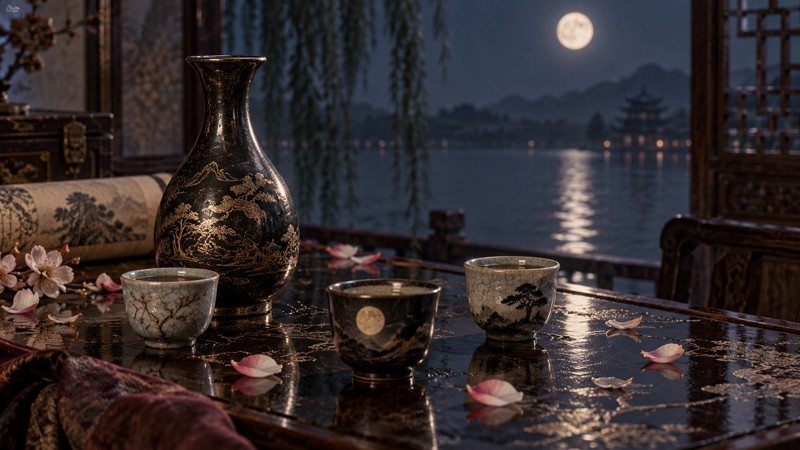
If you’ve ever sat with a favorite drink in hand, gazing up at the moon when no one else is around, you’ve experienced the quiet intimacy of drinking alone by moonlight—a theme that has shaped Tang Dynasty poetry for centuries, blending solitude, artistic freedom, and deep emotional truth. For readers of Chinese poetry, this isn’t just a casual moment; it’s a window into how ancient scholars found meaning in unshared spaces, turning loneliness into a source of creative insight.
This article will explore what drinking alone by moonlight means in Tang poetry, its historical and cultural roots, key poems to study, practical tips for reading these works, and why their relevance endures today.
What Drinking Alone By Moonlight Means in Chinese Poetry
Many Western readers first encounter this theme through romantic poetry that frames solitude as a state of longing or sadness, but Tang Dynasty redefines it as a deliberate choice of authenticity. For Chinese scholars of the Tang era, social gatherings were often formal, requiring polite conversation and adherence to unwritten rules—drinking alone by moonlight was a way to escape these constraints, to be fully oneself without performance.
This isn’t isolation; it’s a shift from external validation to internal reflection, where the drink and the moon become partners in a conversation that needs no audience.
A key misunderstanding for beginners is equating “alone” with loneliness. In Chinese poetic tradition, the moon is a universal companion, a constant that doesn’t judge or demand anything.
When a poet drinks alone with the moon, they’re not just sitting by themselves—they’re connecting to a timeless, natural presence that has witnessed countless human moments. This is why Li Bai writes of the moon and his shadow as his three companions; solitude becomes a trio, turning quiet into magic rather than sorrow.
This theme also reflects the Tang value of “living in harmony with nature,” a core concept in Confucian and Taoist thought. Unlike Western poetry that often pits humans against nature, Tang works integrate the natural world into personal experience.
Drinking alone by moonlight is an act of merging the self with the moon, the sky, and the surrounding landscape, making solitude feel expansive rather than limiting. For example, Wang Wei’s “Bamboo Grove” doesn’t just describe a person alone—it describes a person part of the bamboo, the moon, and the quiet of the night.
Historical and Cultural Background
The Tang Dynasty (618–907 CE) was a period of unprecedented prosperity and creativity, where poetry was central to social life and official advancement. Scholars often traveled between cities, served in imperial courts, or were exiled, leading to frequent separations from friends and family.
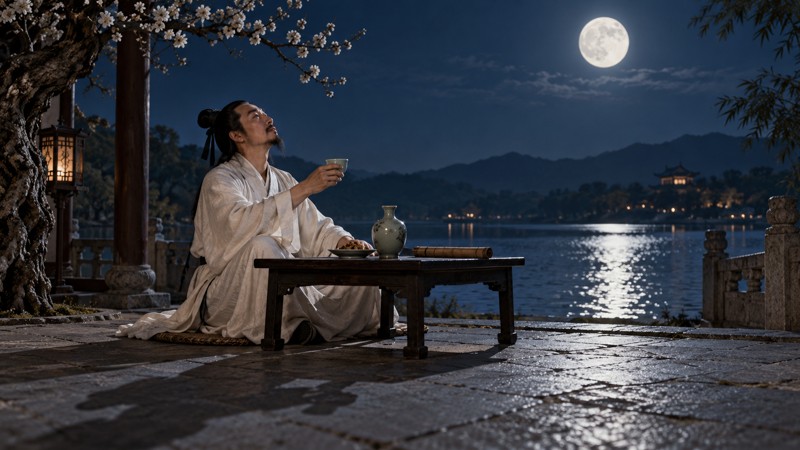
Drinking alone by moonlight became a way to cope with this displacement, turning loneliness into a way to stay connected to loved ones or to find solace in one’s own thoughts. Wine, in particular, was a symbol of freedom—many poets, including Li Bai, used wine to break through the barriers of formal language and express emotions that were too raw for polite company.
Tang society also valued both public achievement and private virtue. A scholar’s success was measured by his ability to serve the state, but his integrity was judged by how he lived in private.
Drinking alone by moonlight allowed poets to show that they could remain true to themselves even in the midst of public life. For Li Bai, who often clashed with court officials, this theme was a rebellion against the rigid norms of imperial society; for Du Fu, who lived through the chaos of the An Lushan Rebellion, it was a way to hold onto his humanity amid suffering.
The moon’s role in Chinese culture predates the Tang, but it took on new meaning during this era. Unlike Western poetry where the moon is often a symbol of romance or mystery, Tang poets saw it as a mirror—reflecting their own feelings, their homes, and their distant loved ones.
The moon rises over every part of the empire, so when a poet gazes at it alone, they know that their friends and family are looking at the same moon, creating an invisible bond. This is why the moon is such a constant in Tang poetry, especially in works about solitude.
Key Poems, Poets, or Examples
The most iconic work on this theme is Li Bai’s *Drinking Alone Under the Moon* (月下独酌), Drinking Alone By Moonlight written around 742 CE when he was working at the Tang imperial court in Chang’an. Li Bai, known as the “Immortal Poet” for his unbridled creativity, writes: “I lift my cup to invite the moon; / The moon then drinks with me, and my shadow too.” The poem’s meaning is that even in solitude, the poet finds companionship in the moon and his own shadow, turning a moment of loneliness into a playful, almost magical celebration.
Arthur Waley’s 1918 translation is one of the most widely read, emphasizing the poem’s lighthearted tone, while Ezra Pound’s version leans into its undercurrent of melancholy. For readers, this poem teaches that solitude isn’t something to fear—it’s a space where you can connect to the world in new ways.
Wang Wei’s *Bamboo Grove* (竹里馆) offers a quieter take on the theme, though it doesn’t explicitly mention drinking. Wang Wei, a poet-painter who combined visual art with poetry, writes: “Sitting alone in the bamboo grove, / I play the lute, and the moon comes to shine.” The meaning here is about finding peace in nature, away from the noise of court life.
The moon is not just a setting—it’s a guest, arriving to share the quiet moment. Burton Watson’s translation captures the poem’s calm, intimate tone, making it a favorite for beginners because of its simplicity and beauty.
This work shows that drinking alone by moonlight doesn’t have to be about wine; it’s about any moment of solitude where you feel connected to the natural world.
Du Fu’s *Moonlit Night* (月夜) takes the theme in a more vulnerable direction, Drinking Alone By Moonlight written during the An Lushan Rebellion when he was separated from his wife and children. Du Fu writes: “The moon shines bright in Fuzhou tonight; / My wife is alone, watching it in her chamber.” Even though he’s not drinking alone, the moon is the bridge between his solitude and his family’s.
The meaning is that the moon unites people even when they are miles apart, turning loneliness into a shared experience. Kenneth Rexroth’s translation highlights Du Fu’s deep love and sorrow, making this poem a powerful example of how the theme can express longing as well as joy.
For readers, this shows that the theme isn’t just about personal freedom—it’s about connection, even when you’re alone.
Zhang Jiuling’s *Thoughts on the Moon* (望月怀远) expands the theme further, focusing on longing for a distant friend. The lines: “The moon rises over the sea; / We share this moment, though miles apart.” While not about drinking, it’s closely tied to the moon’s role as a companion in solitude.
The meaning is that even when you’re alone, you can feel connected to someone else across time and space. Witter Bynner’s translation is elegant and accessible, making it a great entry point for readers new to Tang poetry.
This work teaches that the theme of drinking alone by moonlight is universal—it’s about the human need to connect, even when you’re by yourself.
How to Read and Understand It
Reading Tang poetry about drinking alone by moonlight requires slowing down and paying attention to small, precise details. Unlike Western poetry that often uses elaborate metaphors, Tang poets use simple, concrete images—like the moon, a cup, or bamboo—to convey deep emotions.
For example, in Li Bai’s poem, the line “I lift my cup to invite the moon” is simple, but it’s full of action—Li Bai is choosing to include the moon in his moment, not just observing it. Beginners should read the poem aloud to feel its rhythm; Tang poetry follows strict tonal patterns, so reading it aloud helps you catch the subtle shifts in emotion.
Another tip is to compare different translations. No translation is perfect, and each translator brings their own interpretation.
Arthur Waley’s Li Bai is playful, while Ezra Pound’s version is more somber—reading both helps you see the poem’s layers, not just one side. For example, Waley’s line “The moon then drinks with me” feels like a game, while Pound’s “The moon is my companion” feels more intimate.
By comparing, you’ll get a fuller picture of what the poet intended.
It’s also important to connect the poem to its cultural context. Knowing that Tang poets used wine to escape the formalities of court life helps you understand why Li Bai’s poem feels so rebellious.
Knowing that the moon was a symbol of connection helps you see why Du Fu’s poem about the moon is so powerful. For beginners, Drinking Alone By Moonlight starting with Li Bai’s *Drinking Alone Under the Moon* is a good choice because it’s accessible and captures the core of the theme—solitude as a choice, not a burden.
Why It Still Matters Today
In our modern, busy world, the theme of drinking alone by moonlight is more relevant than ever. Many people feel disconnected from others, overwhelmed by work and social media, so the idea of finding peace in solitude resonates deeply.
Li Bai’s poem reminds us that being alone doesn’t mean being lonely—it means having the space to connect to ourselves and the world around us. A 2021 study by the Pew Research Center found that 60% of adults in the U.S.
report feeling lonely, which makes Tang poetry’s take on solitude a valuable lesson for modern readers.
This theme also fosters cross-cultural appreciation. For Western readers, Drinking Alone By Moonlight Li Bai’s poem isn’t just about ancient Chinese culture—it’s about a universal human experience: sitting alone, looking at the moon, and feeling connected to something larger than yourself.
This helps break down stereotypes about Chinese poetry being obscure or only for scholars; it’s a way to explore emotions that everyone understands. For example, a student learning English might use Li Bai’s poem to practice vocabulary, while also learning about Chinese culture.
For overseas Chinese readers, this theme is a link to their heritage. Growing up in a Western country, many second-generation Chinese feel disconnected from their cultural roots, and Tang poetry offers a way to connect to the values their ancestors held—harmony with nature, authenticity, and the importance of family.
Studying works like Du Fu’s *Moonlit Night* helps them feel closer to their parents and grandparents, who might have grown up with these same themes in their own literature.
Frequently Asked Questions
What is the meaning of drinking alone by moonlight?
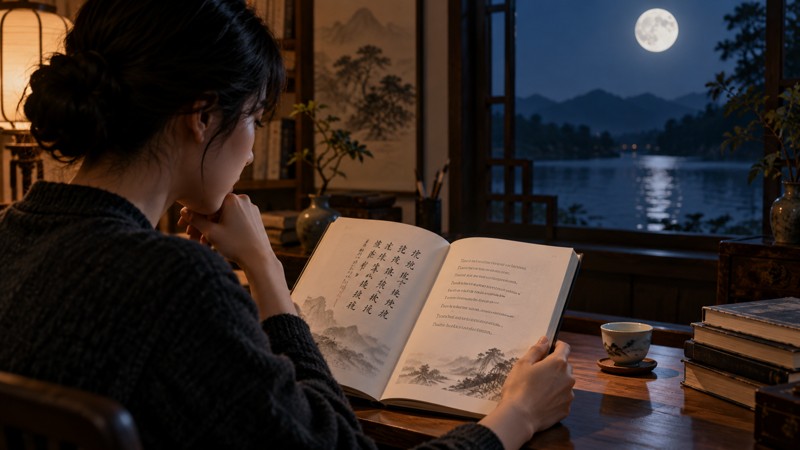
In Tang Dynasty poetry, “drinking alone by moonlight” (月下独酌) symbolizes the poet’s solitary contemplation and search for spiritual companionship. It represents a state of blending one’s spirit with nature, finding harmony with the moon and shadow as drinking companions when human companionship is absent. The theme often expresses both loneliness and a transcendent joy found in communion with the natural world.
Who wrote drinking alone by moonlight and what is the historical context?
The most famous example is Li Bai’s “月下独酌” (Drinking Alone Under the Moon), written during the Kaiyuan period of the Tang Dynasty (8th century). Li Bai, one of the greatest Chinese poets, composed this work during a period when he served briefly at court before embarking on a wandering life. The poem reflects his desire to escape political entanglements and his fascination with Taoist mysticism, which emphasized living in harmony with nature.
What literary devices are used in drinking alone by moonlight?
Li Bai’s poem employs vivid personification, treating the moon, shadow, and wind as sentient companions. It uses rich imagery of moonlight, flowers, and wine to create a transcendent atmosphere. The poem features clever wordplay with the characters for “three” (three figures: poet, moon, shadow) and employs parallelism structure. Contrast between isolation and communion, as well as the interplay between reality and fantasy, are central literary techniques.
What is the cultural significance of drinking alone by moonlight?
This theme reflects the Taoist ideal of achieving unity with nature and the cosmos. It embodies the Chinese literati’s tradition of finding solace in solitude and nature when disillusioned with worldly affairs. The motif represents a sophisticated cultural expression of transcending mundane concerns to achieve spiritual freedom. It also captures the uniquely Chinese aesthetic appreciation of moonlight as a source of poetic inspiration and emotional resonance.
How should drinking alone by moonlight be interpreted?
The poem can be interpreted on multiple levels: literally as a depiction of solitary drinking, metaphorically as a search for companionship and understanding, and spiritually as an exploration of the self’s relationship with the universe. It represents the poet’s attempt to find meaning and joy independent of external circumstances. The work ultimately suggests that true companionship can be found within oneself and through harmony with nature, even in physical solitude.
Ai Poem Writer Free: 7 Hidden Meanings You Missed at First R Poetry In Tang Dynasty: Major Poets, Poems and Legacy How to Read Du Fu Poetry: Meaning and Background Wikipedia