A Chinese poem about the lotus flower may celebrate a vast summer landscape, the natural partnership of leaf and blossom, or a legendary scene on the water. Three strong starting points are Yang Wanli’s Seeing Lin Zifang Off at Jingci Temple at Dawn, Li Shangyin’s Gift of the Lotus, and Li Bai’s Song of Wu: Summer. Below you can read the original Chinese, pinyin, a working English translation, and the image that gives each poem its own meaning.
Quick answer
For a short, vivid lotus poem, begin with Yang Wanli’s four-line West Lake poem: its endless green leaves and sunlit red flowers make the lotus a sign of summer at full scale. Read Li Shangyin next for a closer view of leaves and blossoms opening together, then Li Bai for a lotus-filled lake shaped by movement, memory, and the story of Xi Shi. The lotus can suggest purity in Chinese culture, but these poems do more than repeat one symbol.
Quick reference: three lotus poems
| Poem | Poet and period | Main scene | Best first question |
|---|---|---|---|
| Seeing Lin Zifang Off at Jingci Temple at Dawn 晓出净慈寺送林子方 |
Yang Wanli, Southern Song | West Lake in the sixth lunar month | How does scale turn color into wonder? |
| Gift of the Lotus 赠荷花 |
Li Shangyin, late Tang | Leaves and blossoms opening, folding, and fading together | Why does the poet insist on flower and leaf as a pair? |
| Song of Wu: Summer 子夜吴歌·夏歌 |
Li Bai, Tang | Mirror Lake, lotus blooms, Xi Shi, and a returning boat | How does a landscape become a legendary scene? |
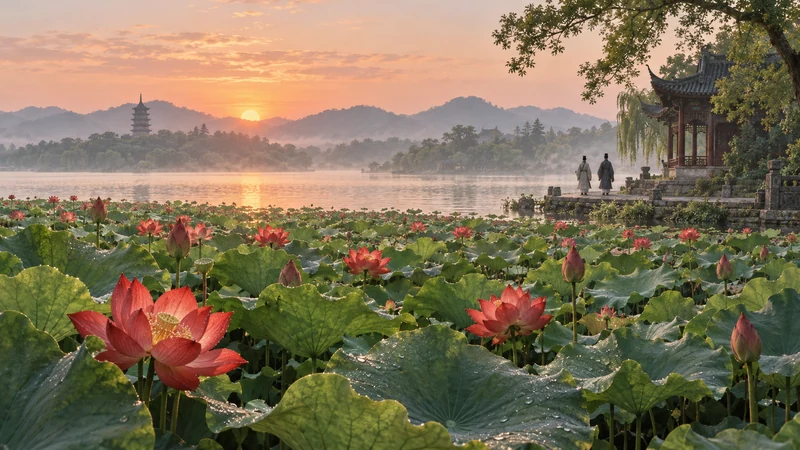
1. Yang Wanli: lotus leaves joining the sky
Yang Wanli’s title, Xiǎo chū Jìngcí Sì sòng Lín Zǐfāng, describes an early-morning departure from Jingci Temple to see Lin Zifang off. Yet the poem gives almost no narrative detail about the two people. It turns outward to West Lake and lets the midsummer lotus field carry the force of the farewell.
毕竟西湖六月中,风光不与四时同。
接天莲叶无穷碧,映日荷花别样红。
Working translation:
After all, in West Lake’s sixth month,
the view is unlike that of any other season.
Lotus leaves meet the sky in boundless green;
lotus blossoms facing the sun glow a red all their own.
The key movement is from a general claim to a precise visual proof. The first couplet says this season is different; the second shows why. Jiē tiān 接天 makes the leaves seem to touch the sky, while wú qióng 无穷 removes any visible limit. Against that field of green, bié yàng hóng 别样红 makes the flowers look unusually red rather than merely naming their color.
“Sixth month” follows the traditional lunar calendar, so it should not be flattened into a fixed Gregorian June. The useful reading point is high summer. Color, light, and distance make a public landscape feel momentous enough for a farewell without the poem telling us what either man says.
2. Li Shangyin: flower and leaf belong together
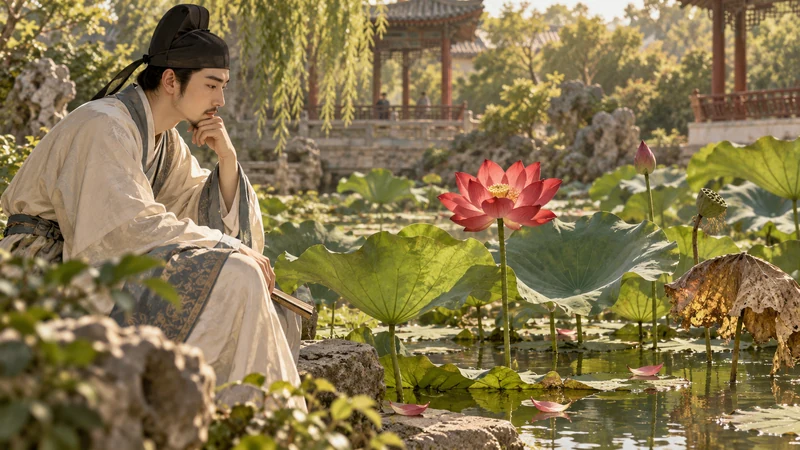
Li Shangyin’s Zèng Héhuā looks more closely. It begins by criticizing the way ordinary flowers and leaves are treated unequally: the flower is prized, while the leaf is discarded. The lotus becomes the exception because its red blossom and green leaf remain visually and emotionally connected.
世间花叶不相伦,花入金盆叶作尘。
惟有绿荷红菡萏,卷舒开合任天真。
此花此叶常相映,翠减红衰愁杀人。
Working translation:
In this world, flower and leaf are not treated alike:
the flower enters a golden basin; the leaf becomes dust.
Only green lotus leaves and red lotus blooms
roll and spread, open and close, following their natural form.
This flower and this leaf keep reflecting one another;
when green fades and red declines, the sight brings grief.
Hàndàn 菡萏 is a literary word for lotus blossom. The paired verbs juǎn/shū 卷舒 and kāi/hé 开合 keep the plant in motion: leaves curl and spread; flowers open and close. The phrase rèn tiānzhēn 任天真 values an unforced natural state.
The last line prevents a simple “lotus equals purity” summary. Beauty here depends on mutual presence, and fading hurts because leaf and flower have been seen together. The linked Wikisource text prints 时作尘, 长相映, and 愁煞人, while the linked alternate text prints 叶作尘, 常相映, and 愁杀人. This page follows the latter reading and names the variants rather than treating one transcription as the only form.
3. Li Bai: a lotus lake becomes a legendary stage
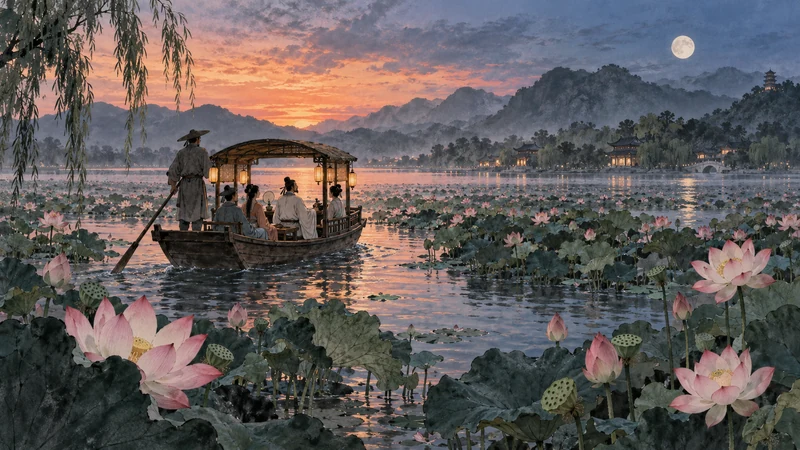
Li Bai’s Zǐyè Wú Gē: Xià Gē, or Song of Wu: Summer, opens on Mirror Lake. The lotus is part of a scene involving Xi Shi, the famous beauty associated with the ancient state of Yue. The poem moves from wide water to human attention and then to the returning boat.
镜湖三百里,菡萏发荷花。
五月西施采,人看隘若耶。
回舟不待月,归去越王家。
Working translation:
Mirror Lake stretches three hundred li;
lotus buds open into flowers.
In the fifth month Xi Shi gathers them;
onlookers crowd the Ruoye stream.
Her returning boat does not wait for moonrise;
she goes back to the King of Yue’s house.
The opening number is poetic scale, not a survey measurement. It makes the lake expansive before the poem concentrates attention on Xi Shi. Ài Ruò Yé 隘若耶 suggests that the viewers crowd or constrict the Ruoye waterway. The flowers are therefore both landscape and setting: they surround an admired figure whose movement draws the public gaze.
Readers who want more context can continue with the site’s guide to Li Bai’s poems and its overview of Tang dynasty poets. The point here is narrower: unlike Yang Wanli’s direct visual panorama, Li Bai’s lotus lake carries an inherited story.
What does the lotus mean in Chinese poetry?
There is no single answer. The lotus has long-standing associations with purity and rebirth because it rises from muddy water and blooms clean. The Metropolitan Museum of Art also notes that later seasonal lotus images could evoke the passing of physical beauty. Those associations help, but a poem’s verbs, setting, season, and speaker decide which meaning is active.
- In Yang Wanli, the lotus is first a landscape of scale, color, light, and high summer.
- In Li Shangyin, flower and leaf model natural partnership, and their decline makes that bond vulnerable.
- In Li Bai, the lotus lake becomes the stage for Xi Shi, public attention, and return.
This is why a symbol list should come after close reading. If every lotus is translated as “purity,” the reader misses the green horizon in one poem, the paired leaf and flower in another, and the crowded legendary scene in the third.
How to study a Chinese lotus poem
- Read the Chinese aloud once. Use the pinyin to keep line rhythm and repeated sounds in view.
- Circle the plant words. 莲, 荷, 菡萏, 叶, 花, 翠, and 红 do different work; “lotus” is not the only useful gloss.
- Track the verbs. 接, 映, 卷, 舒, 开, 合, 发, 采, and 回 turn a flower into a moving scene.
- Identify the scale. Is the poem looking across a lake, at one plant, or along a boat route?
- Compare translations last. The site’s guides to reading Chinese poetry in English and Chinese poem translation explain why one English wording cannot preserve every sound, ambiguity, and image.
Text and context sources: Yang Wanli text; Li Shangyin text and one set of variants; Li Bai text and attribution to Complete Tang Poems, volume 165; and the Metropolitan Museum of Art on lotus, purity, rebirth, and the passing of physical beauty. The English versions above are fresh working translations for this page.
Frequently asked questions
What is the most famous short Chinese poem about lotus flowers?
Yang Wanli’s Seeing Lin Zifang Off at Jingci Temple at Dawn is an excellent short choice. Its final couplet—endless green lotus leaves and sunlit red blossoms—is easy to visualize and memorize.
Are 莲花 and 荷花 the same?
In ordinary modern use, both can refer to the lotus. Classical poetry also uses 莲, 荷, 芙蓉, and 菡萏, with context and period affecting nuance. 菡萏 often names the lotus flower or bud in literary diction.
Does the lotus always symbolize purity?
No. Purity is an important cultural association, but individual poems may emphasize summer color, natural growth, companionship, beauty, decline, memory, or a legendary setting. Read the poem’s actual images and actions before assigning a symbol.
Are the English versions on this page literal translations?
They are close working translations designed to show the main scene and syntax. They do not reproduce the full sound pattern, compression, or all possible meanings of the Chinese. Readers should treat the original text and pinyin as part of the poem, not as decoration beside the English.