If you’ve ever struggled to turn the lyrical lines of a Tang dynasty poem into English that retains both its precise meaning and the quiet beauty of its imagery, chinese poem translation is far more than a linguistic exercise—it’s a delicate negotiation between two distinct literary traditions.
What Chinese Poem Translation Means in Chinese Poetry
Beginners to Chinese poetry often approach translation with the assumption that each character maps directly to an English word, Chinese Poem Translation but this misunderstanding overlooks the core of classical Chinese verse: its reliance on rhythm, symbolism, and unspoken context that transcends literal meaning. For example, a single character like “明” (míng) in Li Bai’s “Quiet Night Thought” translates to “bright,” but it also carries connotations of clarity, enlightenment, and the moon’s glow—all of which shape the poem’s mood in ways a single English word cannot fully capture.
A good translation doesn’t just replace characters; it recreates the poem’s “jingjie” (atmosphere or artistic conception) for an English-speaking audience.
This gap between literal and contextual translation is why many readers find early translations of Tang poetry feel flat or incomplete. Classical Chinese poems, especially those from the Tang dynasty, are built on layers: a line might reference a historical event, a cultural ritual, or a personal emotion that is not stated explicitly.
For instance, in Du Fu’s “Spring View,” the line “感时花溅泪” (grieved by the times, flowers shed tears) doesn’t mean flowers literally cry—it’s a metaphor for the poet’s own sorrow over his country’s fall, projected onto the natural world. A literal translation would miss this emotional projection, so a skilled translator must balance accuracy with interpretive empathy.
Another key point is that chinese poem translation often requires adapting to the constraints of English verse. Classical Tang poems follow strict forms: jueju (four-line quatrains) with a fixed number of characters per line and a tonal pattern, or lushi (eight-line regulated verses) with parallel structure between lines.
These forms create a rhythmic cadence that is central to the poem’s effect, but English, with its stress-timed rhythm, doesn’t align perfectly with Chinese’s tone-timed system. Translators must choose between preserving the original form (even if it means rephrasing) or prioritizing clarity, a choice that shapes how readers experience the poem.
Historical and Cultural Background
The art of translating classical Chinese poetry to English has evolved over two centuries, but its modern roots tie directly to the Tang dynasty’s legacy as China’s golden age of poetry. During the Tang (618–907 CE), poetry was not just a literary pursuit—it was a core part of education, a requirement for passing the imperial civil service exams, and a way for scholars, officials, and even common people to express emotions.
Poems were recited at banquets, written on scrolls, and exchanged between friends, making them a living part of daily life. This cultural weight means that translating Tang poetry is not just about language; it’s about preserving a piece of Chinese collective memory.
Early Western translators of Tang poetry in the 19th century often took liberties with the text, Chinese Poem Translation adapting lines to fit Romantic-era tastes or simplifying complex cultural references. For example, Ezra Pound’s 1915 translation of Li Bai’s “The River-Merchant’s Wife: A Letter” (based on a loose Chinese text) became famous for its lyrical quality, but it deviated significantly from the original meaning.
Modern translators, however, have shifted toward more faithful renditions that prioritize both accuracy and literary merit, recognizing that Tang poetry’s power lies in its specific cultural and historical context.
The Tang dynasty’s literary rules also shape translation challenges. Tang poets used parallelism extensively in regulated verses: two lines that mirror each other in structure, meaning, and tone.
For example, in Wang Wei’s “Autumn Night in the Mountains,” the lines “明月松间照,清泉石上流” (bright moon shines through pines, clear spring flows over stones) are perfectly parallel in Chinese, each line having five characters, matching parts of speech, and a rhythmic beat. Translating this parallelism into English requires either using parallel structure (which can feel forced) or adjusting the lines to retain the imagery without the strict form.
This balance is a constant tension in chinese poem translation.
Key Poems, Poets, or Examples
To understand the nuances of chinese poem translation, examining four iconic Tang poems and their translations offers clear insights into how translators navigate meaning, culture, and form.
First, Li Bai’s (701–762) “Quiet Night Thought” (Jing Ye Si) is one of the most famous poems in Chinese literature, known for its simplicity and universal theme of homesickness. The original four lines are: “床前明月光,疑是地上霜。举头望明月,低头思故乡。” (Before bed, bright moonlight—suspect it’s frost on the ground.
Raise head to look at bright moon, lower head to think of hometown.) Translations vary widely: some literal versions might read, “Before my bed lies a pool of moonlight, I could imagine it’s frost on the ground. I look up at the bright moon, and lower my head thinking of home.” But a more nuanced translation might emphasize the quiet intimacy: “A bright moon shines before my bed— I think it’s frost on the ground.
I lift my head to gaze at the moon, then lower it, thinking of home.” The difference here is in how the translator conveys the subtle shift from surprise (mistaking moon for frost) to quiet longing. For English readers, the moon is a universal symbol of longing, so the translation doesn’t need to explain that cultural reference, but it must retain the poem’s gentle tone.
(For a full deep dive, see Complete Analysis of Li Bai’s “Quiet Night Thoughts”)
Second, Du Fu’s (712–770) “Spring View” (Chun Wang) was written during the An Lushan Rebellion (755–763), a period when the Tang dynasty was collapsing. Chinese Poem Translation The poem’s lines are steeped in sorrow for his country and his own displacement: “国破山河在,城春草木深。感时花溅泪,恨别鸟惊心。” (The nation is broken, mountains and rivers remain; the city in spring, grass and trees grow dense.
Grieved by the times, flowers shed tears; saddened by separation, birds startle the heart.) Translating this requires capturing the contrast between the decaying city and the natural world’s resilience. A translation that misses this contrast would lose the poem’s emotional core: “The country is broken, hills and streams still exist; the capital in spring, grass and trees grow thick.
I grieve over the times, flowers seem to weep; I mourn parting, birds cry with broken hearts.” Here, the translator uses personification (flowers weeping, birds crying) to mirror Du Fu’s own sorrow, a choice that makes the poem’s pain accessible to English readers.
Third, Wang Wei’s (701–761) “Deer Park” (Lu Zhai) is a masterpiece of landscape poetry, focusing on solitude and the quiet harmony between humans and nature. The poem reads: “空山不见人,但闻人语响。返景入深林,复照青苔上。” (Empty mountain, no one seen, only voices heard.
The returning light enters the deep forest, again shines on the green moss.) Wang Wei, a poet and painter, uses “void” and “sound” to create a sense of stillness: the absence of people makes the faint sound of voices more noticeable, and the light filtering through trees adds a delicate glow. A good translation must convey this quiet: “In empty mountains, no one is seen— only the sound of voices echoes back.
The sun’s last rays enter the deep woods, and shine again on the green moss.” Unlike many Tang poems, this one doesn’t have a clear narrative; its power is in its imagery, so the translator must prioritize retaining the visual and auditory details over strict form.
Fourth, Li Bai’s “Viewing Mount Lu Waterfall” (Wang Lu Shan Pu Bu) is a celebration of nature’s grandeur, written during one of his travels. Chinese Poem Translation The lines: “日照香炉生紫烟,遥看瀑布挂前川。飞流直下三千尺,疑是银河落九天。” (The sun illuminates the incense burner peak, creating purple smoke; from far away, the waterfall hangs before the river.
The water falls straight down three thousand feet— I suspect the Milky Way falls from the nine heavens.) Translating this requires capturing Li Bai’s romantic awe. A translation might read: “The sun lights the incense-burner peak, purple mist rises; far off, the waterfall hangs before the river.
It plunges three thousand feet, I think the Milky Way falls from the sky.” Here, the translator retains the exaggeration (three thousand feet, a poetic hyperbole) and the reference to the Milky Way, a symbol of the divine in Chinese culture, which English readers can grasp as a way to describe the waterfall’s otherworldly beauty.
How to Read and Understand It
For anyone new to chinese poem translation, approaching Tang poetry with a few practical strategies can help you avoid common pitfalls and deepen your appreciation. First, start with poems you already know (like “Quiet Night Thought”) because their familiarity lets you compare translations and see how different translators handle the same lines.
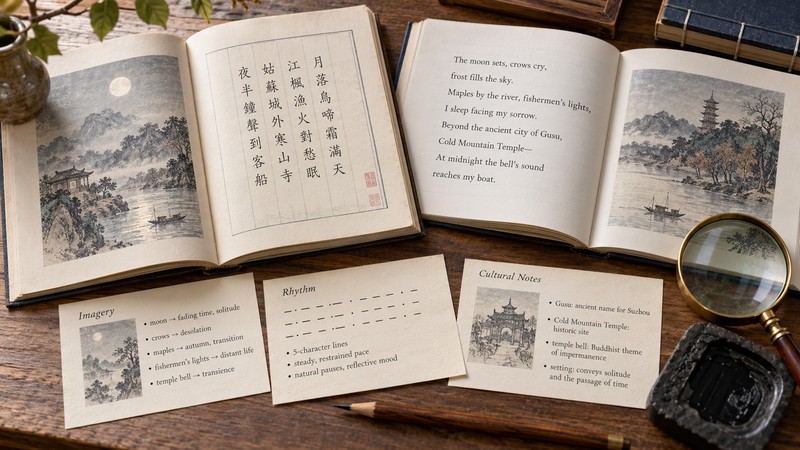
This is a great way to notice choices: does one translator use “bright moon” while another uses “moonlight”? Why?
Does one add a word like “grieved” that isn’t in the original, to convey emotion?
Second, learn to recognize common cultural symbols in Tang poetry. Chinese Poem Translation The moon, as seen in “Quiet Night Thought,” is a symbol of homesickness; plum blossoms stand for resilience in hardship; pine trees represent longevity and integrity.
These symbols are consistent across Tang poems, so once you learn them, you’ll start to see them in different works, making translation easier. For example, when you see “plum blossom” in a Tang poem, you can expect it to carry meaning beyond just the flower.
Third, take time to read translations slowly, line by line, and think about the rhythm. Even if you don’t know Chinese, the rhythm of the translation (whether it flows naturally, has a beat, or feels stilted) can tell you if the translator successfully recreated the poem’s original cadence.
For example, Li Bai’s “Viewing Mount Lu” has a bold, energetic rhythm that should come through in translation—if a version feels flat, it’s likely missing that rhythm. A key expert tip: Beginners should prioritize translations that balance accuracy with readability, rather than those that are overly literal or overly free.
Why It Still Matters Today
In a world where cross-cultural communication is more important than ever, chinese poem translation plays a vital role in connecting global audiences to Chinese literary heritage. Tang poetry, in particular, is a window into Chinese values: respect for nature, emphasis on emotion, and the beauty of everyday moments.
When English readers can read a well-translated version of Du Fu’s “Spring View,” they not only understand a poem—they understand the sorrow of a nation in crisis, a feeling that transcends time and culture.
For students and educators, Tang poetry translations are a powerful tool for learning Chinese language and culture. Many English-speaking students start with “Quiet Night Thought” because it’s short and relatable, and using different translations helps them see how language works.
Teachers can use translation comparisons to teach about tone, symbolism, and cultural context, making Chinese poetry accessible to learners who don’t speak Chinese.
Finally, chinese poem translation keeps Tang poetry alive in the modern world. For centuries, these poems were passed down orally and in written form in China, but translation brings them to a global audience.
When someone searches for “Tang poetry translation” online, they’re not just looking for a meaning—they’re looking for a connection to a culture that has shaped Chinese identity for over a thousand years. This connection is what makes translation so important: it turns ancient lines into something that feels relevant today.
Frequently Asked Questions
What is the meaning of chinese poem translation?
Chinese poem translation refers to the process of rendering Tang Dynasty poetry (poems originally written in Classical Chinese) into modern languages such as English, while preserving the original meaning, rhythm, imagery, and emotional resonance. It involves capturing not just the literal content but also the subtle nuances, cultural references, and artistic elements that define Classical Chinese poetry.
Who wrote chinese poem translation and what is the historical context?
Chinese poem translation of Tang Dynasty works has been undertaken by numerous scholars and poets throughout history. Notable translators include Arthur Waley, David Hawkes, Stephen Owen, and Xu Yuan- translation emerged as a field during the early 20th century when Western scholars became interested in Chinese literature. The Tang Dynasty (618-907 CE) itself produced legendary poets like Li Bai, Du Fu, Wang Wei, and Bai Juyi, whose works later became primary targets for translation into Western languages.
What literary devices are used in chinese poem translation?
Chinese poem translation employs various literary devices including imagery (visual and metaphorical), parallelism (particularly in regulated verse), alliteration, assonance, and careful word choice to maintain tonal quality. Translators often grapple with preserving the original’s use of Chinese characters’ multiple meanings, as well as the delicate balance between literal accuracy and poetic beauty. The challenge lies in conveying the original’s economy of language and subtle connotations.
What is the cultural significance of chinese poem translation?
Chinese poem translation serves as a vital bridge between Eastern and Western literary traditions, allowing global audiences to access one of the world’s greatest poetic legacies. It promotes cross-cultural understanding and appreciation of Chinese philosophy, aesthetics, and values embedded in Tang poetry. These translations have influenced Western modernist poetry and continue to shape global literary discourse, making the wisdom and beauty of Tang Dynasty poetry accessible to readers worldwide.
How should chinese poem translation be interpreted?
Chinese poem translation should be interpreted with attention to both the literal meaning and the underlying emotional context, considering the poet’s historical circumstances and personal experiences. Readers should appreciate that translations involve interpretation and compromise, as no single version can fully capture all dimensions of the original. It is helpful to consult multiple translations, understand the conventions of Tang Dynasty poetry (such as the five-character and seven-character regulated verses), and recognize the cultural symbolism embedded in images like the moon, willow, or crane.
Ai Poem Writer Free: 7 Hidden Meanings You Missed at First R Poem Meaning Website: 7 Hidden Meanings You Missed at First Love Poem Generator: 6 Hidden Meanings You Missed at First R Wikipedia