Tao Yuanming, Li Bai, and Li Qingzhao offer three useful starting points among famous Chinese poets. They belong to different periods—Eastern Jin, Tang, and Song—and the selected texts move from a quiet garden to a swift river journey and a remembered lotus-pond outing.
This is a small classical reading map, rather than a ranking of the three greatest poets. It also extends beyond the Tang period. Start with a scene that interests you, then keep the poet’s name, the work’s title, and its form together. The short Chinese excerpts below use simplified characters; the linked editions print traditional characters. English reading aids are newly written for this page.
Three famous poets: reference facts and first texts
| Poet and period | A first text and what to notice |
|---|---|
| Tao Yuanming 陶渊明 Eastern Jin |
Drinking Wine, no. 5 (饮酒·其五): a fence, flowers, and a change in attention. |
| Li Bai 李白 Tang |
Early Departure from Baidi City (早发白帝城): distance and speed in four seven-character lines. |
| Li Qingzhao 李清照 Song |
Ru Meng Ling, beginning 常记溪亭日暮: a remembered boat outing in a ci lyric. |
The periods matter because “Chinese poetry” covers more than one dynasty or verse form. Here, the different periods help keep three individual texts in view instead of treating every classical poem as the same kind of work.
Tao Yuanming: a quiet scene within the human world
In the fifth of Tao Yuanming’s Drinking Wine poems, the speaker’s dwelling is “within the human world” (结庐在人境). That opening is useful: the poem does not begin by saying that all human surroundings have disappeared. It asks how quiet can be experienced within them.
The best-known image in this selection is:
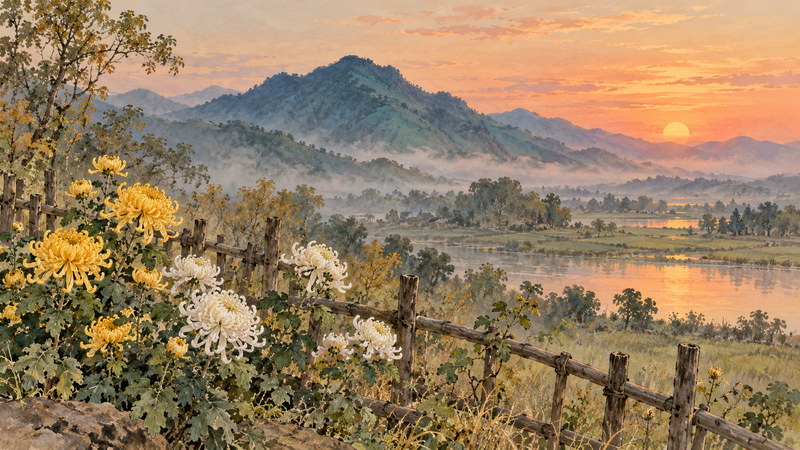
采菊东篱下,悠然见南山。
Original English reading aid: “Picking chrysanthemums by the eastern fence, at ease I see the southern mountain.”
Read the movement from a nearby flower and fence to the mountain. It gives you concrete things to notice before deciding on a large abstract message. The complete poem has ten five-character lines, so this pair is an excerpt, not the whole work. Its evening mountain air and returning birds extend the scene beyond the quoted moment. Calling the poem simply “a rejection of society” can obscure the tension already present in its opening: the dwelling is among people, while the speaker describes a different relation to surrounding noise.
Li Bai: a short poem with a rushing journey
Early Departure from Baidi City, also titled 下江陵 in the linked source, offers a much faster scene. Li Bai’s poem has four seven-character lines. Its opening is:
朝辞白帝彩云间,千里江陵一日还。
Original English reading aid: “At dawn I leave Baidi among bright clouds; a thousand li, and back to Jiangling in a day.”
First mark the departure and destination. Then notice how the expansive “thousand li” is compressed into “one day.” These are the poem’s words, not a modern itinerary or a measured travel claim. The later lines bring in the calls of apes and a light boat passing many mountains, carrying the sense of movement onward.
This makes a useful contrast with Tao Yuanming’s selected scene. One invites attention to the relation between a still observer and nearby objects; the other moves the reader through a landscape. That comparison concerns these two texts. It does not mean every work by Tao is still, or every work by Li Bai is a rushing journey. Avoid turning one memorable poem into a complete personality profile.

Li Qingzhao: a remembered outing in a Song lyric
Li Qingzhao belongs to the Song, not the Tang. Columbia’s primary-source introduction places her life across the Northern and Southern Song division. The selected work here is a different lyric from the one translated on that teaching page: Ru Meng Ling, beginning 常记溪亭日暮.
Ru Meng Ling is a tune-pattern title used for ci lyrics; adding the opening words identifies this particular text. Its lines vary in length, and its repeated 争渡 is visibly different from a four-line, seven-character poem. A turning point reads:
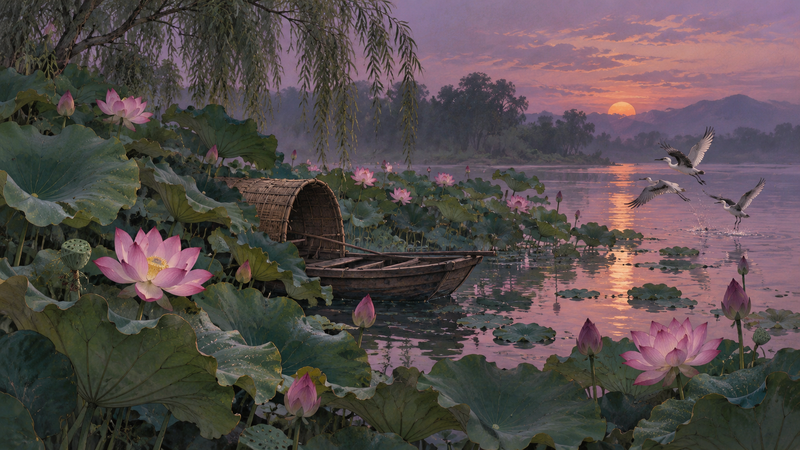
兴尽晚回舟,误入藕花深处。
Original English reading aid: “The outing over, turning home late by boat, we stray deep among the lotus.” The supplied English “we” makes the scene readable; it is not an explicit pronoun in those Chinese lines.
The remembered outing moves from pleasure into a small mistake in navigation, then ends with disturbed water birds. Read those actions before reducing the lyric to a label such as “sad Song poetry.” This text gives you a lively remembered scene. Neither that scene nor an imagined accompanying picture is enough to establish the precise circumstances of a biographical event.
Read a poet through the text, not a fixed label
Choose Tao Yuanming’s poem if you want to follow attention from a small object into a landscape. Choose Li Bai’s if you want to examine how a brief poem creates speed. Choose this Li Qingzhao lyric if you want to follow remembered actions and repetition. Read the whole selected text in its linked edition after the excerpt.
Keep form separate from dynasty: “Tang” names a period, while shi and ci describe different literary forms. For practice preserving titles, authors, and line breaks while reading, see Chinese poems in Chinese characters. A small, accurately identified selection is a stronger beginning than a long list of famous names without any texts.
Questions about these classical poets
Were Tao Yuanming, Li Bai and Li Qingzhao all Tang poets?
No. Tao Yuanming belongs to Eastern Jin, Li Bai to Tang, and Li Qingzhao to Song. Only Li Bai among these three is a Tang poet.
Why can the same title Ru Meng Ling refer to different lyrics?
Ru Meng Ling names a ci tune pattern rather than uniquely identifying one text. Include the author and opening words, here Li Qingzhao and 常记溪亭日暮, to identify the selected lyric.
Are the English lines here published translations?
No. They are original reading aids written for this page. They explain the selected excerpts and sometimes supply an English subject that the Chinese leaves unstated; they are not the only possible interpretations.
Do these three poets form an official ranking?
No. They are three selected classical starting points across different periods. This page does not rank them or claim to represent every major Chinese poet.