The Chinese poem “Lion-Eating Poet in the Stone Den” is a modern Literary Chinese text built almost entirely from characters pronounced shi in Standard Mandarin. This guide addresses the search phrase Chinese poem lion eating poet in the stone den while preserving the work’s correct title and context. On the page, the different characters and grammar carry the story. Read aloud without seeing the characters, the repeated syllables become extremely difficult to distinguish. That contrast makes the piece a useful linguistics demonstration, but it is often misdescribed as an ancient poem, an ordinary tongue twister, or proof that Chinese cannot be romanized.
Basic facts about the lion-eating poet
| Feature | What to know | Common mistake |
|---|---|---|
| Chinese title | 施氏食狮史 / 施氏食獅史 | Treating one English title as a literal word-for-word translation |
| Language | Literary Chinese, read with modern Mandarin pronunciations | Calling it normal spoken Mandarin |
| Sound pattern | The characters are read as shi, distinguished partly by tone | Saying every syllable has the same tone |
| Author history | A well-known version is linked with Yuen Ren Chao; source history also involves an earlier draft credited to Hu Mingfu | Presenting a disputed or simplified attribution as certain |
| Purpose | A constructed demonstration of problems that arise when a Literary Chinese text is heard or represented without enough distinctions | Using it as proof that all Chinese romanization fails |

What happens in the story?
A poet surnamed Shi lives in a stone room and wants to eat ten lions. He goes to the market, encounters ten lions, and has them brought back to his stone chamber. When he tries to eat them, he discovers that they are stone lions. The plot is intentionally absurd because it must fit a severe sound constraint.
The opening is often represented in pinyin as a sequence beginning Shī shì shī shì Shī Shì…. Even with tone marks, a listener faces many near-identical syllables. In characters, however, 石, 室, 诗, 士, 施, 氏 and the other written forms supply visible distinctions.
Copyright boundary: This guide explains the structure and quotes only a brief opening fragment. It does not reproduce the full modern text or a full copyrighted translation.
Why the characters are readable but the audio is hard
Chinese characters encode morphemes and conventional written distinctions, not just a string of phonetic symbols. A reader who knows Literary Chinese can use character identity, syntax, and context to separate the roles in the story. When those distinctions are reduced to repeated Mandarin syllables, much of that information disappears.
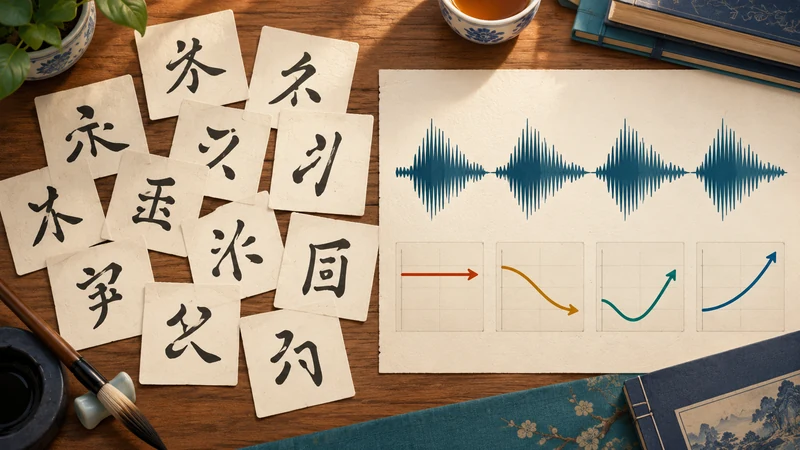
Tone marks help, but they do not fully solve the listening problem. Modern Mandarin has four lexical tones plus a neutral tone, while the constructed passage contains many words that share both syllable and tone. Normal speech avoids this extreme because speakers choose less constrained vocabulary, use disyllabic words, and rely on a conversational context.
It is Literary Chinese, not everyday Mandarin
The piece works because it compresses a story into Literary Chinese. That written register differs from modern spoken Mandarin in vocabulary and grammar. Reading the text with current Mandarin pronunciations maps an older style of writing onto a later sound system. The result is deliberately unnatural as speech.
This also explains why claims about “all words sounding the same” are misleading. The experiment is designed to select only characters with the required modern Mandarin reading. It is not a random sample of Chinese and not a typical poem.
What does the text show about romanization?
It shows that a bare phonetic transcription of a highly compressed Literary Chinese passage can be ambiguous, especially when spaces, tone information, and explanatory context are limited. It does not show that pinyin is useless. Pinyin is effective for pronunciation teaching, dictionary lookup, input, and many other tasks when used with characters and context.
Yuen Ren Chao was himself a major linguist and designer of romanization systems. That biography is one reason scholars warn against turning the passage into a slogan that he opposed every form of romanization. A recent scholarly discussion of one-syllable writing likewise notes that the work is often oversimplified in popular retellings.
Why pronunciation differs across Chinese varieties
The dramatic shi effect depends on reading the characters in modern Standard Mandarin. Other Sinitic varieties preserve different consonants, vowels, tone categories, or syllable endings, so the same written text may not collapse into one repeated syllable in the same way. Earlier stages of Chinese also had distinctions that later merged in Mandarin.

This does not make one variety “more correct.” It shows that writing, historical sound change, and modern regional pronunciation are separate evidence. The text becomes most useful when those layers stay visible.
How to study it without learning the wrong lesson
- Start with the Chinese characters and identify the grammatical roles.
- Add pinyin with tone marks, then notice which distinct characters share a reading.
- Listen to a careful Mandarin reading and compare what information disappears.
- Check a reading in another Chinese variety if reliable audio is available.
- Treat the piece as constructed constrained writing, not a sample of ordinary conversation.
For broader context, compare our guides to Chinese poem translation, Chinese poems with pinyin, and Chinese poetry forms.
Data anchor: sources and attribution limits
The Tsinghua University History Museum identifies Chao as a modern linguist who wrote homophonic miniature texts, including 施氏食狮史. A scholarly 2026 discussion of one-syllable writing notes the popular tendency to overstate its anti-romanization message. Source histories also mention an earlier draft associated with Hu Mingfu, so responsible summaries should distinguish the famous Chao version from the broader development of the exercise.
Frequently asked questions
Is the Lion-Eating Poet an ancient Chinese poem?
No. It is a modern constructed Literary Chinese text associated with twentieth-century language debates and linguistics.
Does every character have exactly the same pronunciation?
They share the syllable shi in Standard Mandarin, but tones differ, and some versions or attribution histories contain textual differences.
Can Mandarin speakers understand it by listening?
Not reliably without prior knowledge or written support. The passage deliberately removes the normal lexical variety that makes spoken language understandable.
Does it prove that pinyin cannot represent Chinese?
No. It demonstrates a severe edge case involving Literary Chinese, homophony, and a constrained text. Pinyin remains useful when tone, spacing, characters, and context are handled appropriately.