Tang dynasty art is easier to recognize when you look for a combination rather than one universal style: energetic brush line, lifelike horses and court figures, brightly glazed tomb ceramics, monumental Buddhist sculpture, and luxury objects that adapt shapes or motifs moving across Asia. The dynasty lasted from 618 to 907, but an object should never be dated from color or subject alone. Material, function, excavation context, inscriptions, and museum provenance all matter.
Quick answer
To identify Tang dynasty art, begin with what the object was made for. A painted handscroll was handled and viewed differently from a tomb figure; a Buddhist cave carving served a religious setting; a silver cup belonged to elite material culture. Then examine material and technique. Flowing ink line, amber-green-cream sancai glaze, modeled earthenware figures, carved limestone, gilded bronze, silk, gold, and silver all appear in Tang collections. Finally, check the date and attribution supplied by a reliable collection record. “Tang style” can describe later works inspired by the period, so appearance by itself is not proof.
At a glance
| Art form | What to examine | What it can tell you | Main caution |
|---|---|---|---|
| Painting and calligraphy | Brush line, ink modulation, format, seals, inscriptions | Court taste, movement, literary culture, later collecting | Many famous works survive through later attributions, copies, or remounting |
| Tomb ceramics | Clay body, pigment or glaze, figure type, find context | Elite burial practice, dress, animals, status, cosmopolitan life | A tomb figure is not a neutral photograph of everyday society |
| Buddhist sculpture | Material, iconography, patron inscriptions, cave or temple setting | Religious patronage, workshop practice, regional style | The sculpture may span several building phases or later repairs |
| Metalwork and textiles | Shape, technique, motif, material, trade parallels | Elite consumption and exchange across Central and West Asia | A foreign-looking form does not automatically mean foreign manufacture |
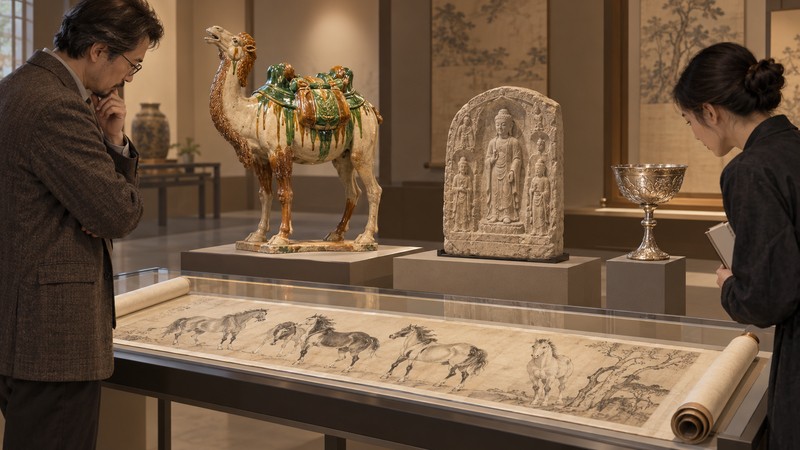
Quick reference: start with material, function, and setting
The most useful question is not “Does this look Chinese?” but “What kind of object is this, and how was it used?” Tang visual culture reached across court, temple, tomb, workshop, and trade. Those settings produced different kinds of evidence.
The Metropolitan Museum of Art’s overview of the Tang dynasty places paintings, Buddhist images, tomb figures, glazed ceramics, silver vessels, and textiles in the same historical frame. That range is the first lesson: Tang art is not a single palette or motif. It is a network of materials, makers, patrons, and uses.
| If you see… | Check next… | Why it matters |
|---|---|---|
| A horse, camel, rider, or attendant | Whether it is painted, modeled in clay, or carved; whether it came from a tomb | The same subject changes meaning with medium and funerary context |
| Green, amber, and cream glaze | Clay type, kiln attribution, object function, and excavation history | These colors often suggest sancai, but color alone cannot authenticate or date an object |
| A Buddha or bodhisattva | Gesture, attributes, inscription, cave or temple location, patronage | Buddhist iconography follows religious conventions as well as period style |
| A silver cup or ewer with an unfamiliar profile | Metalworking method and comparable shapes from Central or West Asia | Form can reveal exchange and adaptation without proving where the object was made |
| An old handscroll | Medium, attribution wording, seals, colophons, and conservation history | Later collectors and remounting can be part of the object’s surviving history |
Painting: read line and movement before color
Tang painting is often discussed through court figures, horses, religious images, and early landscape traditions. Yet survival is uneven. Paper and silk are fragile, and some celebrated images are known through works that museums label “attributed to” a painter rather than as uncontested objects from the artist’s hand.
A practical example is Night-Shining White, a horse portrait attributed to Han Gan and dated around 750 by the Met. The work is a handscroll in ink on paper. Its value for a beginner is not a checklist of “Tang symbols.” It shows how a few controlled lines, ink shading, a taut rope, flared nostrils, and shifting hooves create physical pressure and temperament.
When looking at a Tang or Tang-attributed painting, ask three questions:
- How does the brush describe weight, speed, fabric, hair, rock, or flesh?
- Is the image meant to unfold through a handscroll, confront a viewer on a wall, or serve a religious setting?
- Does the museum say “by,” “attributed to,” “copy after,” or “style of”? Those phrases record different levels of certainty.
This form-first reading also helps with poetry. The site’s guide to Tang dynasty literature explains how genre and medium shape interpretation; visual art deserves the same discipline.
Tomb ceramics: vivid evidence with a funerary purpose
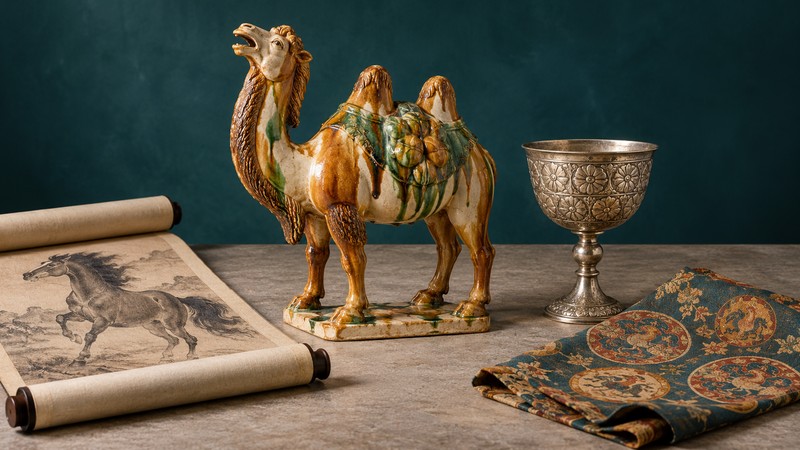
Tang tomb figures can feel immediate: camels carry goods, horses strain forward, attendants stand at ease, and musicians or riders suggest movement. Their liveliness is one reason they are popular in museum displays. But they were created for burial. They reflect choices about status, protection, service, travel, and the afterlife, not a complete census of Tang society.
The best-known surface is sancai, usually translated as “three-color.” It is a lead-glaze palette rather than a rule that every piece must show exactly three hues. Green, amber or yellow-brown, and cream are common. Glazes can run and pool during firing, producing streaks that make the modeled body appear animated.
The British Museum catalogues a glazed camel as a Tang work and associates it, with qualified provenance, with a group said to have come from the tomb of General Liu Tingxun, who died in 728. The camel carries bundles and vessels, and some forms refer to Central or West Asian goods. This tomb group uses imagery of long-distance movement and valued goods; it does not establish a universal Tang experience.
Buddhist sculpture: art shaped by worship, patronage, and place
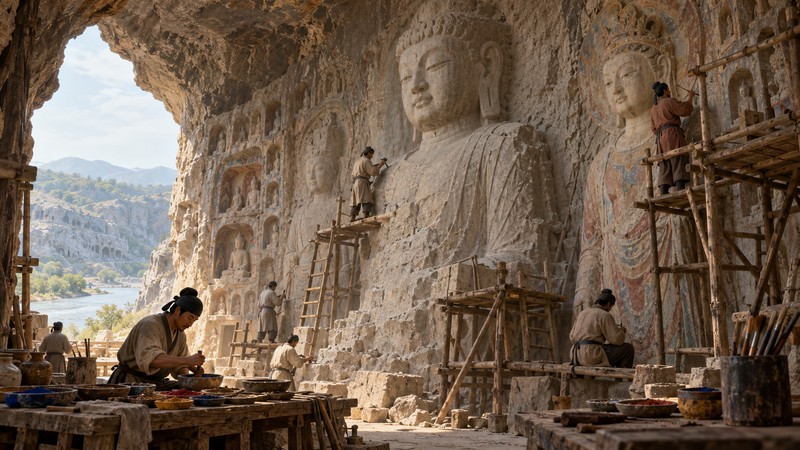
Buddhist art was central to Tang visual culture. Sculptures were not merely freestanding museum objects. They belonged to cave shrines, temples, ritual programs, and donor networks. Scale, placement, companion figures, inscriptions, and the relationship between image and architecture all affect meaning.
The Longmen Grottoes, south of Luoyang, preserve more than 2,300 caves and niches across several periods. UNESCO identifies the seventh- and eighth-century Tang carvings, especially those at Fengxiansi, as major examples of royal cave-temple art. That site makes an important method visible: date a sculpture within the history of a cave, not simply from a serene face or flowing robe.
At a museum, look for the object record’s iconographic language—Buddha, bodhisattva, guardian, disciple—and for notes about original location. A halo, hand gesture, crown, or attendant has a religious role. Treating those features as decoration alone removes the image from the belief and practice that gave it purpose.
Metalwork and textiles: exchange without a simple East-West label
Tang luxury arts often make cultural exchange tangible. Silver, gold, glass, textiles, and ceramic vessels could use shapes or motifs with parallels farther west, while workshops in China changed those forms for local patrons and techniques.
The British Museum describes a Tang silver stem cup with hunters as a vessel type introduced from Central Asia and lands farther west, while its decoration combines motifs and techniques within a Chinese artistic setting. This is more precise than calling the cup simply “foreign.” Objects can carry an imported shape, local manufacture, adapted ornament, and multiple audiences at the same time.
Textiles tell a similar story through weave, fiber, medallions, animals, flowers, and repeated roundels. Because fabric rarely survives as well as stone or ceramic, a preserved fragment may represent a much larger lost world of clothing, furnishings, gifts, and trade.
A five-step museum method
Use this sequence when you encounter an unfamiliar Tang object online or in a gallery:
- Read the full label. Record the museum’s exact date range and whether the attribution is firm, probable, or qualified.
- Name the material and technique. “Ceramic” is only a start; distinguish earthenware, pigment, lead glaze, stoneware, silver, ink on paper, or color on silk where the record allows it.
- Identify function. Tomb object, temple image, handscroll, vessel, ornament, and textile invite different interpretations.
- Locate the context. Findspot, cave, tomb, workshop region, patron, and later collecting history can be more diagnostic than one motif.
- Compare with a dated object. Use an institutional collection record, not an auction title or social-media caption, and compare several features rather than one color.
What “Tang style” does not prove
Three cautions prevent most beginner mistakes.
First, later artists admired Tang models. A later copy, revival, or work “in Tang style” can be historically important without being an eighth-century original. Second, restoration and remounting may alter how an object looks today. A handscroll can accumulate seals and colophons; a sculpture may lose pigment; a ceramic may survive because it was sealed in a tomb. Third, labels change as research advances. Museum records sometimes revise dates, attributions, or object histories.
This uncertainty is productive. It shifts attention from instant visual recognition to evidence. The goal is not to guess a dynasty from a photograph; it is to understand why specialists assign a date and what remains unresolved.
Connect art with Tang poetry carefully
Art and poetry shared courts, religious institutions, landscapes, travel routes, and elite audiences, but one should not be used as a literal illustration of the other without evidence. A horse painting does not automatically explain every horse poem, and a tomb camel does not summarize Silk Road life.
A better comparison starts with method. Notice how a painter controls line, how a poet orders images, and how format guides attention over time. Then add historical context. The site’s Tang poetry analysis guide offers a form-first approach that can be paired with the object-first method here.
Frequently asked questions
What are the main types of Tang dynasty art?
Major surviving categories include painting and calligraphy, tomb ceramics, Buddhist stone and bronze sculpture, metalwork, textiles, lacquer, and architectural decoration. Survival is uneven, so museum collections do not reproduce the original balance of Tang artistic production.
Does sancai always mean exactly three colors?
No. The name is commonly translated as “three-color,” but it refers to a glaze tradition and palette. Individual pieces may show fewer or additional hues. Material analysis, object type, kiln and excavation context matter more than counting colors.
Why are horses and camels common in Tang art?
They could signify transport, military and court culture, elite status, and connections across trade routes. In tomb figures they also served funerary purposes. The meaning depends on the object’s context rather than the animal alone.
Is all Tang Buddhist art found at Longmen?
No. Longmen is a major surviving cave complex, but Tang Buddhist art also appeared at other cave sites, temples, monasteries, and in portable sculpture and painting. Longmen is useful because its setting preserves relationships among carving, architecture, inscriptions, and patronage.
Can I identify an authentic Tang object from a photo?
Not reliably. A photograph can support visual comparison, but authenticity and dating require provenance, material and technical study, condition evidence, inscriptions where relevant, and expert comparison. Use museum records to learn; do not treat a style checklist as authentication.