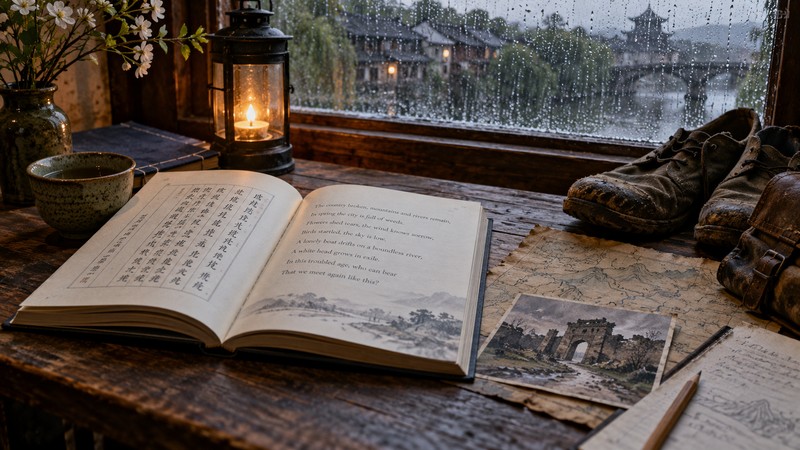
Du Fu poetry stands as one of the most revered bodies of work in Chinese literature, a mirror held up to the joys and sorrows of Tang Dynasty life. For beginners, it often feels like a departure from the whimsical, otherworldly verses of Li Bai, but its depth, emotional honesty, and unflinching focus on human suffering make it essential reading for anyone seeking to understand classical Chinese poetry.
Unlike poets who sang of immortals or natural beauty as escape, Du Fu used his verses to bear witness to the upheaval of his time, turning personal grief into a universal commentary on the human condition.
What Du Fu Poetry Means in Chinese Poetry
Du Fu’s work is often categorized as part of the Mid-Tang shift in Chinese literature, Du Fu Poetry moving away from the extravagant romanticism of the High Tang (712–766) toward a more grounded, realistic style. A common beginner misunderstanding is that Du Fu’s poetry is uniformly somber or tragic, but this overlooks the range of his themes—from quiet moments of domestic warmth to fierce calls for justice.
For example, he wrote tender verses about his children, like “My little boy doesn’t know his father’s sorrow, he just asks when the wine seller will bring more wine.” This balance of personal and collective emotion is a hallmark of his style, setting him apart from peers who focused on either individual experience or grand historical events alone.
Literary scholars at Chinese universities often highlight Du Fu as the “Poet-Sage” (Shi Sheng), a title that reflects his alignment with Confucian values of benevolence (ren) and social responsibility. Unlike Li Bai, who was celebrated for his freedom from social constraints, Du Fu saw poetry as a tool to comment on society, to hold power accountable, and to give voice to the marginalized.
This focus on moral purpose is why his work remains central to Chinese poetry curricula, even centuries after his death. For readers new to classical Chinese poetry, Du Fu’s work offers a relatable entry point: his struggles—financial hardship, separation from family, grief over lost loved ones—are universal, making his verses accessible even without deep knowledge of Chinese history.
Another key aspect is his mastery of form. Du Fu excelled in both the regulated verse (lüshi) and the short lyric (jueju), Du Fu Poetry adhering strictly to tonal patterns and rhyme schemes while infusing them with raw emotion.
This balance of technical precision and emotional depth is what makes his work enduring; it’s not just about what he says, but how he says it, using traditional poetic structures to amplify his message.
Historical and Cultural Background
Du Fu lived through one of the most transformative periods in Chinese history: the An Lushan Rebellion (755–763), a civil war that shattered the prosperity of the High Tang and left millions dead. Born in 712, the same year as the Tang’s most famous emperor, Xuanzong, Du Fu grew up in a time when Chang’an (modern Xi’an) was the cultural capital of the world, a city bustling with poets, scholars, and artists.
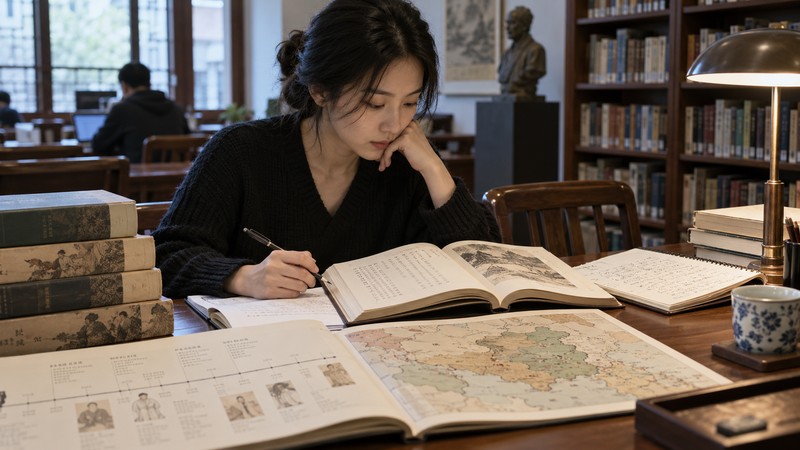
But as he reached adulthood, the empire began to unravel: corruption at court, military overexpansion, and growing unrest among the peasantry laid the groundwork for the rebellion.
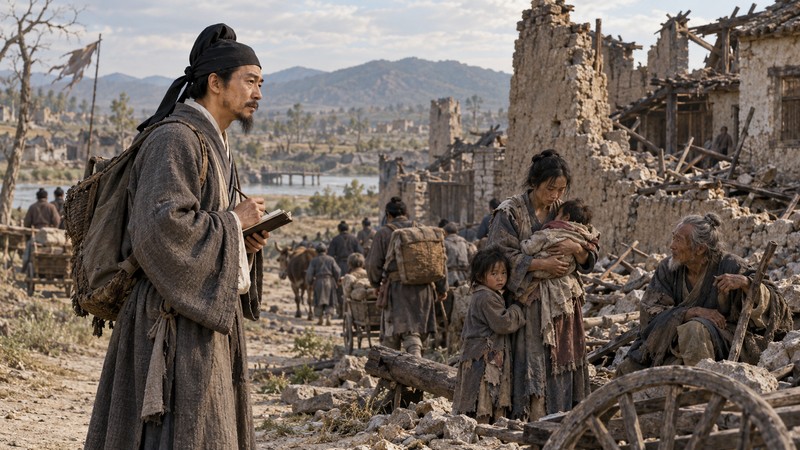
In 755, the rebel general An Lushan led a massive army south, capturing Chang’an and forcing the imperial court to flee. Du Fu Poetry Du Fu, who was trying to reach the emperor to offer his services, was captured and held in the occupied capital for nearly a year.
This experience of loss, displacement, and powerlessness is the foundation of his most powerful work. For example, his poem “Spring View” (Chun Wang) was written during this period of captivity, when he could see the ruins of Chang’an from his hiding place.
The poem’s opening lines—“The country is broken, mountains and rivers remain; the city spring grass grows deep”—capture the paradox of enduring nature amid human catastrophe, a theme that runs through all of his later work.
In Chinese cultural memory, Du Fu is remembered not just as a poet, but as a witness. His work is often studied in middle school and high school curricula because it teaches students about the importance of empathy and social awareness.
Unlike other Tang poets who wrote about their own adventures or romantic pursuits, Du Fu wrote about the conscription of soldiers, the suffering of refugees, and the poverty of farmers. This focus on the common people made his poetry resonate across generations, even as the Tang Dynasty declined further in the centuries after his death.
Key Poems, Poets, or Examples
To understand Du Fu poetry, it’s helpful to examine specific works that illustrate his style and themes, often in contrast to other Tang poets. The first is Du Fu’s “Spring View” (Chun Wang), written in 757 during his captivity in Chang’an.
The poem uses simple, vivid imagery to convey the devastation of war: “The country is broken, mountains and rivers remain; the city spring grass grows deep.” The next lines, “I feel the flowers shed tears at the sight of the war, and the birds startle at the sound of the army’s drums,” personify nature to mirror human grief, a technique that makes the poem’s emotional impact immediate. This work is often taught as an example of Du Fu’s ability to blend personal emotion with historical reality, and its English translations (by Burton Watson and others) have made it accessible to Western readers.
Second, Du Fu’s “The Ballad of the Army Carts” (Bing Che Xing), a narrative poem written in the yuefu (folk ballad) style. This poem details the conscription of young men into the imperial army, showing the devastating effect on families.
Lines like “At the Bridge of Wei, the soldiers are leaving, their parents and wives rushing to see them off, the dust rising so high it covers the Xianyang Bridge” describe a scene of collective grief, while later lines reveal the cycle of war: “Those who were conscripted to fight in the south are now dead, and those who were conscripted to fight in the north are still fighting.” Unlike many poems that glorify military service, Du Fu’s work exposes the human cost of war, a rare perspective in Tang poetry.
Third, Li Bai’s “Quiet Night Thoughts” (Jing Ye Si), written around the same time as Du Fu’s early work. Du Fu Poetry While not a Du Fu poem, it is essential for comparison because it represents the High Tang romantic style that Du Fu reacted against.
Li Bai’s poem is a simple, intimate meditation on homesickness: “Before my bed, there is bright light, I think it’s frost on the ground. I look up at the bright moon, and lower my head to think of my hometown.” The emotion is personal and quiet, focusing on individual experience, whereas Du Fu’s work is collective and historical.
This contrast helps readers see Du Fu’s unique contribution to Tang poetry: shifting focus from the self to society.
Fourth, Du Fu’s “My Thatched Hut is Broken by the Autumn Wind” (written in 761), a deeply personal poem that evolves into a universal plea. The poem opens with the chaos of his own home: “The autumn wind howls and tears the thatch from my roof, the thatch flies over the river and scatters in the fields.” But by the end, he transcends his own suffering to write: “When will I get a big house with a thousand rooms, to shelter all the poor scholars in the world?
Even if my own hut is destroyed by the wind, I will be satisfied.” This line encapsulates Du Fu’s core virtue: empathy for others, even in his own hardship.
How to Read and Understand It
Reading Du Fu poetry requires more than just translating words; it requires understanding the cultural and historical context that shaped his work. A practical tip for beginners is to start with his shorter, more accessible poems, like “My Thatched Hut is Broken by the Autumn Wind,” which balances personal struggle with universal compassion.
This approach avoids overwhelming new readers with the complexity of his longer narrative poems while still showcasing his unique voice.
Another key tip is to read the original Chinese if possible, or at least compare multiple translations. Many English translations of Du Fu’s work simplify the tonal patterns and cultural nuances, but reading a translation by a scholar like Burton Watson, who is fluent in classical Chinese, can capture the subtlety of his verse.
For example, Watson’s translation of “Spring View” preserves the poem’s formal structure, while Ezra Pound’s translation (though influential) takes more liberties with the original meaning. Comparing these translations helps readers understand how language shapes the interpretation of poetry.
Reading aloud is also important for appreciating Du Fu’s work. Tang poetry follows strict rhythmic patterns, Du Fu Poetry and reading aloud helps catch the flow of lines and the emphasis on key words.
For example, in “The Ballad of the Army Carts,” the repetition of phrases like “the fathers and mothers” and “the wives and children” creates a rhythmic chant that mirrors the grief of the scene. By reading aloud, readers can feel the emotion of the poem more deeply, rather than just understanding it intellectually.
Finally, it’s helpful to read Du Fu’s biography alongside his poems. His life—from his youth spent traveling to his later years of poverty and displacement—provides context for his work.
For example, his poem “Gazing at the Mountains” (Wang Yue) was written when he was young, before the rebellion, and shows his ambition: “I will climb the highest mountain, and see all the small mountains beneath.” This contrasts with his later poems, which are focused on survival and empathy. Understanding this evolution helps readers see how his experiences shaped his poetry.
Why It Still Matters Today
Du Fu poetry remains relevant today because of its focus on empathy and social justice, themes that resonate with readers across cultures and time periods. In a world still grappling with conflict, poverty, and displacement, his work offers a voice for the marginalized, reminding readers that poetry can be a tool for change.
For example, “The Ballad of the Army Carts” is still studied in discussions about the human cost of war, and his verses about poverty are cited in modern conversations about inequality.
In China, Du Fu is a national treasure, and his work is part of the cultural identity of the country. Even today, Chinese poets and writers look to his work as a model of how to use art to comment on society.
His title “Poet-Sage” reflects his status as a moral guide, not just a literary figure. For overseas Chinese, his poetry is a link to their cultural heritage, a way to connect with the history and values of their homeland.
Cross-culturally, Du Fu Poetry Du Fu’s work has gained popularity in recent decades, thanks to translations by scholars like Burton Watson and others. Western readers often relate to his realism, which is similar to the work of modern writers like Charles Dickens, who also focused on social issues.
Unlike Li Bai, who is often seen as a “romantic poet” in the West, Du Fu is seen as a “poet of the people,” making his work more accessible to readers who are interested in social commentary. This cross-cultural appeal shows that the themes of Du Fu’s poetry—suffering, empathy, and love for humanity—are universal, transcending time and language.
Frequently Asked Questions
What is the meaning of du fu poetry?
Du Fu poetry refers to the works of Du Fu (712-770 CE), a renowned poet of the Tang Dynasty. His poetry encompasses a wide range of themes including political commentary, social justice, personal suffering, natural landscapes, and historical reflection. Often called the “Poet-Historian,” Du Fu’s works provide profound insights into the social and political conditions of his era, blending personal emotion with broader historical and philosophical concerns.
Who wrote du fu poetry and what is the historical context?
Du Fu wrote du fu poetry during the Tang Dynasty, particularly during the An Lushan Rebellion (755-763), which profoundly shaped his work. Born in 712 CE in Henan Province, Du Fu lived through a period of political turmoil, economic hardship, and social upheaval. He served briefly as a court official but spent much of his life traveling and living in poverty, giving him direct experience with the common people’s suffering. His poetry became a powerful vehicle for expressing the human cost of historical events.
What literary devices are used in du fu poetry?
Du Fu poetry employs numerous literary devices including parallelism (对仗), allusion (用典), imagery (意象), personification (拟人), and symbolism (象征). He masterfully uses contrast to highlight social inequalities, such as in “Spring View” where he contrasts the ruined city with the flourishing spring landscape. His use of precise diction, strict poetic forms, and the careful balance of visual and auditory images demonstrates his technical mastery while conveying deep emotional resonance.
What is the cultural significance of du fu poetry?
Du Fu poetry holds immense cultural significance in Chinese literary history and is considered the pinnacle of Chinese realist poetry. His works became models of social consciousness in poetry, influencing generations of writers who sought to combine artistic excellence with moral engagement. Du Fu is revered as the “Poet-Historian” because his poems document the human experience during one of China’s most tumultuous periods. His poetry continues to be studied, recited, and celebrated as essential to understanding Chinese culture, history, and literary tradition.
How should du fu poetry be interpreted?
Du fu poetry should be interpreted with attention to its historical context, biographical background, and poetic techniques. Readers should consider the political circumstances of when each poem was written, as many reflect the An Lushan Rebellion and its aftermath. Attention should be paid to Du Fu’s use of concrete imagery, his compassion for the common people, and his philosophical reflections on suffering and resilience. Understanding the formal constraints of classical Chinese poetry, such as regulated verse, helps appreciate his technical skill in weaving personal emotion with universal themes of loss, hope, and human dignity.
Chinese Poetry Tang Dynasty: Major Poets, Poems and Legacy Poem Maker Online: 6 Hidden Meanings You Missed at First Rea Ancient Chinese Poetry: Major Poets, Poems and Legacy Wikipedia