For anyone who has ever lingered over a line of classical Chinese verse—whether the soft ache of a moonlit night or the weight of a nation’s sorrow—poetry in tang dynasty is not just a historical chapter, but the soul of Chinese poetic tradition. Spanning nearly three centuries (618–907 CE), this era birthed over 48,900 surviving poems, compiled in the 18th-century *Complete Tang Poems*, and shaped every subsequent generation of Chinese literature.
It is a body of work that balances formal precision, raw emotion, and universal themes, making it accessible to beginners and profound for seasoned scholars alike.
What Poetry In Tang Dynasty Means in Chinese Poetry
In the context of Chinese poetic history, poetry in tang dynasty represents its golden age—a pinnacle where classical Chinese verse reached its most refined and enduring form. Unlike earlier poetic traditions, which often leaned into loose structures and personal anecdotes, Tang poetry codified distinct forms: the jueju (four-line poem, 5 or 7 characters per line, strict rhyme) and lushi (eight-line poem with parallel structure between middle lines and fixed tone patterns).
These forms acted as frameworks for poets to weave together nature, emotion, and social commentary, creating works that were both artistically rigorous and emotionally resonant. For Chinese culture, Tang poetry is not just art—it is a shared language, referenced in daily life, taught in schools, and embedded in cultural rituals from banquets to family gatherings.
Historical and Cultural Background
The rise of Tang poetry is inextricably linked to the dynasty’s golden age of prosperity and cultural openness. After the collapse of the preceding Sui dynasty, the Tang unified China, expanding its borders through the Silk Road, fostering trade and exchange with Central Asia, India, and the Middle East.
This multicultural environment infused poetry with new themes: references to foreign lands, musical instruments, and religious ideas (Buddhism and Taoism flourished during this era, shaping many poets’ worldviews).
A key catalyst for poetry’s prominence was the imperial examination system, Poetry In Tang Dynasty which began requiring candidates to compose lushi as part of their evaluations. This meant poetry was not just a pastime for nobles—it was a path to social mobility, so scholars of all classes devoted themselves to mastering verse.
The An Lushan Rebellion (755–763) marked a turning point: the dynasty’s decline shifted poetry from the romantic, carefree works of early Tang to the realistic, socially conscious pieces of late Tang, reflecting the suffering of war, displacement, and national loss. Poets like Li Bai and Du Fu, whose works defined their eras, embodied these shifts: Li Bai (early Tang) was the “Poet Immortal,” a free-spirited wanderer, while Du Fu (late Tang) was the “Poet Sage,” a chronicler of his time’s chaos.
Key Poems, Poets, or Examples
To understand poetry in tang dynasty, one cannot ignore its most iconic voices and works, which remain central to Chinese cultural memory:
- Li Bai (701–762 CE): *Quiet Night Thought* (Jing Ye Si)
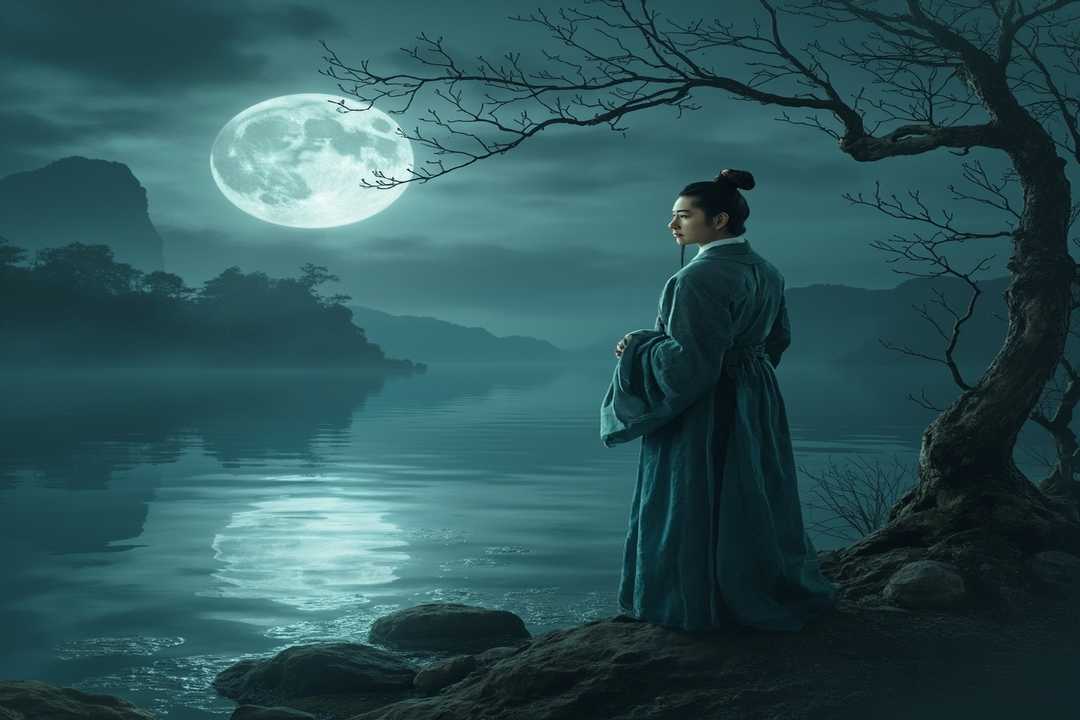
This 5-character jueju, written around 726 CE during Li Bai’s travels far from his home, is one of the most famous poems in China. Its meaning is deceptively simple: a quiet moment of a moonlit night, where the speaker mistakes moonlight for frost on the ground, looks up at the moon, and bows to think of his family.
The translation context: Arthur Waley’s 1918 English translation preserved its brevity and warmth, making it accessible to global readers. Why it matters: It distills the universal emotion of homesickness into four lines, using vivid imagery (moon, frost) that requires no prior cultural knowledge to feel.
It is taught to Chinese children in kindergarten, a testament to its timelessness.
- Du Fu (712–770 CE): *Spring View* (Chun Wang)
Written in 757, when the An Lushan Rebellion had occupied the capital Chang’an, this lushi is a masterpiece of formal mastery and emotional depth. Its lines describe the ruined city: “The hills and streams remain, though the capital’s broken; / In spring, grass grows thick and wild.” The poem’s core lines—“Flowers weep at the sight of war; / Birds grieve as men’s hearts break”—personify nature to mirror human suffering.
Why it matters: It is a defining work of late Tang poetry, blending strict form with raw empathy, and capturing the trauma of a nation in crisis. Du Fu’s focus on social reality set a standard for poetic responsibility that endures today.
- Wang Wei (701–761 CE): *Birdsong Stream* (Niao Yu Jian)
A master of Tang’s “mountain and water” poetry, Wang Wei was influenced by Buddhism, which shines through this piece. The poem uses quiet, detailed imagery: “Empty mountains have no one, / Yet I hear voices speaking; / The sun shines through the trees, / And the light falls on the green moss.” Why it matters: It embodies the Tang ideal of harmony between humanity and nature, and Wang Wei’s ability to turn a simple landscape into a meditation on inner peace.
This work has shaped Chinese landscape art and poetry for centuries.
How to Read and Understand It
For students, teachers, or poetry lovers new to poetry in tang dynasty, these practical tips will help you engage with its beauty:
- Start with simple forms: Begin with jueju (four-line poems) like *Quiet Night Thought*—their brevity makes them easy to memorize and understand before moving to longer lushi.
- Learn basic form rules: Jueju has a consistent rhyme scheme (usually the 2nd and 4th lines rhyme), Poetry In Tang Dynasty while lushi requires parallelism between lines 3–4 and 5–6 (e.g., if line 3 describes a mountain, line 4 might describe a river). Knowing these rules deepens your appreciation of the craft.
- Context is key: Always note when and why a poem was written. Li Bai’s *Quiet Night Thought* is a travel poem, while Du Fu’s *Spring View* is a war poem—their contexts explain their tones.
- Read aloud: Classical Chinese is tonal, Poetry In Tang Dynasty and Tang poetry was often sung. Reading aloud lets you feel the rhythm and emotion, even if you don’t understand every character.
- Use annotated translations: Choose translations that explain cultural references (e.g., “frost” in *Quiet Night Thought* is a common metaphor for distance) and capture the original’s imagery, not just literal meaning.
Why It Still Matters Today
Poetry in tang dynasty remains relevant for three core reasons:
- Cultural identity: For Chinese people worldwide, Tang poetry is a link to their heritage. It is a mandatory part of Chinese school curricula, and quotes from Tang poems appear in media, politics, and daily conversation.
- During the COVID-19 pandemic, for example, many Chinese social media users shared lines like Li Bai’s “A thousand miles of clear moon shine on you” to express solidarity with distant loved ones.
- Cross-cultural appreciation: Global readers are drawn to Tang poetry’s universal themes—longing, Poetry In Tang Dynasty love of nature, grief, and hope. Translations of Li Bai and Du Fu are widely studied in universities, introducing Western audiences to Chinese aesthetics of balance and imagery.
- Emotional resonance: The best Tang poems transcend time. A line about missing family, a nation’s sorrow, or the beauty of a mountain stream feels as real today as it did 1,200 years ago.
Frequently Asked Questions
What is the meaning of poetry in tang dynasty?
Poetry in the Tang Dynasty (618-907 CE) represents the pinnacle of classical Chinese poetry, characterized by its elegant expression of nature, human emotions, and philosophical reflections. It served as the primary medium for intellectual and artistic expression, reflecting the prosperity, cosmopolitan culture, and spiritual depth of one of China’s most celebrated historical periods.
Who wrote poetry in tang dynasty and what is the historical context?
Poetry in the Tang Dynasty was written by numerous scholars, officials, and poets, with the most famous being Li Bai, Du Fu, Wang Wei, Meng Haoran, and Li Shangyin. The historical context included the flourishing of the Silk Road, the rise of the civil service examination system, patronage from the imperial court, and the general prosperity of the era, which allowed poets to travel, contemplate, and create works that captured both personal experiences and grand philosophical themes.
What literary devices are used in poetry in tang dynasty?
Tang Dynasty poetry employs numerous literary devices including parallelism (对仗), vivid imagery (意象), allusion (用典), metaphor and symbolism, tone-painting (声律), and careful attention to rhyme and tonal patterns within the regulated verse forms (律诗) and ancient style poems (古体诗). Poets also used contrast, personification, and strategic use of empty space (虚实) to create depth and resonance.
What is the cultural significance of poetry in tang dynasty?
Poetry in the Tang Dynasty held immense cultural significance as it was essential for social advancement through civil service examinations, served as a form of social communication among the educated elite, expressed Confucian, Taoist, and Buddhist philosophical ideas, and documented the era’s cultural sophistication. Poetry was also central to entertainment at court gatherings and private banquets, making it a defining art form that shaped Chinese cultural identity for centuries.
How should poetry in tang dynasty be interpreted?
Poetry from the Tang Dynasty should be interpreted by considering the poet’s biographical background, the historical circumstances of composition, the cultural and philosophical contexts (especially Taoist spontaneity and Buddhist mindfulness), the formal structural elements, and the emotional resonance beneath the surface imagery. Readers should pay attention to the interplay between the physical world described and the inner psychological or spiritual states, while recognizing that Tang poets often embedded multiple layers of meaning within seemingly simple verses.
Haiku Poetry: The Complete Guide and Examples (2026) Ancient Chinese Culture: 6 Hidden Meanings You Missed at Fir Love Poems: 5 Facts & Complete Analysis Wikipedia
Quick Answer and Evidence Check
Poetry In Tang Dynasty: Major Poets, Poems and Legacy is easiest to evaluate by separating the direct definition, the practical context, and the evidence used to support the conclusion.
Basic Facts
- Primary topic: Poetry In Tang Dynasty: Major Poets, Poems and Legacy
- Best check: confirm the definition, example, and usage boundary agree.
- Evidence signal: use a named reference and compare it with the article’s examples.
Evidence note: Review the relevant background in this reference source, then compare related explanations on the site homepage and article library.
Quick reference: Poetry In Tang Dynasty: Major Poets, Poems and Legacy = direct answer + factual summary + cited evidence + practical boundary.
Reader Checks
What should a reader verify first?
Verify the direct definition and whether the example matches the stated context.
Why include an evidence check?
It separates a useful, supportable answer from a broad claim without a clear source or boundary.