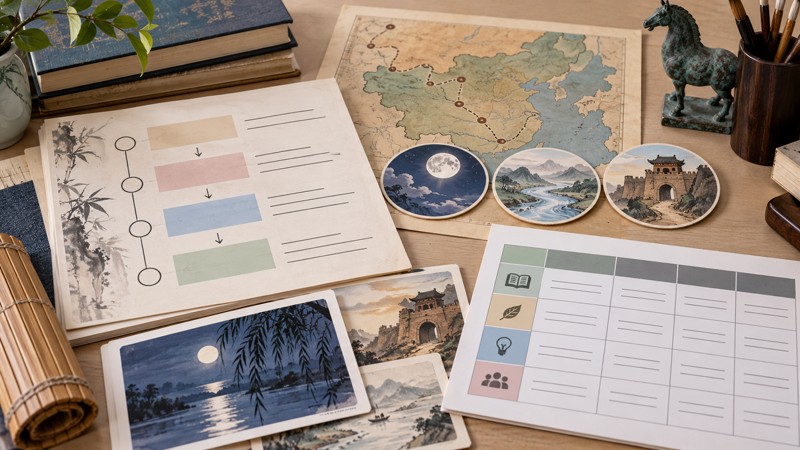
If you’ve ever wanted to teach or learn the timeless beauty of Chinese classical poetry, a well-structured Tang poetry lesson plan is your key to unlocking the works of Li Bai, Du Fu, and other iconic Tang Dynasty poets. This plan balances historical context, hands-on analysis, and cultural relevance to make Tang poetry accessible to learners of all levels, from high school students to adult enthusiasts.
Quick Answer
A Tang poetry lesson plan should guide students from literal wording to imagery, speaker, form, historical context, and personal response before asking for interpretation.
Basic Facts
- Teaching object: Tang poetry close reading
- Core layers: Text, image, speaker, form, allusion, and context
- Best classroom use: Read aloud, annotate, compare translations, and discuss evidence
- Common mistake: Turning the poem into a single moral summary
Quick reference: Tang poetry lesson plan = literal reading + image analysis + context + evidence-based interpretation + student response.
Unlike generic Western poetry lessons, it centers on the unique conventions of classical Chinese verse, ensuring learners grasp not just the words, but the spirit behind them.
What Tang Poetry Lesson Plan Means in Chinese Poetry
For Chinese poetry learners, a Tang poetry lesson plan is far more than a list of poems to study – it’s a framework that bridges the gap between modern understanding and the literary traditions of the Tang Dynasty (618–907 CE). Many beginners, especially those new to Chinese culture, mistakenly assume Tang poetry is just rhyming lines, but this is a narrow view.
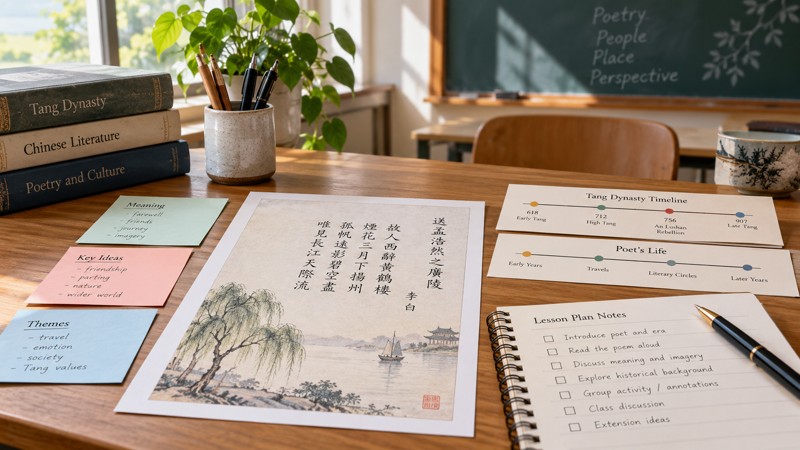
In reality, Tang poetry is built on strict tonal patterns, concise imagery, and themes tied to Confucian ethics, Buddhist philosophy, and the social dynamics of a prosperous empire. The lesson plan addresses this misunderstanding by structuring learning around core concepts: for example, distinguishing between jueju (four-line quatrains) and lüshi (eight-line regulated verse), two of the most common forms of Tang poetry.
A key part of the lesson plan is integrating cultural context with textual analysis. Unlike Western lessons that often focus solely on the poem’s form, Tang poetry lessons require learners to connect a poem’s lines to the poet’s life and the historical events of their time.
For instance, when teaching a poem by Du Fu, learners are encouraged to learn about the An Lushan Rebellion, a civil war that reshaped Tang society, to understand why his works shifted from celebratory to somber. This approach helps learners see poetry as a living record, not just an artistic exercise.
Another critical element is prioritizing emotional resonance. Tang poets used verse to express personal feelings, Tang Poetry Lesson Plan social critique, and even spiritual introspection – a universal quality that makes their works relatable to modern audiences.
The lesson plan guides learners to identify these emotions in the text, rather than just memorizing definitions or historical dates. For example, in Li Bai’s “Quiet Night Thought”, the line “The moonlight before my bed looks like frost” is not just a description of light; it’s a reflection of loneliness and longing, a feeling anyone can recognize.
This focus on emotion ensures that learners don’t just study poetry, but connect with it on a human level.
Historical and Cultural Background
The Tang Dynasty is widely regarded as the golden age of Chinese poetry, and a solid lesson plan must start with this historical context to help learners understand why Tang poetry achieved such prominence. During the Tang, the empire was politically stable, economically prosperous, and culturally diverse – conditions that allowed scholars, poets, and artists to thrive.
The imperial examination system, which selected officials based in part on their poetry skills, also encouraged people to master verse, leading to a surge in poetic creativity across all social classes. This context is essential because it explains why Tang poets were not just isolated artists, but part of a vibrant, intellectual community.
A pivotal historical event that shaped Tang poetry was the An Lushan Rebellion (755–763 CE), Tang Poetry Lesson Plan a devastating civil war that weakened the empire and changed the lives of countless poets. For example, Du Fu, one of the greatest realist poets of the Tang, lived through this rebellion, and his works from this period reflect the suffering of ordinary people, the destruction of cities, and the grief of displacement.
A lesson plan that includes this context helps learners understand why Du Fu’s “Spring View” – a poem about the ruined capital of Chang’an – is so powerful. It’s not just a poem about loss; it’s a historical document that captures the trauma of an empire in crisis.
Cultural practices also play a key role in Tang poetry. Many Tang poets were also scholars, calligraphers, and musicians, and poetry was often shared at social gatherings, like banquets or mountain retreats.
For example, Wang Wei, a landscape poet and Buddhist, often wrote poems while traveling in the mountains, blending his love of nature with his spiritual beliefs. A lesson plan can incorporate these practices by having learners write their own short poems, or study Tang calligraphy of classic poems, to experience the way poetry was integrated into daily life.
This immersive approach makes the lesson plan more engaging and helps learners connect with the culture behind the verse.
Key Poems, Poets, or Examples
To make the lesson plan concrete, Tang Poetry Lesson Plan it’s important to include well-known Tang poems that represent different styles and themes, each with clear context and learning takeaways. The four examples below are ideal for a beginner’s lesson, as they cover different poets, forms, and emotions.

First, Li Bai’s *Quiet Night Thought* (Jing Ye Si), written in 726 CE during his travels in Yangzhou. Li Bai (701–762 CE) is known as the “Poet Immortal” for his romantic, free-spirited verse.
This jueju (four-line quatrain) is one of the most famous poems in Chinese literature, with a simple yet profound message: homesickness. The original Chinese lines are: “床前明月光 / 疑是地上霜 / 举头望明月 / 低头思故乡” (Before my bed, bright moonlight / I suspect it’s frost on the ground / I lift my head to gaze at the bright moon / I lower my head and think of my hometown).
For learners, this poem teaches the power of concise imagery – a single word like “霜” (frost) evokes cold, loneliness, and the quiet of the night, all in one character. It’s perfect for beginners because it’s short, easy to memorize, and its emotion is universal.
Second, Du Fu’s *Spring View* (Chun Wang), written in 757 CE, during the An Lushan Rebellion. Tang Poetry Lesson Plan Du Fu (712–770 CE) is called the “Poet Sage” for his realistic, compassionate works.
This poem is an eight-line regulated verse (lüshi), a more complex form with strict tonal and rhyme rules. The lines describe Chang’an after it was captured by rebel forces: “国破山河在 / 城春草木深 / 感时花溅泪 / 恨别鸟惊心” (The state is broken, mountains and rivers remain / The city in spring, grass and trees are deep / Grief over time makes flowers shed tears / Sorrow at parting makes birds startle).
The poem’s power comes from its contrast between the beauty of spring and the destruction of the city, and Du Fu’s deep love for his country. For learners, this example teaches how poetry reflects historical trauma, and how a poet’s personal experience shapes their work.
Third, Wang Wei’s *The Deer Enclosure* (Lu Zhai), written in the mid-8th century. Wang Wei (701–761 CE) was a landscape poet and a Buddhist monk, known for his quiet, introspective verses.
This jueju is set in a secluded mountain forest: “空山不见人 / 但闻人语响 / 返景入深林 / 复照青苔上” (Empty mountain, no one is seen / Only the sound of voices is heard / Returning light enters the deep forest / Again shines on the green moss). The poem’s beauty lies in its use of negative space – the absence of people, the sound of voices, the light filtering through trees – to create a sense of peace and solitude.
For learners, this example teaches the concept of “jing yi” (scene and mind merged), a core principle of Tang poetry where the natural world reflects the poet’s inner state.
Fourth, Bai Juyi’s *Song of the Pipa* (Pi Pa Xing), written in 816 CE. Tang Poetry Lesson Plan Bai Juyi (772–846 CE) was a late Tang poet, known for his simple, accessible verse and social criticism.
This long narrative poem tells the story of a musician he meets on a river, who once played for the emperor but now lives in poverty. The poem’s lines describe her playing, her life story, and Bai Juyi’s reflection on their shared displacement: “同是天涯沦落人 / 相逢何必曾相识” (We are both wanderers in the world / Meeting need not mean we were friends before).
For learners, this example shows how Tang poetry can address social issues, and how narrative elements add depth to verse. It’s also useful for teaching longer forms, as it’s broken into stanzas that tell a complete story.
How to Read and Understand It
A Tang poetry lesson plan must include practical guidance for reading and understanding the poems, as many beginners struggle with the language and cultural nuances. First, learners should start with the original Chinese text, using pinyin (romanization) to pronounce the characters correctly.
Unlike English, classical Chinese has tonal patterns that are essential to the poem’s rhythm and meaning – for example, a rising tone vs. a falling tone can change a word’s meaning, or affect the poem’s flow.
A good lesson plan includes audio recordings of the poems being recited by native speakers, which helps learners master these tones and the natural rhythm of Tang verse.
Second, learners should read the poem slowly, line by line, and break down each character’s meaning. Tang Poetry Lesson Plan Tang poems are extremely concise, so each word carries significant weight.
For example, in *Quiet Night Thought*, the character “举” (lift) in “举头望明月” is not just a physical action – it’s a gesture of longing, as the poet reaches for the moon, a symbol of his hometown. The lesson plan encourages learners to keep a vocabulary notebook, noting key characters and their contexts, which helps build their understanding over time.
Third, it’s important to balance literal and interpretive meaning. Beginners often make the mistake of over-interpreting lines, adding modern ideas that the original poet didn’t intend.
A good lesson plan teaches learners to start with the literal meaning: what does each line say? Then, they can add context: who was the poet, what was happening in their life, and what cultural symbols are being used.
For example, the moon in Tang poetry is a common symbol of homesickness, so when Li Bai writes about the moon, learners don’t need to guess at its meaning – it’s a well-established cultural trope. This approach ensures that learners respect the original work while still engaging with it creatively.
Finally, learners should practice writing their own short Tang-style poems, using the jueju form, to experience the constraints and creativity of classical Chinese verse. Tang Poetry Lesson Plan This hands-on activity helps them understand why Tang poets chose certain words and structures, and it makes the lesson plan more interactive.
For example, a learner might write a four-line poem about their own experience of missing a friend, using the same concise imagery as Li Bai. This practice bridges the gap between reading and creating, deepening their understanding of Tang poetry.
Why It Still Matters Today
A Tang poetry lesson plan is relevant today because Tang poetry remains a vital part of global culture, connecting people across time and borders. For overseas Chinese, Tang poetry is a link to their cultural roots – many families teach classic poems to their children to help them feel connected to their heritage.
For example, a Chinese-American child learning *Quiet Night Thought* might not have been to China, but they can relate to the feeling of missing a loved one, making the poem a personal connection to their identity.
Cross-culturally, Tang Poetry Lesson Plan Tang poetry’s universal themes resonate with English-speaking audiences, even if they don’t understand the original Chinese. Poems like *Quiet Night Thought* or *Spring View* talk about love, loss, and beauty – emotions that are universal.
This makes Tang poetry a powerful tool for cross-cultural exchange, as it allows people to understand Chinese culture through a shared human experience. A lesson plan that emphasizes these universal themes helps learners see that poetry is not just a foreign art form, but a way to connect with others.
Educationally, Tang poetry teaches critical skills that apply to other areas of learning. Studying Tang poetry requires close reading, attention to detail, and historical context – skills that are valuable in literature, history, and even social studies.
For example, analyzing Du Fu’s *Spring View* helps learners understand the impact of war on ordinary people, which is a key topic in history classes. A lesson plan that integrates these skills makes Tang poetry more than just a literary study – it’s a way to develop broader critical thinking abilities.
Modern adaptations of Tang poetry also show its enduring relevance. Many classic Tang poems have been set to music, used in films, or shared on social media, reaching new audiences every day.
For example, the song *Quiet Night Thought* is a popular lullaby in China, and it’s been covered by artists around the world. This means that a Tang poetry lesson plan can connect learners to a living tradition, not just a dead historical artifact.
It shows that the beauty of Tang poetry is not just in its old words, but in the way it continues to speak to people today.
Frequently Asked Questions
What is the meaning of tang poetry lesson plan?
A Tang poetry lesson plan refers to an educational framework designed to teach students about the poetry of the Tang Dynasty (618-907 CE), one of China’s golden ages of literature. These lesson plans typically cover famous poets like Li Bai, Du Fu, Wang Wei, and Bai Juyi, focusing on understanding the forms, themes, and historical context of classical Tang poetry.
Who wrote tang poetry lesson plan and what is the historical context?
“Tang poetry lesson plan” is not a single work written by one author, but rather a modern educational concept. The Tang Dynasty poetry itself was composed by numerous renowned poets during a period of cultural flourishing in Chinese history. The lesson plans are developed by contemporary educators and scholars to help students engage with this classical literary tradition.
What literary devices are used in tang poetry lesson plan?
Tang poetry employs various literary devices including imagery, symbolism, parallelism, allusion, and regulated verse forms. Common techniques include Five-Character Regulated Verse (五言律詩) and Seven-Character Regulated Verse (七言律詩), as well as the use of contrasting imagery, nature symbolism, and subtle references to historical events and Buddhist/Taoist philosophy.
What is the cultural significance of tang poetry lesson plan?
Studying Tang poetry through lesson plans is culturally significant because it preserves and transmits one of the world’s greatest poetic traditions. These lessons help students understand Chinese aesthetics, philosophical thought, historical experiences, and the artistic achievements of a civilization that influenced East Asian culture profoundly. Tang poetry remains central to Chinese literary education and cultural identity.
How should tang poetry lesson plan be interpreted?
Tang poetry lesson plans should be interpreted as gateways to understanding classical Chinese literature and culture. Students should approach them with attention to the poets’ intentions, the historical circumstances of composition, the technical aspects of form and language, and the emotional resonance of the verses. Effective interpretation combines scholarly analysis with personal appreciation of the poetry’s beauty and depth.
How to Read Quiet Night Thought: Meaning and Background Chinese Poetry In English: Major Poets, Poems and Legacy Poem Interpretation Example: 7 Hidden Meanings You Missed at Wikipedia