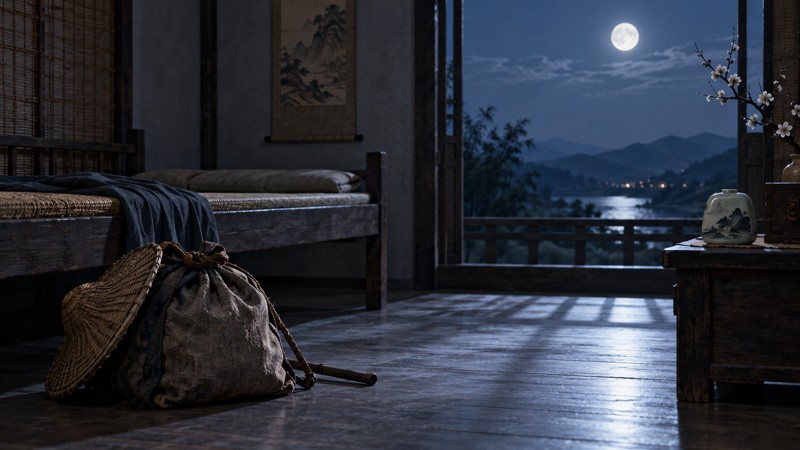
Quiet Night Thought is a poem that transcends time and borders, serving as a gentle gateway for millions to explore the depth of Tang Dynasty poetry. For many new to classical Chinese verse, this short, intimate work feels like a personal conversation with Li Bai, the legendary “Immortal Poet” of the 8th century, whose nomadic life gave voice to universal feelings of loneliness and longing.
What Quiet Night Thought Means in Chinese Poetry
In Chinese literary tradition, “quiet night thought” (jingye si) refers to a specific genre of introspective verse set during the stillness of night, when the noise of daily life fades and inner emotions surface. Unlike Western poetry that often leans into dramatic soliloquies or external conflict, Tang quiet night poems rely on subtle, sensory imagery—moonlight, frost, distant bells, or the rustle of trees—to convey emotion without explicit declaration.
Beginners frequently misunderstand this genre as merely “homesick poetry,” but its core lies in capturing the fragile, fleeting moments of human connection to place and memory.
Take Li Bai’s Quiet Night Thought: every line is a small, observable detail. The moonlight on the bed, mistaken for frost, is a moment of disorientation in the quiet dark; the act of raising one’s head to gaze at the moon links the immediate space to a larger, shared celestial symbol (the moon as a universal mirror for longing).
This simplicity is intentional—Tang poets believed that the most profound emotions could be expressed through ordinary scenes, avoiding flowery language that would distance readers from the truth of the feeling.
For Chinese readers, this poem is not just a work of literature but a cultural touchstone. It is memorized in primary schools across China, recited at family gatherings, and referenced in everyday conversation when someone misses home.
This cultural embedding means that quiet night thought is not limited to a single poem, but a recurring theme in Tang verse that unites poets across centuries in their exploration of solitude and belonging.
Historical and Cultural Background
The Tang Dynasty (618–907 CE) was a period of unprecedented expansion and cultural vibrancy, which led many poets to leave their hometowns for extended periods. For aspiring scholars, traveling to the capital (Chang’an, modern Xi’an) was necessary to take the imperial exam, the path to official status.
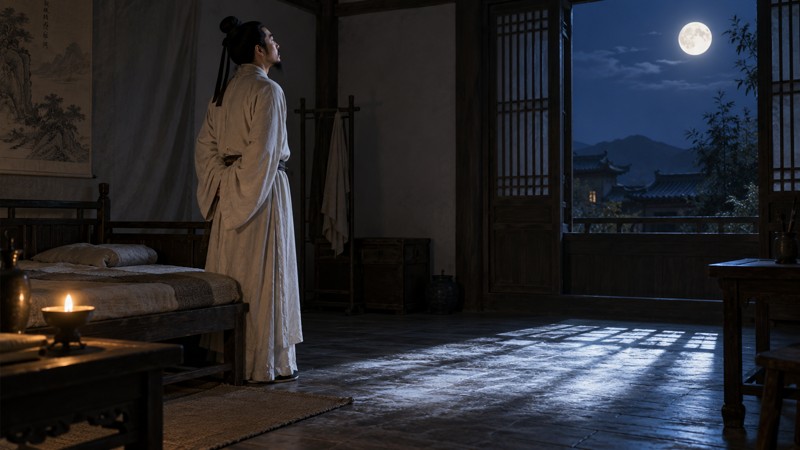
For poets like Li Bai, who rejected formal office, travel was a way to seek inspiration and freedom. These years of wandering meant that homesickness was a constant companion for many Tang poets, giving rise to a rich body of verse centered on quiet night reflection.
Li Bai wrote Quiet Night Thought in 726 CE, when he was 25 years old, traveling in Yangzhou (a bustling commercial city in modern Jiangsu province) after leaving his hometown in Sichuan. At the time, he was away from his wife, whom he had married the year before, and his extended family.
His nomadic lifestyle—he would spend decades moving between different regions, never settling long—meant that he experienced loneliness deeply, and this poem captures a specific, intimate moment of that loneliness.
In Tang literary circles, the “quiet realm” (qingjing) was highly valued as a space for self-cultivation and reflection. Poets would often retreat to mountains, forests, or quiet villages to write, using the stillness to sharpen their observations.
This cultural emphasis on quiet introspection is why night scenes are so common in Tang poetry: the darkness removes distractions, allowing poets to confront their emotions directly. Li Bai’s choice to set Quiet Night Thought in a simple bedroom, not a grand landscape, reflects this focus on personal, internal experience.
Key Poems, Poets, or Examples
Li Bai’s *Quiet Night Thought* (726 CE, Tang Dynasty). The original is a five-character jueju (four-line fixed-form poem): “床前明月光,疑是地上霜。举头望明月,低头思故乡.” Literally translated, this reads: “Before my bed lies bright moonlight, I think it’s frost on the ground.
I raise my head to look at the bright moon, then lower it and think of my hometown.” What readers learn here is that Li Bai uses minimal, everyday imagery to convey profound emotion—no complex metaphors, just a single moment of disorientation and longing. This makes the poem accessible, even to those unfamiliar with Chinese culture, as the feeling of missing home is universal.
Du Fu’s *Spring View* (757 CE, Tang Dynasty). Du Fu, often called the “Poet-Historian,” wrote this during the An Lushan Rebellion, when rebel forces occupied Chang’an.
The lines: “国破山河在,城春草木深。感时花溅泪,恨别鸟惊心.” Meaning: “The country is broken, but mountains and rivers remain; the city in spring is overgrown with grass. Grief over time makes flowers shed tears; sorrow at separation makes birds startle.” This example shows that quiet night thought is not just personal—Du Fu’s poem, written in a war-torn city, uses the quiet of spring to amplify collective grief.
Even in crisis, stillness lets the weight of loss feel more acute.
Wang Wei’s *Deer Enclosure* (731 CE, Quiet Night Thought Tang Dynasty). Wang Wei, a poet-painter, wrote this during his seclusion in the Wangchuan mountain villa.
The poem: “空山不见人,但闻人语响。返景入深林,复照青苔上.” Meaning: “An empty mountain, no one to see, only the echo of voices. The setting sun’s light enters the deep forest, shining again on the green moss.” This adds depth to the quiet night theme: it is not just loneliness, but solace.
Wang Wei’s poem uses quiet nature to show solitude can be a space of peace, connecting with the natural world rather than feeling isolated.
Zhang Ji’s *Night Mooring by the Maple Bridge* (756 CE, Tang Dynasty). Zhang Ji wrote this while mooring his boat outside Suzhou, after failing the imperial exam.
The lines: “月落乌啼霜满天,江枫渔火对愁眠。姑苏城外寒山寺,夜半钟声到客船.” Meaning: “The moon sets, crows cry, frost fills the sky; river maples and fishing lights accompany my sorrowful sleep. Outside Suzhou’s Hanshan Temple, the midnight bell reaches my passenger boat.” This ties together travel, failure, and quiet longing—core to quiet night thought.
The poem uses night sounds (crows, bells) and sights (frost, fishing lights) to make disappointment tangible, showing how quiet moments amplify personal struggle.
How to Read and Understand It
To read Tang quiet night poems effectively, start with their form. Most are jueju, a short, tightly structured form with strict rhythm and line length.
For Li Bai’s Quiet Night Thought, the five characters per line create a breath-like rhythm, mirroring the slow pace of a quiet night. When reading aloud, emphasize pauses between lines to capture stillness—do not rush, as each line is a small, meaningful step in the emotional journey.
Translation is a key challenge, as subtle Chinese nuances are often lost in English. For example, “疑是地上霜” does not just mean “it’s frost”—it captures the half-asleep traveler’s surprise at mistaking moonlight for cold, a moment of disorientation central to the poem’s adrift feeling.
To avoid missing this, compare multiple translations: Ezra Pound’s famous version simplifies imagery, while Arthur Waley’s retains more original subtlety.
Context is essential for deep understanding. For Du Fu’s *Spring View*, knowing he was in a war-torn city, separated from family, makes grief feel real.
For Zhang Ji’s poem, understanding he failed the imperial exam adds layers to his sorrow. Beginners should start with famous works like Quiet Night Thought, then explore others, researching poets’ lives and historical contexts to connect words to human experience.
This practice turns a simple poem into a window into another time and emotion.
Why It Still Matters Today
In a world of constant digital noise, the quiet night thought genre offers a timeless space for reflection. The feeling of longing for home or a simpler time is as relevant now as in the Tang Dynasty.
Whether a student abroad, a worker away from family, or anyone isolated in a busy city, these poems capture quiet moments when we pause and think of what we miss. They remind readers that solitude does not have to be empty—it can be a chance to confront what matters most.
Cross-culturally, Tang quiet night poems bridge East and West. Western readers unfamiliar with Chinese still connect with universal emotions: loneliness, homesickness, the beauty of a quiet night.
Li Bai’s Quiet Night Thought is taught globally, introducing classical Chinese culture in an accessible way that transcends language barriers. This makes the genre a powerful tool for cultural exchange, showing that human experiences are shared across centuries and borders.
For overseas Chinese communities, these poems link to heritage. Many second-generation Chinese-Americans learn Quiet Night Thought from parents, using it to connect with their roots.
This shows Tang poetry is not a historical artifact—it is a living part of modern identity, passed down through generations. It also teaches empathy: understanding Li Bai’s wanderlust or Du Fu’s grief helps readers relate to others’ struggles, regardless of background.
Frequently Asked Questions
What is the meaning of quiet night thought?
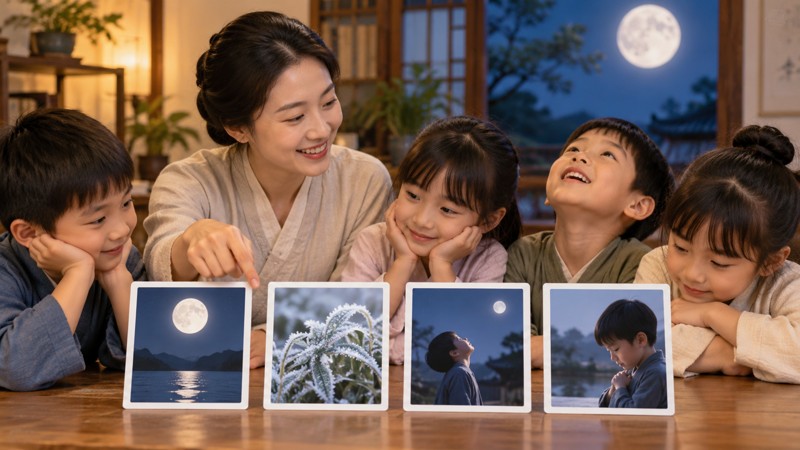
“Quiet Night Thought” (静夜思) by Li Bai describes the poet looking at the bright moonlight on a quiet night, feeling homesick and missing his homeland. The moon serves as a symbol of reunion and nostalgia, while the frost on the ground represents the coldness of separation from family.
Who wrote quiet night thought and what is the historical context?
Li Bai wrote “Quiet Night Thought” during the Tang Dynasty (618-907 CE), likely while traveling away from his hometown in Suiye (present-day Kyrgyzstan). The poem was composed around 726 CE when Li Bai was in his mid-twenties, serving as a wandering poet-scholar seeking official position.
What literary devices are used in quiet night thought?
The poem employs several literary devices including: personification (the moonlight “comes” to the poet), imagery (bright moonlight, frost on the ground), symbolism (moon as思念 symbol), and parallel structure. The simple yet profound imagery creates a clear visual picture while expressing deep emotional resonance.
What is the cultural significance of quiet night thought?
This poem has become one of the most memorized Chinese poems worldwide, representing the enduring Chinese cultural value of cherishing family bonds and homeland. It captures the universal human experience of longing for home during times of separation, making it relatable across generations and cultures.
How should quiet night thought be interpreted?
The poem should be interpreted on multiple levels: literally as a description of a peaceful night scene, and metaphorically as an expression of homesickness and the human condition. The final two lines, where the poet raises his head to look at the moon then lowers it thinking of home, show the cyclical nature of longing and how natural beauty can trigger emotional reflection.
Chinese Poetry Translation: Major Poets, Poems and Legacy Poem Maker Online: 6 Hidden Meanings You Missed at First Rea Ancient Chinese Poetry: Major Poets, Poems and Legacy Wikipedia