For an introduction to medieval Chinese poets before the Tang, start with Tao Yuanming (陶渊明/陶淵明) and Xie Lingyun (谢灵运/謝靈運). Reading a short passage from each gives you something more useful than a list of names: two different ways that attention to a landscape can organize a poem.
This is a focused early-medieval starting point, not a complete roster of poets covered by every use of the word “medieval.” Below, the Chinese excerpts are linked to their texts. The Mandarin pinyin supports modern reading aloud; it does not reconstruct the pronunciation of their period. The English glosses are original teaching translations for this guide, not quotations from a published English translator.
Place these poets in their source context
Do not assume that an English historical label gives Chinese literary history exactly the same boundaries as European history. This guide identifies its scope through the authors and texts it actually discusses. Both poets wrote before the Tang dynasty.
The contents of Columbia University Press’s Classical Chinese Literature: An Anthology of Translations place Tao Yuanming and a chapter on Xie Lingyun and Bao Zhao in its Han-and-Disunion section, before the separate Sui, Tang and Five Dynasties section. Early Medieval Chinese Texts: A Bibliographical Guide also includes an entry on the Xie Lingyun collection. These are useful orientation points, not a claim to have reproduced either book’s complete discussion.
Swipe or scroll horizontally to see all columns.
| Poet | Text used here | Passage to notice | Reading question |
|---|---|---|---|
| Tao Yuanming | “Drinking Wine,” no. 5, from 饮酒二十首 | Picking chrysanthemums and seeing the southern mountain | How does a small action lead into a wider view? |
| Xie Lingyun | 登池上楼/登池上樓 | Spring grass, a pond and birds among willows | How does seasonal change become visible and audible? |
Tao Yuanming: follow the movement of attention
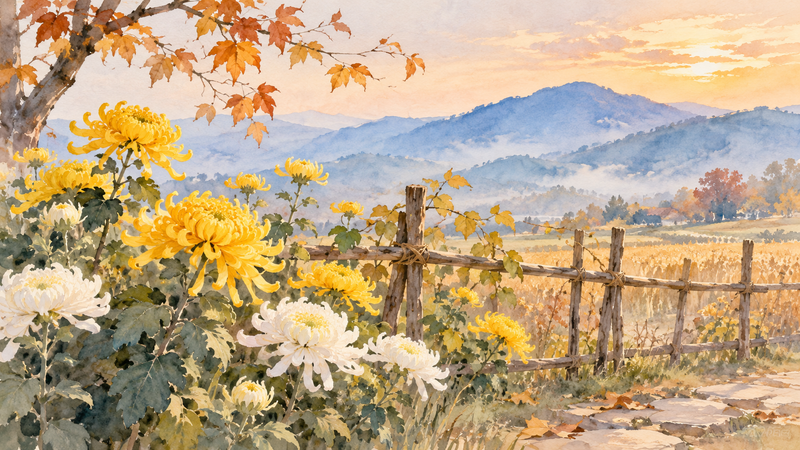
In the fifth poem of Drinking Wine, the speaker first describes living among people without the noise of carriages and horses. The poem connects that condition with the mind being distant. The following couplet then moves from an action close at hand to a mountain in view:
採菊東籬下,悠然見南山。
Cǎi jú dōng lí xià, yōu rán jiàn nán shān.
Teaching gloss: Picking chrysanthemums beneath the eastern fence, I calmly see the southern mountain.
Read the action and the view together. The line does not require a long account of a journey before the mountain appears. In this passage, a change in attention is enough to widen the scene. “Calmly” is one way of giving an English learner an entry into 悠然; it is not an assertion that a single English adverb captures every nuance.
The full poem continues with evening mountain air and returning birds. Keep reading past the famous couplet instead of treating it as an isolated instruction to live in the countryside. The speaker’s words are literary evidence for the poem; they do not by themselves prove the exact location, date or emotional circumstances of every moment in the poet’s life.
Xie Lingyun: notice a changing season
The linked text of 登池上樓, a title rendered here as “Ascending the Tower by the Pond,” begins before its familiar spring scene. The speaker describes difficulty with public life and withdrawal, illness, and a period of limited awareness of seasonal change. Then looking and listening bring the surroundings into focus.
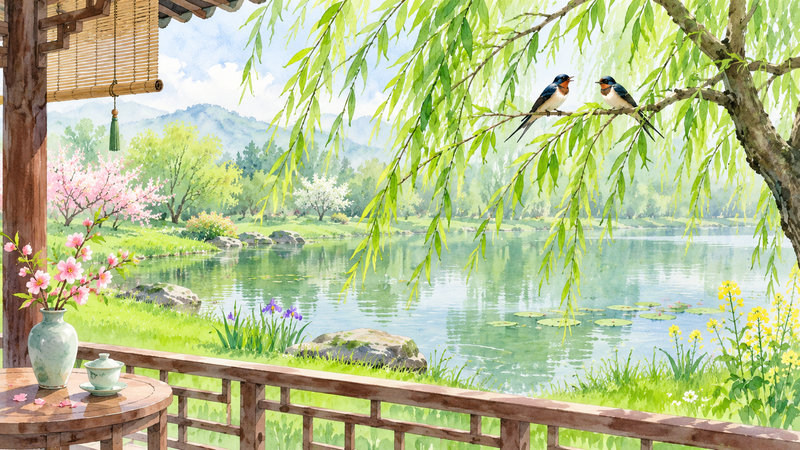
池塘生春草,園柳變鳴禽。
Chí táng shēng chūn cǎo, yuán liǔ biàn míng qín.
Teaching gloss: Spring grass grows around the pond; among the garden willows, the singing birds change.
Compare the sensory details: grass becomes visible, while the birds add sound and the sense of a changing season. The second line is compressed; the gloss opens it out for a learner. It is not saying that willow trees literally transform into birds. Keep the whole couplet and its surrounding passage in view when comparing translations.
The poem does not stop at a pleasant spring picture. Its later lines return to the difficulty of living apart from others and maintaining one’s resolve. That movement is why a simple label such as “nature poetry” can be an introduction but should not replace reading the full poem.
Compare the passages without flattening the poets
In these excerpts, Tao’s small act opens onto a broader view; Xie’s scene makes a newly perceived season visible and audible. That is a comparison of two passages, not a rule that every poem by Tao is effortless or every poem by Xie is elaborate. A larger conclusion about either writer requires a larger selection of work.
Try reading the lines once for objects and again for actions. In Tao’s couplet, note picking and seeing. In Xie’s, note growing and changing. Then ask what the surrounding poem does with those perceptions. This keeps your interpretation tied to language rather than to a generic painting of a scholar beside mountains.
Keep a source note beside your reading
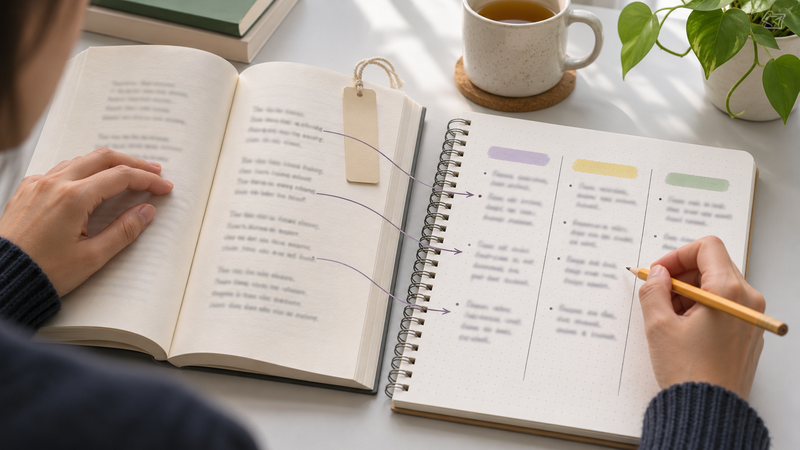
Record the author, Chinese title, poem number when relevant, source link and the exact lines you are discussing. For Tao, “Drinking Wine” alone is incomplete because the linked sequence contains twenty poems. Adding “no. 5” makes your reference useful to another reader.
Keep original text, pronunciation help and interpretation in separate lines of your notes. If a translation adds an explicit “I” or expands a compressed image, identify that as an English rendering choice. Our guide to learning one Chinese poem offers a practical reading routine. For the broader educational and artistic reasons to read these works, see the importance of Chinese poetry.
Begin with these two complete poems, even if you study only a couplet closely at first. The aim is to recognize each voice in context before enlarging the reading list. An author name becomes much easier to remember once you can point to a particular action, image and question in the text.