The importance of Chinese poetry lies in what people did with it: they studied it, used it in social exchanges, shaped personal experience into verse and combined it with visual art. These roles changed across periods. The Book of Songs in the Analects, Tang examination poetry and later poetry inscribed on paintings belong to related traditions, but they are not one unchanged practice.
For an English-language reader, that distinction makes individual poems more rewarding. A farewell poem can be an act between friends, not just a description of a boat. A poem about spring can hold fear and separation rather than seasonal celebration. Understanding a work’s use helps explain why its images, form and wording mattered—and prevents the claim that every Chinese person understood every poem in the same way.
Four cultural roles in context
| Role | Specific evidence | Useful boundary |
|---|---|---|
| Education | The Analects connects the Odes with reflection and social understanding. | It discusses the Book of Songs, not all later verse. |
| Public and social life | Tang examination composition and poems exchanged on visits or departures | Literary skill was not a guarantee of office or equal access. |
| Expression | Du Fu’s Spring View sets spring growth beside disruption and separation. | A poem is a shaped perspective, not a complete historical report. |
| Visual art | Poetry, calligraphy and painting interact in scholar-art traditions. | Not every inscription is a poem or the painter’s own writing. |
Education and cultivated attention
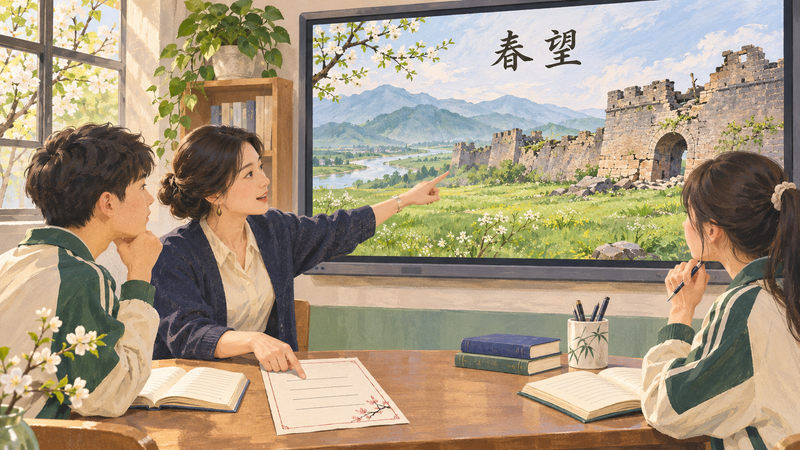
In the Analects, book 17, Confucius is represented as explaining that study of the Odes supports reflection, social relations and the expression of discontent. The passage also mentions learning the names of animals and plants. Its subject is the Book of Songs, an early collection, rather than a prediction about every poem written afterward.
This gives a concrete answer to “Why study poetry?” A reader attends to language, situations and relationships through particular words and images. It does not establish that memorizing a certain number of poems automatically produces moral virtue or measurable cognitive gains. For the early text’s particular role, our Confucius and Chinese poetry guide develops the context.
Examinations and social exchange
Columbia’s Asia for Educators introduction to Tang poetry explains that poetry composition became an examination requirement. It also distinguishes formal examination verse from poems written for visits, gatherings and farewells. Those settings help explain why literary accomplishment could matter beyond private enjoyment.
The scope matters: this is an account of educated Tang social life, not proof of universal literacy or an examination route open on equal terms to everyone. Poems could help people participate in networks, yet no single poem guaranteed a government post. When reading a farewell, ask who is addressing whom and what occasion gives the words their force.
A poem makes experience particular
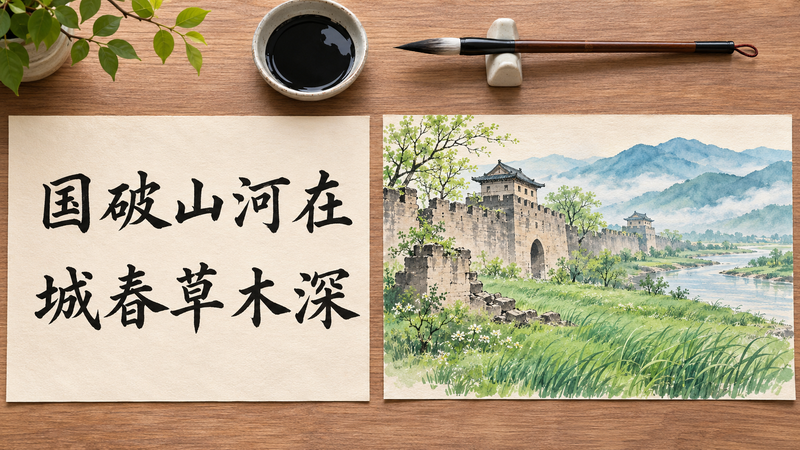
Du Fu’s 春望 (Chūn Wàng, “Spring View”) begins with a striking contrast. The public transcription preserves these opening lines:
国破山河在,城春草木深。
Guó pò shān hé zài, chéng chūn cǎo mù shēn. An original explanatory translation: “The state is shattered; mountains and rivers remain. Spring in the city: grasses and trees grow thick.” The source notes a textual variant for 春; this reading follows the displayed main text.
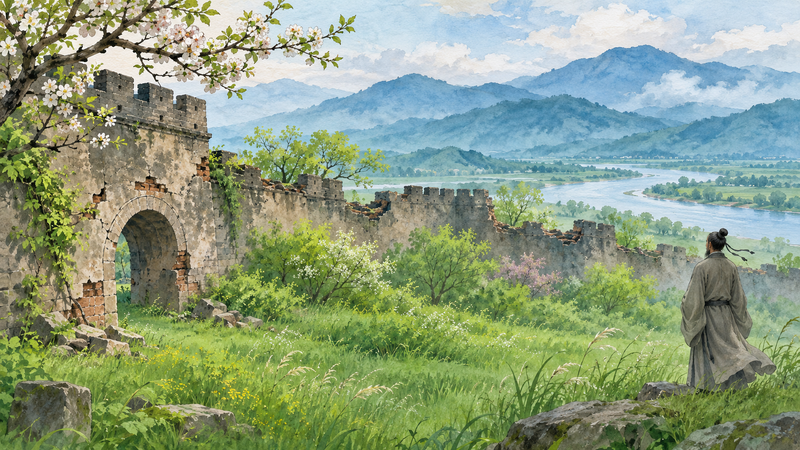
Natural continuity does not cancel human disruption. The next couplet brings flowers, tears, birds and the shock of separation into the same spring setting. That tension is a reason to read the poem itself: a summary such as “Du Fu felt sad” loses the relationship between the enduring landscape and the damaged human world. This is a close-reading observation, not a claim that a poem supplies a complete record of events.
Poetry within painting and calligraphy
In The Metropolitan Museum of Art’s account of Chinese painting, scholar-artists combine poetry, calligraphy and painting as the “three perfections.” Words and brushwork can contribute to the meaning of an image. A viewer therefore needs to notice the writing, rather than treat it only as decoration.
The same essay explains that later owners and admirers could add responses and seals. Consequently, writing on an artwork may belong to more than one moment or person. Check an object’s catalogue description before identifying an inscription as the artist’s poem. Nor should a modern illustration of a poem be presented as an original historical painting. The image below is explicitly a new teaching illustration.
When viewing an actual work, first read its museum label: identify the artist, date, medium and any separately attributed inscription. Then compare the poem’s image with the painted scene and the placement of the writing. Agreement may be suggestive; it does not make every mountain or flower a fixed symbol with one universal interpretation.
Read one poem through its purpose
Start with an identified text and author, then ask what the poem is doing: addressing a friend, registering disruption, exploring a landscape or responding to another work. Quote a short passage before explaining your reading. Keep a translator’s wording separate from your own paraphrase, and note a variant when it changes the argument.
For a longer example, continue with Du Fu’s Spring View. The cultural importance of Chinese poetry becomes tangible in that process: a small number of lines connects language, feeling and social experience without reducing them to one slogan.
Source note: the linked Analects translation, Columbia teaching transcripts, Met essay and Spring View transcription were checked November 13, 2026. The English rendering and close reading here are original explanatory work. Illustrations are modern interpretations.