Li Bai’s Chinese moon poem for Wang Changling is 《闻王昌龄左迁龙标遥有此寄》, a four-line poem that entrusts the speaker’s worried heart to the bright moon. Its subject is concern for a distant friend. If you remember “我寄愁心与明月,” this is the poem to look for, rather than Quiet Night Thought or a scene of drinking with a shadow.
The long Chinese title supplies a useful starting point: Li Bai has heard of Wang Changling’s demotion to Longbiao and sends this poem from afar. The movement is from hearing news to imagining companionship across distance. The moon matters because of what the speaker asks it to carry, not because moonlight always has one fixed meaning in Chinese poetry.
Below are the Chinese text, pinyin and an original English reading. The version used here has 随风, “with the wind,” in its last line; a recorded variant has 随君, “following you.” Keep that difference visible when comparing translations.
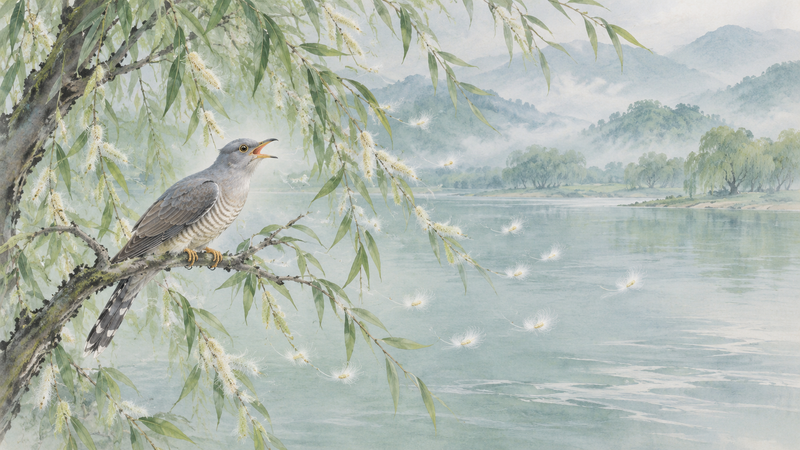
Read the Chinese text and pinyin
闻王昌龄左迁龙标遥有此寄 — 李白
Wén Wáng Chānglíng zuǒqiān Lóngbiāo yáo yǒu cǐ jì
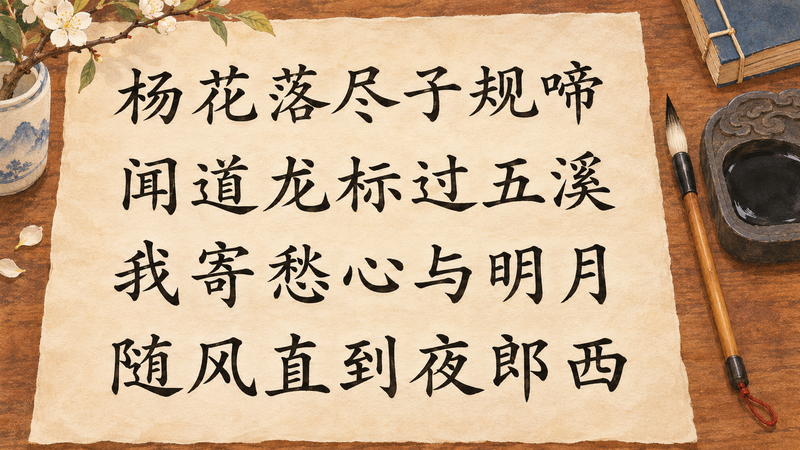
杨花落尽子规啼,
闻道龙标过五溪。
我寄愁心与明月,
随风直到夜郎西。
Yáng huā luò jìn zǐ guī tí,
Wén dào Lóngbiāo guò Wǔxī.
Wǒ jì chóu xīn yǔ míng yuè,
Suí fēng zhí dào Yèláng xī.
The poetry reading list hosted by Zhejiang Normal University, item 121 on page 26, prints this wording. The Wikisource transcription records variants in the first and last lines. Our display uses simplified characters; that transcription uses traditional characters.
An original English reading
The willow fluff has fallen; cuckoos cry.
I hear you, bound for Longbiao, have passed the Five Streams.
I entrust my worried heart to the bright moon:
with the wind, all the way west of Yelang.
This is our own English rendering of the displayed text, not a quotation from a published translator. “You” in line two makes the friend explicit for an English reader. “Worried heart” keeps the feeling in 愁心, while “entrust” gives 寄 an action. The final line leaves the imagined movement close to the Chinese instead of adding a promised safe arrival.
Translation involves choices even in twenty-eight characters. A rhymed English poem might sound more finished, but it could also require words that the Chinese does not contain. For a first reading, follow the changing action: a sound in the landscape, news of a friend, the giving of a feeling, and a wish that it travel far.
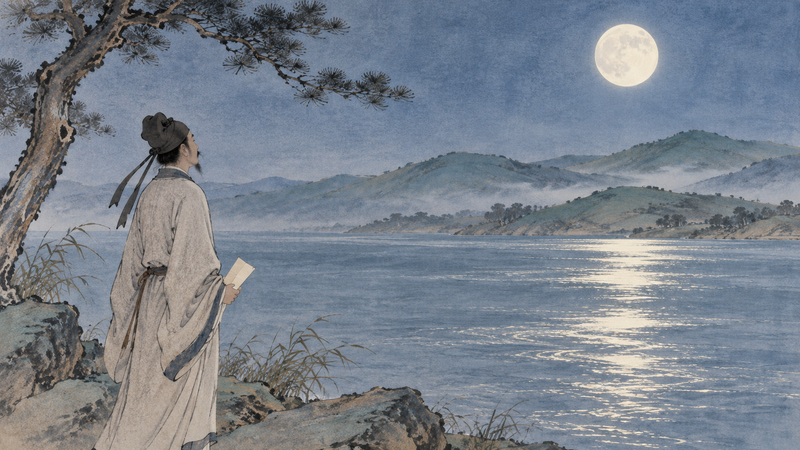
Meaning: notice what the speaker does
| Wording | Plain reading | What to notice |
|---|---|---|
| 杨花落尽 / 子规啼 | Willow fluff has fallen; cuckoos call | The opening is heard as well as seen |
| 闻道 | I hear that… | The speaker receives news from a distance |
| 我寄愁心与明月 | I entrust my worried heart to the bright moon | A feeling is imagined as something that can be sent |
| 随风直到 | With the wind, reaching all the way | The sentence pushes beyond the speaker’s immediate setting |
A useful close-reading question is not simply “What does the moon symbolize?” Ask instead: “What becomes possible when the speaker gives the moon his feeling?” In this reading, the image lets care move where the speaker cannot personally accompany the friend. That is a claim about the poem’s imaginative action, not evidence that Li Bai believed a celestial body could deliver a literal message.
The place names also resist a purely decorative reading. They give the feeling a direction and a distant destination. This short guide does not turn them into a precise modern itinerary or settle historical debates about geographical identification. The emotional movement remains legible without adding an unsupported travel map.
Version context: 随风 and 随君
随风 directs attention to the wind; 随君 brings the friend directly into the last line. The Wikisource transcription marks 君 as an alternate reading at that point. Therefore, an English version that says “follow you” may be responding to a different Chinese text, rather than carelessly mistranslating the version displayed above.
When placing two English translations side by side, put the Chinese last line above each one. Check the base wording before evaluating style. If you copy a version for a class, record its translator and edition as well. Do not silently combine the first half of one translation with the ending of another and attribute the mixture to Li Bai.
Try a two-minute reading exercise
Read the poem once for sound and once for action. On the second pass, underline 闻道 and 寄. Then write one English sentence explaining the difference between receiving news and sending concern. A possible original response is: “He hears about his friend’s difficult journey and imagines the moon carrying the feeling he cannot deliver in person.”
For another moon setting, use our Quiet Night Thought page. The Táo Yāo reading offers a different exercise in identifying the speaker, occasion and image. Carry over the method of reading a particular text, rather than assuming that a shared image or a familiar author gives every poem the same emotion.
A version question
Is “我寄愁心与明月” from Quiet Night Thought?
No. It is the third line of the poem addressed from afar to Wang Changling. Quiet Night Thought is a different poem. Identify the remembered Chinese line before selecting an English title.
Text and interpretation: Chinese wording follows the university-hosted list, with variants checked against the linked transcription. Pinyin, English rendering, interpretive questions and exercises are editorial work here. No exact composition date, verified portrait or definitive modern route is claimed.