A Chinese poem about love and marriage can celebrate a household rather than describe a private romance. 桃夭 (Táo Yāo), from the Shijing’s Zhou Nan section, is a short marriage poem built around a peach tree: blossoms, fruit and leaves accompany a repeated wish for harmony at home. It is an anonymous early poem, not a work by a named Tang poet. For someone choosing a marriage reading, its difference from a poem about separation matters more than how familiar one attractive line sounds.
The Ministry of Education dictionary entry identifies the collection and its three stanzas, and records its connection with congratulating a bride. Below, the Chinese follows the National University of the Arts teaching text. The English is an original explanatory rendering for this article; the pinyin is modern Mandarin, not reconstructed ancient pronunciation.
Read the marriage poem in context
| Text detail | What it establishes | What it does not establish |
|---|---|---|
| Title: 桃夭 / Táo Yāo | A poem in Shijing, Zhou Nan | A named Tang author or a documented personal wedding |
| Three repeated stanzas | Blossoms, fruit and leaves provide changing images | A literal diary of one tree across a single wedding day |
| 之子于歸 | A woman entering marriage in the received reading | A gender-neutral modern vow word for word |
| 室家 / 家室 / 家人 | The ending turns toward home and household | A promise that poetry ensures a successful marriage |
Read the entire short text before choosing it for a ceremony. Its emotional centre is a public wish for a shared life, rather than a speaker asking a distant lover to return. A modern couple may welcome that emphasis, or may prefer a more individual voice. Either choice begins with recognizing what the old wording says.
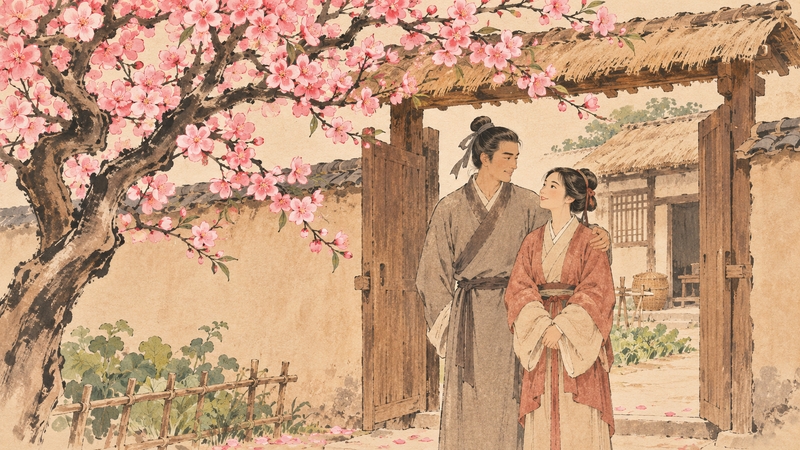
First stanza: blossoms and a new household
桃之夭夭,灼灼其華。
之子于歸,宜其室家。
Táo zhī yāo yāo, zhuó zhuó qí huā.
Zhī zǐ yú guī, yí qí shì jiā.
Original English reading aid: “The peach tree grows fresh and flourishing, its blossoms bright. This woman goes to marry; may she bring harmony to her home.” The word “may” makes the blessing audible in English; it is an interpretive choice rather than a separate Chinese word in the line. Here 華 is read huā, referring to flowers.
Notice the sequence. First comes something visible outside: a young, flowering tree. Only then does the poem turn to the person marrying. The link lets the reader experience brightness and vitality before meeting the household wish. The poem does not need a description of jewellery, a banquet or a palace to create celebration.
于歸 should not be translated casually as “comes back home.” In this marriage context, 歸 concerns a woman marrying. That historical direction matters. A modern English adaptation can speak of two people making a home, but it should be credited as an adaptation; the change should not be presented as a literal translation of the old social arrangement.
Second stanza: fruit changes the image
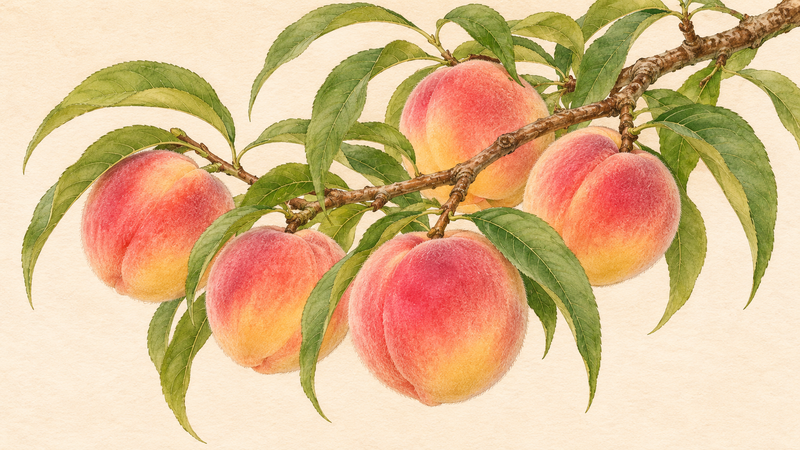
桃之夭夭,有蕡其實。
之子于歸,宜其家室。
Táo zhī yāo yāo, yǒu fén qí shí.
Zhī zǐ yú guī, yí qí jiā shì.
Original English reading aid: “The peach tree grows fresh and flourishing, abundant in its fruit. This woman goes to marry; may she bring harmony to her household.” 實 here means fruit; 蕡 is read fén in this line. Replacing the blossoms with fruit gives the second stanza its own material image while the marriage refrain remains recognizable.
A reader may connect fruit with flourishing family life. Keep that interpretive association separate from instructions to a modern couple. The lines do not specify a number of children, promise fertility or prescribe a life plan. If a ceremony audience might hear the image as pressure to have children, discuss that openly before choosing this stanza.
Third stanza: leaves and the people at home
桃之夭夭,其葉蓁蓁。
之子于歸,宜其家人。
Táo zhī yāo yāo, qí yè zhēn zhēn.
Zhī zǐ yú guī, yí qí jiā rén.
Original English reading aid: “The peach tree grows fresh and flourishing, its leaves thick and full. This woman goes to marry; may she bring harmony among the people of her home.” The final 家人 makes the household’s people explicit. The English expands the line to show that relational emphasis; it does not attempt to preserve the ancient metre.
The three endings are easy to flatten into the same English phrase. Reading them aloud in Chinese preserves the movement from 室家 to 家室 and then 家人. The tree changes too, from blossom to fruit to full foliage. Repetition is doing two jobs: holding the blessing steady and allowing the image to develop.
There is also a limit to the comparison. A plant does not explain a marriage. The poem offers an image and a wish; it cannot settle how partners share decisions, care work or responsibilities. Modern readers can appreciate the language while discussing those matters in their own terms.
Prepare a reading without mislabelling the poem
For a short reading, introduce it as “Táo Yāo, an anonymous marriage poem from the Shijing.” If using only the first stanza, say it is an excerpt. A bilingual programme can print the Chinese, a credited English version and a brief explanation of the household blessing. Practise the modern Mandarin with a fluent reader if pronunciation is unfamiliar; a slow, clear delivery serves the repetition better than rushing.
Choose the translation with the couple. An original adaptation such as “May the home you make together flourish” may suit their values, but those words are not a quotation from the ancient Chinese. Put “adapted from Táo Yāo” beside them. Do not attribute the adaptation to Confucius, Li Bai or an unidentified “ancient Chinese proverb.”
For a different emotional register, compare the courtship, vow and separation in three ancient Chinese love poems. For the collection behind this work, continue with Shijing and Chu Ci. These comparisons help keep a marriage blessing distinct from a love poem whose ending is unresolved.
Questions about Táo Yāo
Is Táo Yāo a Tang dynasty poem?
No. It belongs to the earlier Shijing collection, in the Zhou Nan section. Its author is not identified in the cited teaching text.
Can I use only the opening stanza?
You can choose an excerpt for a reading, clearly label it as such and identify the English translator or adapter. Read all three stanzas first so the chosen lines retain their context.
Does it describe a modern equal partnership?
The received wording addresses a woman marrying and entering a household. A couple can discuss or adapt that framing, but an adaptation should be distinguished from a literal rendering.