There is no objective list of the most beautiful Chinese poetry. A useful starting selection is Wang Wei’s Deer Enclosure, Yang Wanli’s Little Pond, and Li Shangyin’s Night Rain, Sent North. Each offers a different pleasure: something heard but unseen, a tiny detail noticed at just the right moment, and an unhappy present imagined as a future memory.
Read these poems as three invitations, not a ranking. The traditional Chinese texts below follow Hong Kong Education Bureau reading materials, linked beside each poem. The English versions are new prose translations prepared for this article; they aim to make the scenes understandable without pretending to reproduce the Chinese rhyme and rhythm. The pictures are imagined responses to the texts, not records of places as the poets saw them.
Choose the kind of beauty you want to notice
| Poem and poet | First thing to notice | What changes on rereading |
|---|---|---|
| 鹿柴 — 王維 Deer Enclosure — Wang Wei |
Voices without visible speakers | A small patch of light makes the surrounding forest feel deeper. |
| 小池 — 楊萬里 Little Pond — Yang Wanli |
A dragonfly on a young lotus leaf | The spring and tree shade seem to have feelings. |
| 夜雨寄北 — 李商隱 Night Rain, Sent North — Li Shangyin |
Rain falling during a separation | The same rainy night becomes something to talk about after a hoped-for reunion. |
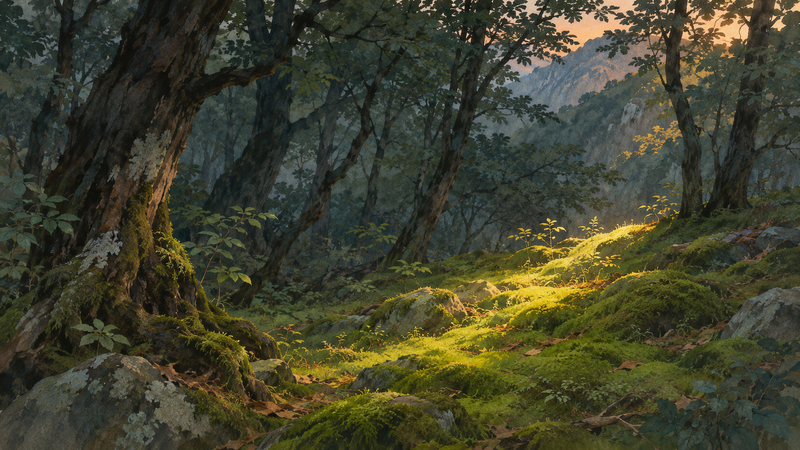
Deer Enclosure: hear the unseen, then watch the light
Wang Wei’s title 鹿柴 is read Lù Zhài; 柴 here refers to an enclosure, rather than carrying its everyday pronunciation chái. The Education Bureau text and notes also explain 返景 as the returning light of sunset.
空山不見人,但聞人語響。
返景入深林,復照青苔上。
New prose translation: In the empty mountain, no one is seen; only the echo of people’s voices is heard. Returning sunset light enters the deep woods and shines again upon the green moss.
The first pair of lines separates seeing from hearing. The place is not simply lifeless: voices reach the speaker even though their owners remain out of sight. The second pair brings attention down to moss. Rather than describing every tree, the poem lets a brief illumination suggest the depth around it. On a second reading, notice how little of the scene is directly shown. Resist adding a deer just because the title suggests one.
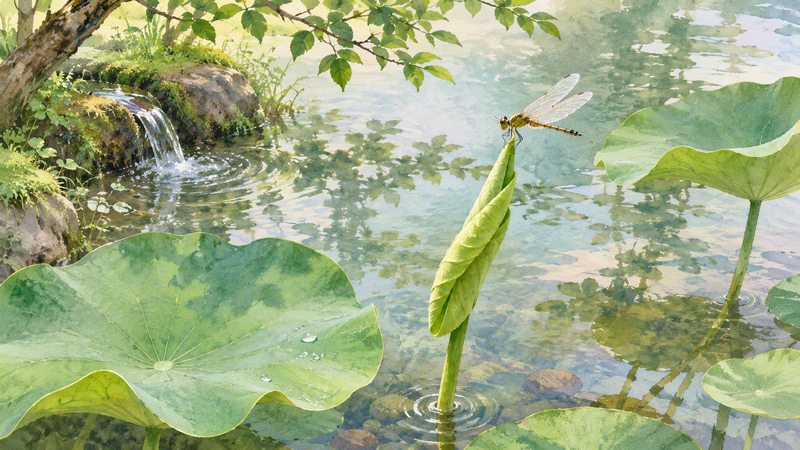
Little Pond: a dragonfly on an emerging leaf
Yang Wanli’s 小池, Xiǎo Chí, makes a very small setting worth sustained attention. The Education Bureau edition identifies 尖尖角 as the pointed shape of a new lotus leaf that has not yet unfolded.
泉眼無聲惜細流,樹陰照水愛晴柔。
小荷才露尖尖角,早有蜻蜓立上頭。
New prose translation: The spring’s mouth is silent, cherishing its slender stream; tree shade rests on the water, loving the gentle brightness. A young lotus leaf has only just shown its pointed tip, and already a dragonfly stands upon it.
Two small words make the setting feel responsive: 惜 suggests cherishing, and 愛 suggests loving. This is personification, not a claim that water or shade literally experiences emotion. The final pair catches a tiny sequence: the leaf has only just appeared, but the dragonfly is already there. Try reading the last two lines as one unfolding observation. Their attraction lies partly in that timing; a grander landscape would not do the same work.
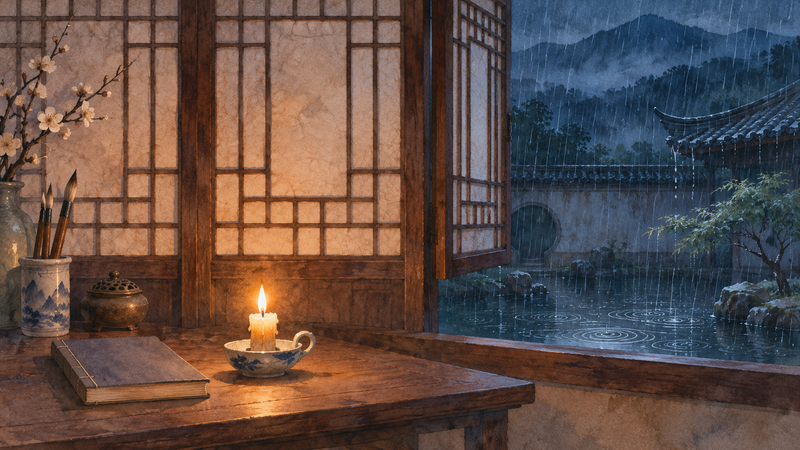
Night Rain: imagine a future memory
Li Shangyin’s 夜雨寄北, Yè Yǔ Jì Běi, moves between separation and hoped-for reunion. The source notes acknowledge different views of its date and recipient. A wife is a familiar interpretation, but the identity should not be presented as settled fact.
君問歸期未有期,巴山夜雨漲秋池。
何當共剪西窗燭,卻話巴山夜雨時。
New prose translation: You ask when I will return; there is no date yet. Night rain in the Ba mountains swells the autumn pool. When shall we trim the candle together by the western window and speak again of this time of night rain in the Ba mountains?
The rain does not disappear when the speaker imagines happiness. Instead, it returns as the subject of a future conversation. Read the repeated 巴山夜雨 in both places: first as the situation being endured, then as something the speaker hopes to remember together with the addressee. The emotional movement is therefore more specific than a general complaint about missing someone. The poem makes room for companionship before that companionship has been regained.
Read once for the scene, again for the movement
On your first pass, describe only what is present. For Deer Enclosure, name the voices, trees, light, and moss. For Little Pond, name the spring, shade, leaf, and dragonfly. For Night Rain, separate the rainy night from the anticipated candlelit conversation. This keeps an illustration or a remembered translation from quietly replacing the words.
On the second pass, ask what changes: what becomes visible, what happens just before or after something else, or which repeated phrase now carries a different feeling? Your answer gives you a reason to call a poem beautiful instead of borrowing a ranking. If you want a wider selection afterward, explore famous Chinese poems. For another historically grounded reading comparison, see the guide to medieval Chinese poets.
Keep translations beside the original where possible. An English version may choose smooth sentences, a strong image, or a rhyme at the expense of another feature. Compare what each version makes you notice rather than assuming that the most elegant English wording is the only possible meaning of the Chinese.
Questions about this selection
Which poem is the best starting point if I know little Chinese?
Little Pond offers a concrete starting point: a spring, reflected shade, a young leaf, and a dragonfly. Read the scene first, then notice how “only just” and “already” shape its final moment. This is a reading suggestion, not a claim that every beginner will prefer it.
Is the pointed lotus shape a flower?
In the cited notes for Little Pond, it is a young lotus leaf that remains rolled before unfolding. An image showing only a flower bud would miss that detail.
Are these the definitive English translations?
No. They are new prose translations for this article. They preserve the broad scene and relationships but do not reproduce the original rhyme, tonal pattern, or every possible nuance.