The golden age of Chinese poetry usually means the Tang dynasty, 618–907 CE. The phrase recognizes an unusually influential body of poetry, including work by Li Bai, Du Fu and Wang Wei. It does not mean that poetry began in the Tang, that every Tang poem shares one style, or that later Chinese writing represents a simple decline.
A second distinction matters: the whole Tang dynasty is broader than the literary phase called High Tang, 盛唐, Shèng Táng. A book may use “golden age” loosely for Tang poetry while concentrating on its celebrated eighth-century writers. Check which period the author actually discusses before turning a phrase of praise into a precise date range.
For a reader, the useful question is what this label helps you notice in a poem. The answer involves developed poetic forms, different ways of seeing the world, and the later selection of works that became classics. Two short passages below make that range more concrete.
The meaning and period of the golden-age label
The University of Toronto’s Representative Poetry Online identifies the Tang period as a golden age. The University of Chicago Library’s poetry exhibition likewise presents it as a major summit of Chinese poetic achievement. These are judgments about literary importance, not measurements proving that one era defeats every other era.
| Term | Scope | What to check |
|---|---|---|
| Tang dynasty | 618–907 CE | The historical frame, not one uniform poetic voice |
| High Tang, 盛唐 | One phase within Tang poetry | The periodization used by the particular source |
| Golden age | A description of exceptional literary achievement | Which poets, forms and works support that judgment |
| Three Hundred Tang Poems | A later anthology of selected Tang works | The compiler and edition, not a Tang-era publication date |
The Hong Kong Public Libraries lecture transcript organizes Tang poetry into Early, High, Middle and Late phases. It places Li Bai, Du Fu and Wang Wei in its High Tang discussion, while treating Bai Juyi and Li Shangyin in later phases. Do not compress all these writers into a single generation.
Why did poetry flourish in the Tang?
The same library lecture connects the flourishing of verse with several conditions: early Tang strength, cultural interaction, the importance of poetic ability in examinations, and the development of regulated poetic forms. These offer context, not a recipe that automatically produces great poems whenever a state becomes prosperous.
The Metropolitan Museum of Art’s Tang overview describes cosmopolitan Chang’an and an influential eighth-century artistic culture. It also connects poetry with court life and military experience. A golden age of writing can therefore contain grief, displacement and criticism as well as confidence and beauty. Artistic achievement does not establish that everyone lived comfortably.
Form also gives the reader something practical to examine. Count the characters in a line, notice how neighboring lines balance one another, and listen for repetition. An English translation can communicate a scene while rearranging its rhythm and syntax. It should not be treated as a transparent copy of every formal feature.
Two passages show why one mood is not enough
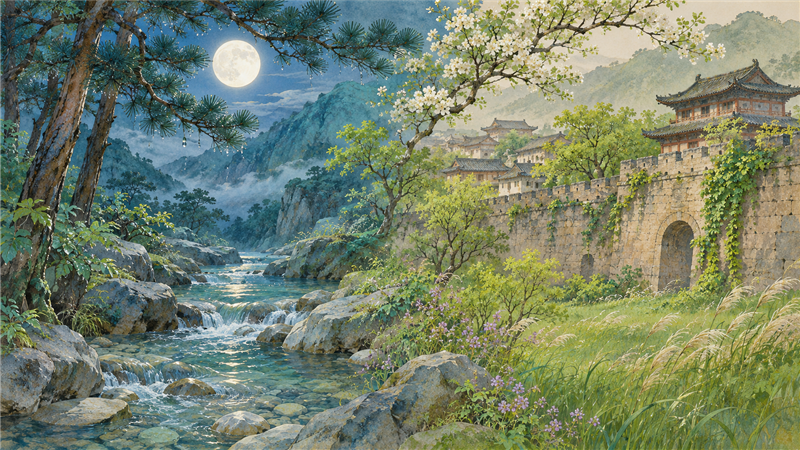
In Wang Wei’s 山居秋暝, Shān jū qiū míng, a mountain evening after rain includes these lines:
明月松間照,清泉石上流。
Míng yuè sōng jiān zhào, qīng quán shí shàng liú.
The bright moon shines between the pines;
a clear spring flows over the stones.
This fresh working translation preserves the paired images rather than reproducing the entire poem’s sound pattern. Light among trees balances water over stone. Read the rest of the poem before calling its setting empty of human life: subsequent lines include people returning and a fishing boat.
Du Fu’s 春望, Chūn wàng, turns the spring scene in another direction:
國破山河在,城春草木深。
Guó pò shān hé zài, chéng chūn cǎo mù shēn.
The state lies broken; mountains and rivers remain.
In the city in spring, grasses and trees grow thick.
Here the survival of landscape does not erase human loss. The contrast between broken political order and continuing natural growth gives spring an unsettling force. These are the familiar readings followed here; the linked transcription also records 荒 as a variant for 春 in the second line.
The comparison is a reading exercise, not a claim that Wang Wei always writes serenity or Du Fu always writes sorrow. Their different scenes explain why “golden” should not become a single cheerful mood. For a fuller close reading, continue with our Spring View guide.
Later readers helped make the classics
The poems themselves belong to the Tang, but familiar collections can be much later. Toronto’s anthology account identifies Sun Zhu, 孙洙, as the Qing compiler of Three Hundred Tang Poems. Selecting poems for later readers is different from writing them during the dynasty.
This matters when you buy a book or plan a reading list. An anthology shows a selection, not the whole period. Check the contents, explanatory notes and translation policy. A volume centered on Li Bai and Du Fu may be excellent for its purpose while giving little sense of Middle or Late Tang writing. Our history of Chinese poetry places Tang work within a longer timeline.
Questions about the golden age
Is the golden age the same as High Tang?
Not necessarily. “Golden age” often describes the Tang dynasty broadly. High Tang is one literary phase within it. State which meaning you intend and follow the periodization of your source.
Did Chinese poetry begin in the Tang dynasty?
No. The Tang inherited earlier poetic traditions. Calling it a golden age describes its achievement and influence, not the invention of Chinese poetry.
Does the label make Song poetry less important?
No. It is a useful historical description, not an objective ranking that settles every reader’s preferences. Read individual works and their forms before comparing periods.