A one-line history—“Tang means poetry, Song means lyrics, Yuan means drama”—is easy to remember and easy to misuse. Tang poets wrote more than regulated verse. Song writers did not stop writing shi. Yuan and later readers copied, printed, criticized, and imitated earlier works while producing new forms of their own.
This guide therefore treats periods as useful coordinates, not sealed boxes. It gives you a first reading task for each stage and shows where to verify broad claims. It is a map for choosing the next text, not a claim that one page can represent every language, region, community, manuscript, performance, or critical tradition in China.
A timeline of forms, not sealed dynastic boxes
| Reading stop | Forms or collections to notice | What changes the reading | Do not assume |
|---|---|---|---|
| Early transmitted poetry | Book of Poetry, Chu Ci | Repetition, ritual or court setting, regional voice, composite collections | One named author or one uniform style |
| Han to Six Dynasties | yuefu songs, fu, five-character verse | Performance, compilation, description, developing literary authorship | Every “folk song” is an untouched oral transcript |
| Tang | Ancient-style and regulated shi, quatrains, ballads, early ci | Line length, tonal pattern, couplet structure, occasion, historical setting | All Tang poems are quatrains or landscape poems |
| Song | shi and flourishing ci | Tune title, variable line length, voice, circulation, commentary | ci replaced shi |
| Yuan and later imperial periods | qu, theater songs, continued shi and ci | Performance role, speaker, print anthology, imitation and criticism | Poetry disappeared between Song and modernity |
| Modern and contemporary | Vernacular poetry, free verse, classical-style writing, translation | Print, education, audio, politics, global forms, individual publication history | Modernization erased classical practice |
The rows overlap. A form can begin before the dynasty with which it is most strongly associated and continue long afterward. A transmitted anthology can also contain materials from more than one date or setting. That is why form, source, and performance context are more reliable guides than a dynasty label alone.
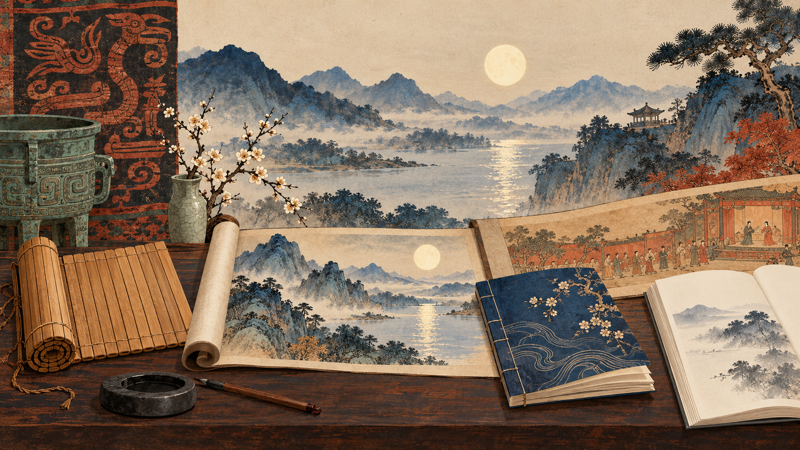
Early poetry begins with collections, not a single origin story
The Book of Poetry, often called the Shijing, is a foundational transmitted anthology. Its sections preserve different kinds of pieces, and repetition is often structurally important. When you read an ode, notice recurring phrases, changes between stanzas, who appears to speak, and what later editorial frame surrounds the text. Do not turn the speaker automatically into a securely identified historical author.
The Chu Ci, or Songs of Chu, offers another major early route. Its long lines, recurring particles, journeys, landscapes, addresses, and ritual or political voices differ from the compact stanza patterns many readers first meet in the Book of Poetry. “Early Chinese poetry” is therefore already plural. Our focused guide to reading the Shijing and Chu Ci in context compares the two without forcing them into one origin myth.
The Chinese Text Project provides public text collections for both the Book of Poetry and the Chu Ci. Use those pages as text witnesses and navigation aids, while keeping in mind that dating, attribution, and translation remain scholarly questions.
Han and Six Dynasties poetry expands the available reading routes
Han-period yuefu is often translated as “Music Bureau poetry” or “ballad.” The label can point to institutional collection, musical association, or later imitation, depending on the text. A poem preserved under that heading is not automatically a word-for-word record of an anonymous singer. Ask who compiled it, when the surviving version was transmitted, and whether a later literary author is working in a song tradition.
Fu adds another problem for English labels. It can combine catalog, description, argument, rhythm, and prose-like movement. Calling every fu simply a “poem” or simply an “essay” hides how the form works. Our guide to fu in Chinese poetry explains why genre, title, and the poet Du Fu must be kept separate.
Across the Six Dynasties, five-character verse, landscape writing, social exchange, reclusion, court compilation, and individual authorship develop along several paths. The key point is not to memorize a single evolutionary ladder. Instead, compare a poem’s line pattern, occasion, speaking position, and transmission with an earlier song or anthology piece.
Tang shi: prominence does not mean uniformity
The Tang dynasty is justly central to histories of Chinese poetry. The Metropolitan Museum of Art’s cultural timeline notes the extraordinary flourishing of shi and names writers such as Wang Wei, Li Bai, Du Fu, Bai Juyi, and Gao Shi. But “Tang poem” is a period label, not a form label.
Some Tang poems use regulated forms with controlled line length, tonal pattern, rhyme, and parallel couplets. Others use ancient-style verse, ballad modes, long narratives, occasional poems, or early song lyrics. Even two five-character quatrains can produce very different effects through syntax, allusion, scene, and speaker.
Start by identifying the visible structure: how many lines, how many characters per line, where the rhyme appears, and whether middle couplets are parallel. Then add historical context.
Song ci: tune patterns reshape the lyric
Ci uses tune patterns that permit variable line lengths. The tune title identifies a formal pattern; it does not necessarily summarize the poem’s subject. A poem written to a tune associated with one name may address travel, memory, politics, love, or another occasion entirely.
The form has roots before the Song and becomes especially prominent during it. The Met timeline places the growing popularity of ci in the late Tang, while a Library of Congress record for a Northern Song collection by Huang Tingjian shows a developed authorial ci corpus in material transmission. Neither fact means that Song writers abandoned shi. Su Shi, Huang Tingjian, Lu You, and many others worked across forms.
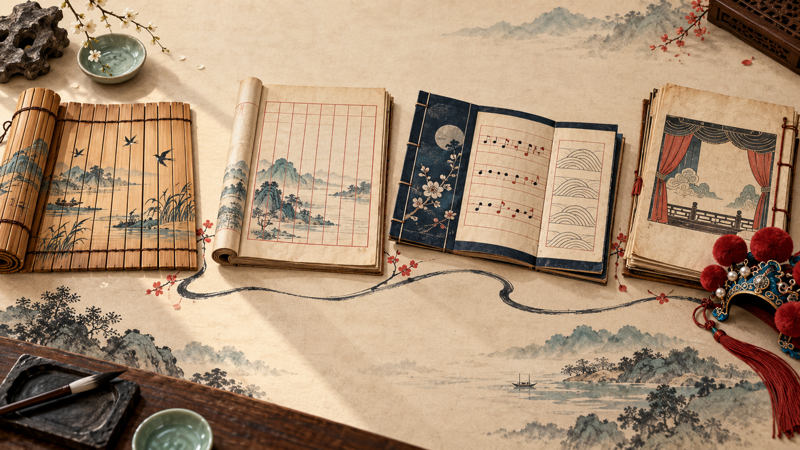
Yuan qu and theater add performance-centered questions
Qu is strongly associated with Yuan song and drama. When a lyric belongs to a theatrical work, identify the character, scene, and dramatic action before treating it as the poet’s direct confession. Performance conventions, musical mode, and colloquial diction can matter as much as the image that survives on the page.
At the same time, Yuan writers continued to compose shi and ci. Later Ming and Qing writers did the same while producing anthologies, commentaries, criticism, imitation, and new print editions. Those centuries are not a blank corridor between classical “golden ages” and modern poetry. They are part of how earlier texts were selected, read, standardized, contested, and made available to later audiences.
Modern poetry changes the medium without erasing the past
Twentieth-century vernacular and free-verse experiments change diction, line, publication, and the social position of the poet. Translation and contact with other literary traditions become especially visible. Newspapers, magazines, schools, recitation, audio, and later digital circulation create new reading communities.
Yet “modern” does not mean “without tradition.” Modern poets quote, reject, translate, reframe, or return to classical forms. Writers also continue to compose classical-style verse. A good modern reading records the publication date and version, the language register, the lineation, and the poet’s historical setting rather than assuming free verse has no form.
For a first author-based route, see our guide to four famous modern Chinese poets. It is an entry point, not a ranking or a complete canon.
Choose a reading route by evidence, not dynasty alone
Four mistakes that distort the history
- Assigning one form to one dynasty. Associations such as Tang–shi and Song–ci are useful, but forms begin, continue, and revive across boundaries.
- Treating every speaker as the poet. Anthology pieces, dramatic lyrics, persona poems, and occasional verse require different attribution checks.
- Reading only English category labels. “Ode,” “ballad,” “rhapsody,” “lyric,” and “song” are helpful translations, not perfect one-to-one genre identities.
- Calling the timeline progress. New media and forms expand possibilities; they do not prove that later poetry is more advanced or that earlier practice disappeared.
Questions about the history of Chinese poetry
What is the earliest collection of Chinese poetry?
The Book of Poetry is the earliest major transmitted anthology usually placed at the start of literary histories. Its pieces are diverse, and their dates, authorship, performance, and editorial history should not be reduced to one origin story.
Why is Tang poetry so famous?
The Tang period produced an extraordinary range of poets and forms, and later education and anthologies helped preserve its prestige. Fame does not mean all Tang poems share one structure or subject.
Did ci replace shi in the Song dynasty?
No. Ci flourished in the Song, but writers continued to compose shi and other forms. A history should track coexistence as well as innovation.
Is modern Chinese poetry disconnected from classical poetry?
No. Vernacular and free-verse movements changed poetic language and media, while quotation, adaptation, rejection, translation, and continued classical-style composition kept multiple relationships with the past active.
Sources and verification notes
- Chinese Text Project: Book of Poetry
- Chinese Text Project: Chu Ci
- Metropolitan Museum of Art: China, 500–1000 A.D.
- Library of Congress: Huang Tingjian ci collection record
- Asia Society: Visible Traces curriculum resource
Boundary: This is a reader’s orientation to major transmitted forms. It does not replace specialist histories, manuscript study, regional and minority-language traditions, or the source notes required for an individual poem.