Quick answer: In Chinese poetry, fu (賦, simplified 赋; fù) names a literary genre often translated as “rhapsody” or “rhyme-prose.” It can combine prose-like passages with patterned, rhymed language and develop a subject through extended description, dialogue or reflection. It is not the name of one poem, and it is not the same character as the Fu in the poet Du Fu (杜甫).
The search phrase “fu Chinese poetry” can lead to two different subjects, so check the character before choosing a text. If you first met Chinese poetry through short Tang poems, a long fu can look unfamiliar. Follow how the writing moves: a setting comes into view, details accumulate, a voice changes or an argument emerges. Notice development across passages as well as the beauty of an isolated phrase.
- Chinese character
- 賦 / 赋, pronounced fù.
- English labels
- Rhapsody and rhyme-prose are useful approximations, not exact equivalents.
- Historical scope
- Fu is strongly associated with Han literature but continued in later periods.
- First reading task
- Identify the subject, follow the sequence of description and notice changes in voice or thought.
The meaning of “rhapsody” in the fu genre
The Chinese University of Hong Kong Press description of Chinese Rhyme-Prose presents fu as a combination of prose and rhymed verse, often more expansive than condensed lyric poetry. The term “rhyme-prose” highlights that mixture. It should not be read as a promise that every sentence follows one simple formula.
Nicholas Morrow Williams’s introduction to the rhapsodic imagination places fu within Chinese poetry and stresses the range of subjects it can explore. “Rhapsody” suggests some of its energy, but no English label fully replaces the Chinese genre name. Keeping fu alongside an English gloss avoids forcing the work into an unrelated Western category.
Fu is broader than one dynasty or one verse pattern
Fu has an important Han history, but “Han” and “fu” are not interchangeable labels. Reading Fu Poetry presents selected works from the Han through the Song and emphasizes the genre’s varied styles and forms of personal and social expression. A later work should therefore be read in its own period rather than treated as an unchanged survival of a single early pattern.
The practical consequence is simple: check the particular work before counting lines or making a rule. An anthology’s introduction and notes can tell you which form of fu it presents. A paragraph layout in an English translation may help show the argument, while concealing some sound patterns in the Chinese. Neither the visual appearance of a translated page nor its length alone establishes the genre.
Our guide to how form changes a Tang poem’s meaning offers a useful comparison. It encourages attention to structure, but a rule learned for a short regulated poem should not automatically be imposed on a fu.
Read one image from Su Shi’s Red Cliff fu
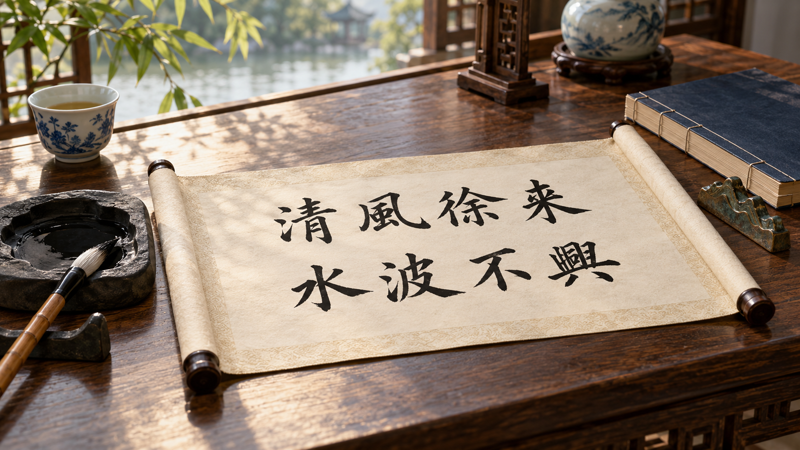
Su Shi’s Former Red Cliff Fu (前赤壁賦) provides a manageable example. The public-domain Chinese text opens with a boat outing and includes this phrase:
清風徐來,水波不興。
Qīng fēng xú lái, shuǐ bō bù xīng.
A clear breeze comes gently; no waves rise on the water.
The English line above is an original close teaching gloss. 清風 identifies the breeze, 徐 gives its unhurried movement, and 不興 says the water’s waves do not rise. The paired clauses place movement beside stillness. That contrast can be seen without first memorizing a long list of literary terms.
Now put the image back into the work. The outing develops through song and the sound of a flute; a guest expresses sorrow, and Su’s answering voice reflects on change through water and the moon. The ending returns to ease among the companions. These turns matter because the calm opening does not simply remain a decorative landscape throughout.
This is one Song work, not a miniature definition of every fu. Its scene, voices and reflection show why reading only a pretty phrase can miss the larger composition. The point is to connect local language with the passage that follows.

Use three passes instead of translating every word at once
- Find the subject and situation. Who is speaking, and what object, place or occasion organizes the passage? In the Red Cliff example, begin with the outing rather than jumping immediately to an abstract moral.
- Track what changes. Mark a shift from scenery to sound, a change of speaker or a turn from description to reflection. Summarize each section in one plain sentence.
- Return to the language. Read a short phrase for rhythm, repetition and contrast, then ask what it contributes to that section’s movement.
This method is a suggested study routine. It does not establish a mandatory three-part structure for the genre. If a different fu organizes its material through a catalog, an address to an object or another pattern, adapt the notes to what the work actually does.
| Reading question | What to record | Common mistake |
|---|---|---|
| What does fu mean here? | The genre character 賦 / 赋 and the named work | Confusing it with Du Fu’s personal name |
| How does the passage develop? | Sequence of details, speakers or ideas | Treating every section as unrelated decoration |
| What does a translation show? | The translator’s choices and available notes | Assuming English line breaks reproduce every Chinese sound pattern |
| What is specific to this work? | Author, period and textual evidence | Making one work a rule for all fu |
Choose a text with notes before choosing the longest one
For a first encounter, look for a named translator, an introduction to the work and notes that explain unfamiliar references. A short annotated selection can be more useful than a long unannotated text. Keep a copy of the Chinese passage beside the translation so you can see which phrases the explanation discusses.
If you are teaching a learner, begin with the eight-character Red Cliff phrase above. Ask what moves, what remains calm and what information the next paragraph adds. Then read a longer section together. The aim is to connect an image with a developing voice, not to finish an entire long work in one sitting. For earlier literary context, see Shijing and Chu Ci in early Chinese poetry.

Questions about fu in Chinese poetry
Is fu the same as Du Fu?
No. The literary genre is 賦 / 赋, pronounced fù. The poet’s name is 杜甫, Dù Fǔ; the second character and its tone are different.
Is every fu a Han dynasty work?
No. Fu is strongly associated with Han literature, but writers continued to use and develop it later. Su Shi’s Red Cliff fu is a Song example.
Must a fu have the same number of characters in every line?
No single equal-line rule defines the whole genre. Consult the particular text and its form; prose-like passages and patterned language can coexist.
Should I call fu prose or poetry?
Rhapsody or rhyme-prose can be helpful introductory labels. Scholars also discuss fu as a major poetic genre. Preserve the term fu and explain the particular work rather than forcing a simple either-or answer.
Source and reading anchor
The press descriptions linked above support the broad genre explanation and its historical range. Su Shi’s Chinese text supports the quoted phrase and the sequence discussed here. The English gloss and study routine are original teaching material; the illustrations do not reproduce an original manuscript or claim a documentary likeness of the author.