To learn a Chinese poem, connect the printed words, their sounds and the scene before trying to recite from memory. This exercise uses the four-line poem 寻隐者不遇 (Xún yǐn zhě bù yù), often taught under Jia Dao’s name. You will work with one checked text, modern Mandarin pinyin and four image cues rather than memorize an English explanation in place of the poem.
The aim is modest: read the lines accurately, explain what they say and notice where your recall becomes uncertain. There is no promised number of minutes or claim that this method has been tested on a class. If you are new to Mandarin, ask a teacher or proficient speaker to check your pronunciation before repeatedly practicing a mistake.
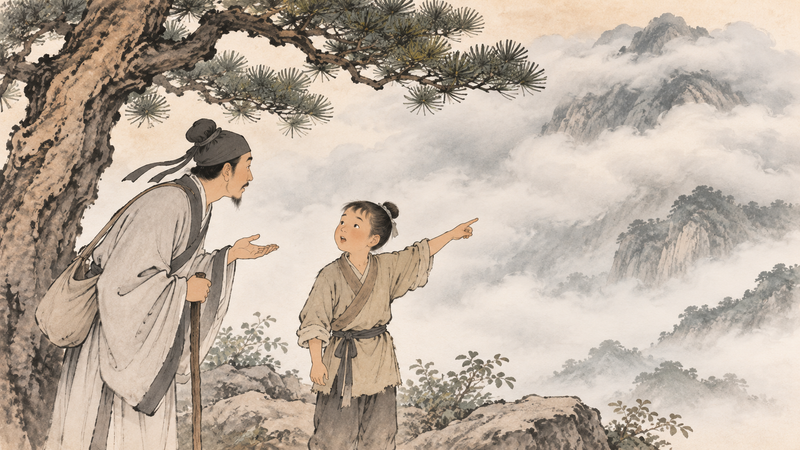
The practice instructions and English teaching gloss below are written for this guide. They are not a published translator’s version, and the illustrations do not document an actual meeting in the poet’s life.
Step 1: keep a checked text beside you
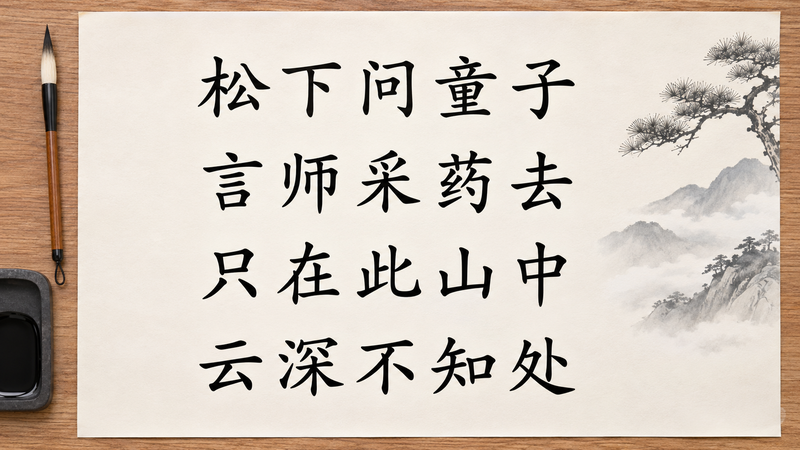
The primary text and its attribution note give these four lines. This page displays simplified characters; the source uses traditional forms such as 問, 師, 採, 藥, 雲 and 處. The work is commonly attributed to Jia Dao, while the preserved note also records an attribution to Sun Ge under another title. That uncertainty should remain visible rather than be replaced by a made-up composition story.
| Chinese line | Modern Mandarin pinyin | Picture cue |
|---|---|---|
| 松下问童子 | Sōng xià wèn tóng zǐ | Pine and question |
| 言师采药去 | Yán shī cǎi yào qù | Herbs |
| 只在此山中 | Zhǐ zài cǐ shān zhōng | Mountain |
| 云深不知处 | Yún shēn bù zhī chù | Deep cloud |
Original teaching gloss:
Under a pine, I ask a child;
the child says the master has gone to gather herbs.
He is somewhere in this mountain,
but deep clouds hide where he is.
The English supplies subjects to make the conversation readable. It is not a word-for-word map or a claim that the Chinese contains every English pronoun. Copy the Chinese once, checking each character against the text rather than relying on the picture.
Step 2: connect words to the scene
Retell the scene in plain English before reciting. A visitor asks a child a question. The answer places the absent master in the mountain, gathering herbs, but does not provide an exact location. The ending keeps the person sought out of view. Do not add a meeting, a return home or a named destination that the four lines do not give.
Now pair a cue with each line: pine, herbs, mountain, cloud. These are memory prompts for this particular exercise, not an ancient teaching system. Say which Chinese words make each cue appropriate. For instance, 山 gives the mountain cue; 云 gives the cloud cue. If you remember a beautiful mountain picture but cannot recover the words, uncover the line and read it again.
The four lines each contain five characters, excluding punctuation. The dictionary account of jueju explains the four-line form and its five- and seven-character varieties. This short form suits the chosen exercise; it does not mean that all Chinese poems have twenty characters.
Step 3: check sounds before reciting
Read one line at a time while pointing to the characters. Pinyin here separates syllables for learning and shows citation tones in modern Mandarin. It does not reconstruct Tang-period pronunciation. A fluent reading also needs natural phrasing; five characters do not require five equally stressed beats.
Check the final word especially: 处 is chù, meaning a place or location. The Ministry of Education entry for 處 distinguishes this noun reading from chǔ in other uses. Do not choose a pronunciation merely because a dictionary lists it first.
If you record yourself, compare one line with a teacher’s reading rather than judging accuracy from your confidence. Note a concrete uncertainty, such as “the tone of 问” or “the final in 中.” This page does not supply an audio recording, and a generated illustration is not a pronunciation reference.
Step 4: use cues and check the original
Cover the Chinese and leave only your four picture cues visible. Try the first line, then uncover it and compare. Continue through the poem. When you miss a word, identify the exact difference before repeating the whole piece: did you omit a character, replace one with a similar-sounding word, or reverse the middle lines?
For example, remembering “mountain” is not enough if you substitute another location for 此山. The task is to recover the chosen text, not produce a paraphrase that seems close. Keep the English gloss covered during this check so that its longer sentence structure does not become the sequence you recite.
Finally, hide the cues too. If you cannot continue, return to the last accurate line and check what comes next. Pause or seek pronunciation help when needed; finishing quickly is not the measure of a successful first attempt.

Record a second reading
On a later attempt, write down what you can do without looking: read the Chinese, recall the order, explain the scene or pronounce a previously difficult word. These are separate achievements. Knowing an English explanation does not establish accurate Mandarin recitation, and remembering the sounds does not necessarily establish understanding.
For broader reading habits, continue with how to read Chinese poetry. When you want to examine what a line pattern contributes to a reading, use the guide to form and meaning. Keep this poem’s checked text beside your own notes so that practice remains anchored to words you can verify.