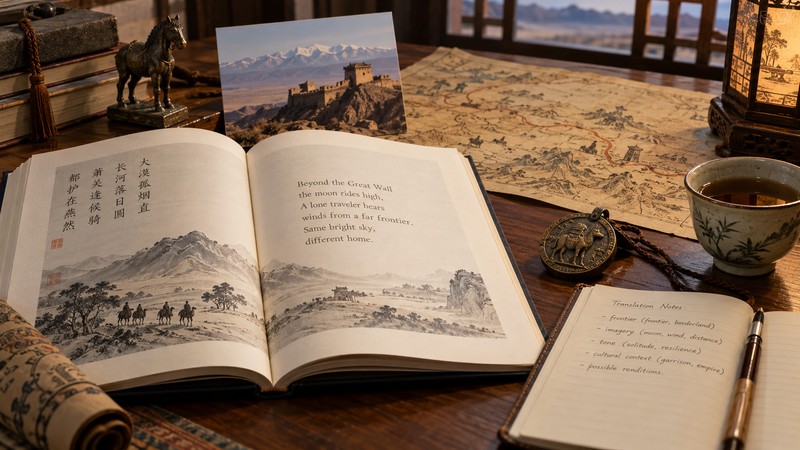
If you’ve ever held a translation of an ancient poem, trying to feel the quiet longing in lines written over a millennium ago, tang poems in english offer a vital bridge between China’s golden age of poetry and modern readers. These translations do more than swap Chinese characters for English words—they carry the weight of Tang Dynasty culture, the poets’ joys and sorrows, and the subtle beauty that makes classical Chinese poetry timeless.
For many, they are the first step into understanding a literary tradition that shaped East Asian culture for centuries.
What Tang Poems In English Means in Chinese Poetry
Tang poems in english refers to English translations of works from China’s Tang Dynasty (618–907 CE), a period when Chinese poetry reached its artistic peak. Unlike Western poetry, which often relies on rhyme and strict meter, classical Chinese poetry uses concise, imagery-dense lines that pack layers of meaning into just a few words.
Translating these works requires balancing literal accuracy with the preservation of poetic tone—a skill that separates superficial conversions from meaningful translations.
A common misunderstanding among beginners is that these translations are mere word-for-word swaps, but this is far from the truth. Skilled translators adapt the original’s emotional and thematic core to English without diluting its essence.
For example, the Chinese word “ming” (bright) when describing the moon in Tang poetry isn’t just about light—it often symbolizes clarity, nostalgia, or connection to home. A beginner might miss this nuance if a translation only uses “bright moon,” but a thoughtful translator might use “cool bright moon” to hint at the quiet, reflective tone the original conveys.
This attention to nuance is why tang poems in english are more than linguistic tools; they are cultural artifacts that carry the spirit of ancient China to new audiences. Another key element is respecting Tang poetry’s structure—whether the four-line jueju or eight-line lushi.
The tight line breaks and rhythmic patterns of classical Chinese mirror the poem’s emotional pace, and good translations echo this rhythm to keep the work’s impact intact. For instance, a jueju’s brevity forces readers to pause and reflect, a rhythm that English translations should preserve to avoid flattening the original’s power.
Historical and Cultural Background
The Tang Dynasty was a time of extraordinary cultural flourishing, where poetry was central to daily life. Imperial exams required candidates to compose poetry, social gatherings revolved around reciting works over wine, and even emperors were known to write poems.

This integration of poetry into society means tang poems in english aren’t just literary pieces—they are windows into the lives of people living in a dynamic, expanding empire.
Poets of the Tang era ranged from the romantic, Tang Poems In English free-spirited Li Bai (701–762 CE) to the realistic, history-focused Du Fu (712–770 CE), each shaping the literary landscape. Li Bai’s works celebrated nature, adventure, and the pursuit of freedom, while Du Fu’s poems often reflected the suffering of ordinary people during events like the An Lushan Rebellion (755–763 CE), a civil war that devastated the empire.
When these works are translated into English, they bring to life the tensions and triumphs of a bygone era, making history accessible through raw emotion.
The translation of Tang poetry into English has a rich history, dating back to the 19th century, but it gained widespread popularity in the 20th century through scholars like Ezra Pound, whose *Cathay* (1915) introduced many Western readers to Tang poems. While some early translations took liberties with the original, modern translators have prioritized faithfulness to the text, ensuring that tang poems in english today are both accurate and poetic.
This shift has allowed readers to engage with the works more deeply, connecting with the poets’ original intentions rather than a translator’s interpretation.
For Chinese communities around the world, tang poems in english are a way to maintain cultural heritage. Many overseas Chinese parents use these translations to teach their children about their roots, while non-Chinese readers use them to explore a literary tradition vastly different from Western poetry.
In this way, translations of Tang poetry act as a cultural bridge, fostering cross-cultural understanding and appreciation.
Key Poems, Poets, or Examples
Tang poems in english are best understood through concrete examples that showcase the diversity of the era’s literary talent. Let’s explore four iconic works, their poets, and what they teach readers:
First, Li Bai’s *Quiet Night Thought* (Jing Ye Si). Tang Poems In English Written around 726 CE, this short jueju is one of the most famous Tang poems.
Li Bai, known as the “Immortal Poet” for his wild, imaginative verse, wrote this while staying in an inn away from home. The lines: “Before my bed, there is bright light / I suspect it’s frost on the ground / I lift my head to look at the mountain moon / I lower my head to think of my hometown.” The translation captures the quiet homesickness at the poem’s core, teaching readers how simple, everyday imagery (a bed, moonlight) can convey deep emotion.
For a deeper dive, see the full analysis of Li Bai’s *Quiet Night Thoughts*.
Second, Du Fu’s *Spring View* (Chun Wang). Written in 757 CE during the An Lushan Rebellion, when Chang’an (the Tang capital) was under rebel control, Du Fu’s poem reflects the devastation of war.
The original lines: “The country is broken, mountains and rivers remain / The city is spring, grass and trees are deep / I feel sad at the time, flowers bring tears / I hate parting, birds start to hear.” The translation emphasizes the contrast between enduring nature and human suffering, teaching readers about the historical context of the Tang Dynasty and how poetry documents tragedy.
Third, Wang Wei’s *Deer Park* (Lu Chai). Tang Poems In English Wang Wei (701–761 CE) was not only a poet but also a painter, and his landscape poetry is known for its meditative quality.
*Deer Park* is part of his “Wang River Collection,” a series about his mountain retreat. The lines: “Empty mountain, no one is seen / But I hear voices / The sunlight filters through the deep woods / And shines back on the green moss.” The translation captures the serene, mystical tone, highlighting Wang Wei’s Buddhist influence, and teaching readers how poetry conveys quiet solitude and connection to nature.
Fourth, Li Bai’s *Viewing Mount Lu* (Wang Lu Shan Pu Bu). Written during his travels in southern China around 725 CE, this poem celebrates nature’s power.
The lines: “The sun shines on the incense burner, purple smoke rises / The waterfall hangs in front of the river, 3,000 feet high / It flies down from the sky, as if the Milky Way falls into the sky.” The translation uses vivid imagery to convey awe, teaching readers about Li Bai’s romantic style and his ability to turn a natural wonder into a universal experience.
How to Read and Understand It
Reading tang poems in english requires a deliberate approach to capture their essence. For beginners, start with short poems like *Quiet Night Thought* or *Deer Park*—their brevity makes them easier to grasp, and they showcase core Tang poetic techniques.
When reading, take time to pause at each line; classical Chinese poetry is designed to be savored, not rushed. For example, in *Spring View*, the line about flowers bringing tears is not just a description—it’s a metaphor for the poet’s own grief, so slow reading allows you to feel that emotion.
Pay attention to cultural context embedded in the poems. Many Tang works reference historical events, social customs, or philosophical ideas (Confucianism, Buddhism) that are not immediately obvious to English readers.
For instance, *Quiet Night Thought*’s theme of homesickness is universal, but writing poetry to express that feeling is a deeply Chinese tradition. Modern translations often include footnotes to explain these references, so use them to deepen your understanding.
Be aware of translation limits. No English translation can fully capture classical Chinese’s nuances, Tang Poems In English where fewer words carry more layers of meaning.
For example, the Chinese word “qing” can mean “clear,” “pure,” or “serene” depending on context. A translator might choose “pure” in one line and “serene” in another, but these choices are subjective.
Instead of seeking a “perfect” translation, focus on the emotional and thematic core the translator conveys.
For students and teachers, tang poems in english are a valuable tool for learning about poetry and Chinese culture. Comparing Tang jueju to Western forms like Shakespearean sonnets helps students understand the unique qualities of classical Chinese poetry while highlighting universal themes like love and loss.
This cross-cultural comparison fosters critical thinking and empathy, making literature more accessible and engaging.
Why It Still Matters Today
Tang poems in english remain relevant because they connect modern readers to universal human experiences. Homesickness, grief over loss, awe at nature—these emotions transcend time and culture, and Tang poems convey them with a depth that resonates today.
*Quiet Night Thought*, for example, is still shared during Chinese New Year, when many are away from home, making it a timeless expression of longing.
For cross-cultural understanding, tang poems in english are invaluable. They offer a window into a culture often misunderstood, showing that ancient Chinese people had the same joys and sorrows as people today.
Reading Du Fu’s *Spring View* allows non-Chinese readers to understand war’s impact regardless of background, breaking down stereotypes and fostering empathy.
In education, tang poems in english are used to teach global literature and cultural studies. Schools around the world include these translations in curricula, introducing students to a literary tradition over a thousand years old.
This expands literary horizons and develops critical thinking as students analyze how translators adapt works across languages.
For overseas Chinese communities, tang poems in english are a link to heritage. Many second- and third-generation Chinese Americans grow up speaking English at home, so translations allow them to connect with poems their grandparents recited.
This preserves cultural identity and ensures Tang poetry’s legacy continues for future generations.
Frequently Asked Questions
What is the meaning of tang poems in english?
Tang poems in English refer to the translations of classical poetry from the Tang Dynasty (618-907 CE) of China, rendered into the English language. These poems convey the original Chinese verses, themes, and artistic expressions while adapting them for English-speaking readers. The meaning often centers on nature, love, melancholy, friendship, philosophical reflections, and the beauty of the fleeting moments of life, reflecting the profound emotional and spiritual depth of medieval Chinese culture.
Who wrote tang poems in english and what is the historical context?
The original Tang poems were written by renowned poets such as Li Bai, Du Fu, Wang Wei, Bai Juyi, and Li Shangyin, among many others. The translation of these poems into English began primarily in the 19th and 20th centuries, driven by Western scholars, missionaries, and sinologists who sought to introduce Chinese literature to English-speaking audiences. This translation movement coincided with increased cultural exchange between China and the West, particularly after the Opium Wars and throughout the 20th century.
What literary devices are used in tang poems in english?
Tang poems employ numerous literary devices, including vivid imagery of natural landscapes (mountains, rivers, moon, flowers), symbolism (cranes representing longevity, willow branches symbolizing parting), allusion to historical figures and legends, parallelism and balanced structures, personification of natural elements, and subtle irony. In translation, these devices are sometimes preserved through careful word choice, while others require adaptation to maintain their effect in English, such as recreating the musical quality of the original’s regulated verse forms.
What is the cultural significance of tang poems in english?
Tang poems in English hold significant cultural value as they bridge East and West, allowing global audiences to access one of the golden ages of Chinese literature. They represent the pinnacle of Chinese poetic achievement and have influenced world literature profoundly. These translations have fostered cross-cultural understanding, inspired Western poets and artists, and serve as educational tools for learning about Chinese history, philosophy, and aesthetics. They also demonstrate the universal human experiences that transcend linguistic and cultural boundaries.
How should tang poems in english be interpreted?
Tang poems in English should be interpreted with attention to both the original Chinese context and the translation process. Readers should consider the poet’s historical circumstances, the symbolic language of Tang Dynasty culture, and the emotional resonance beneath the often spare and suggestive wording. Understanding the conventions of Tang poetry—such as the use of juxtaposition, allusion, and tonal patterning—enhances appreciation. Additionally, recognizing that translations involve interpretation can help readers engage with multiple versions of the same poem to grasp fuller meaning.
Tang Dynasty Art: 6 Hidden Meanings You Missed at First Read Chinese Poem Translation: Tang Poetry Guide and Cultural Con Ancient Chinese Poetry: Major Poets, Poems and Legacy Wikipedia