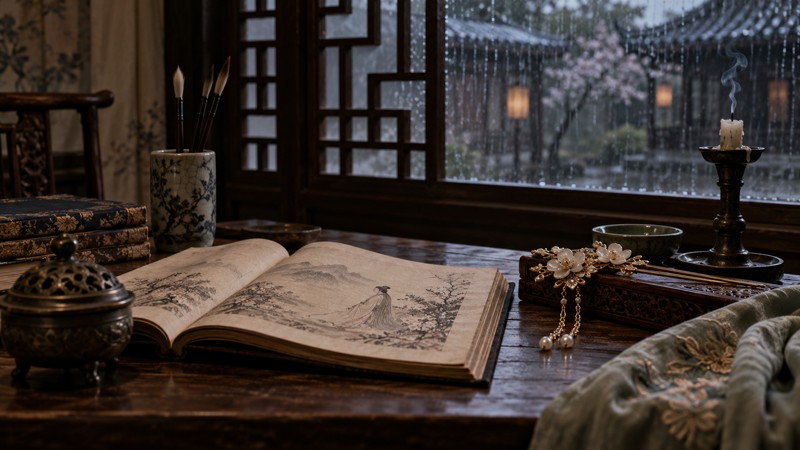
When a new student of Tang poetry flips open an anthology, they often land on Bai Juyi’s *Song of Everlasting Sorrow*—a 120-line narrative poem that has captivated readers for over a millennium. More than just a tale of imperial love, it is a window into mid-Tang sorrow, woven from historical trauma and mythic longing.
What Song Of Everlasting Sorrow Means in Chinese Poetry
Many beginners misunderstand the title: “Everlasting Sorrow” does not refer to a single fleeting grief, but a layered, enduring sorrow that spans decades, crosses worlds, and touches both emperors and common people. In classical Chinese poetry, sorrow (ai) is not just personal; it is often tied to collective experience, and Bai Juyi’s work exemplifies this.
Unlike Western epics that focus on heroic deeds, Tang narrative poetry centers on emotional truth, even when the subject is a royal couple. The poem’s core is the gap between what was (the emperor’s carefree days with Yang Guifei) and what could never be again (her violent death in the 756 Mawei Slope incident during the An Lushan Rebellion).
For Chinese poets, this tension between past joy and present loss is a recurring theme, but Bai elevates it by blending historical accuracy with the supernatural—sending a Taoist priest to find Yang’s spirit in the Penglai Isles, a touch that makes the sorrow feel both universal and deeply rooted in Tang cultural beliefs about the afterlife. Beginners often miss how the poem balances critique and sympathy: Bai does not shy away from Emperor Xuanzong’s indulgence that led to the rebellion, yet he also makes the emperor’s longing tangible, turning a historical cautionary tale into a work of emotional resonance.
This balance is why *Song of Everlasting Sorrow* remains a defining work of Tang poetry, not just a historical document.
Historical and Cultural Background
To understand *Song of Everlasting Sorrow*, one must ground it in the chaos of mid-Tang China. Bai Juyi wrote the poem around 806, when he was a young scholar in the imperial capital of Chang’an (modern Xi’an), decades after the An Lushan Rebellion had shattered the Tang Dynasty’s golden age.

The rebellion, led by general An Lushan, forced Xuanzong to flee Chang’an; during the escape, his troops mutinied, demanding Yang Guifei’s death as punishment for the empire’s decline. Her execution marked the end of Xuanzong’s reign, and the start of the Tang’s slow decline into instability.
Bai, a poet known for his “simple and plain” style that resonated with ordinary people, chose this dramatic historical event to explore themes of power, loss, and memory. In Tang literary culture, narrative poetry was a way to engage with current events, and Bai’s work was widely read and recited across the empire—even by common folk, because it used clear language and vivid imagery.
Unlike earlier Tang poets who focused on personal or landscape themes, Bai expanded the scope of Tang poetry to include large-scale historical trauma, making it accessible to a broader audience. This cultural context is key: *Song of Everlasting Sorrow* is not just a love story, but a reflection of a dynasty in crisis, and the sorrow it depicts is both personal (the emperor’s grief) and collective (the empire’s loss).
Key Poems, Poets, or Examples
To grasp the depth of *Song of Everlasting Sorrow*, it helps to compare it to other Tang poems that express sorrow, each offering a different lens into the Chinese poetic tradition. The four examples below highlight how Tang poets varied their expressions of grief, from intimate personal longing to collective historical trauma.
First, Bai Juyi’s *Song of Everlasting Sorrow* itself: as the core work, its structure follows three acts: the idyllic days of Xuanzong and Yang in the palace, the sudden tragedy of her death, and the emperor’s endless longing. The poem’s power lies in its use of specific, sensory details—like the “peach and plum flowers” in the palace garden, or the “rain beating the willows” at Mawei Slope—to evoke emotion.
For readers, this shows how narrative poetry can turn a historical event into a universal story of loss, making it relatable even centuries later.
Second, Li Bai’s *Quiet Night Thought* (726): a short, lyrical poem about homesickness, written when Li Bai was traveling far from home. Unlike Bai Juyi’s long narrative, Li Bai uses just 20 characters to express sorrow: “Before my bed, bright moonlight / I think it’s frost on the ground / I lift my head to look at the moon / I lower my head to think of home.” This poem captures the quiet, intimate sorrow of separation, contrasting with the grand, imperial sorrow of *Song of Everlasting Sorrow*.
It teaches readers that Tang sorrow can be both vast and small, depending on the poet’s focus.
Third, Du Fu’s *Spring View* (757): written during the An Lushan Rebellion, when Chang’an was occupied by enemy forces. Du Fu, who was trapped in the city, wrote: “The country is broken, mountains and rivers remain / In the city spring grass and trees grow deep / I feel sad at the flowers, tears fall / I grieve at the parting birds, my heart aches.” Du Fu’s sorrow is collective: he mourns the destruction of his homeland, not just personal loss.
This connects to *Song of Everlasting Sorrow*, as both poems reflect the trauma of the rebellion, but Du Fu’s is a citizen’s grief, while Bai’s is an emperor’s. It shows how Tang poets used sorrow to comment on societal and political change.
Fourth, Wang Wei’s *Parting at Weicheng* (742): a farewell poem about saying goodbye to a friend, written when Wang Wei was serving as an official in Weicheng. The poem’s lines: “The morning rain washes the dust of Weicheng / The willows by the guest house are fresh and new / I urge you to drink another cup of wine / For west of the Yang Pass, there are no old friends.” This poem expresses the quiet sorrow of temporary separation, a theme that echoes the emperor’s longing for Yang in *Song of Everlasting Sorrow*.
Both use natural imagery (willows, wine) to convey sadness, showing how Tang poets used common symbols to express deep emotion.
How to Read and Understand It
Reading Tang poetry, especially *Song of Everlasting Sorrow*, requires more than just translating words—it requires engaging with its rhythm, imagery, and cultural context. For beginners, the first step is to read the original Chinese aloud, to feel the tonal patterns that give Tang poetry its musicality.
The original lines of *Song of Everlasting Sorrow* follow a consistent rhythm, with seven characters per line (qi yan shi), which creates a flowing, narrative cadence. English translations often lose this rhythm, so reading a side-by-side version can help catch the poem’s musicality.
Next, pay attention to imagery: Bai uses willows, flowers, moonlight, and rain to signal sorrow—willows in Chinese culture symbolize farewell, for example, so their appearance at Mawei Slope reinforces the tragedy of Yang’s death. Beginners should also avoid reducing the poem to a love story; instead, look for the layers of critique and sympathy.
For example, Bai writes about Xuanzong’s indulgence in the palace, but also about his lonely nights after Yang’s death, so the poem is not just a condemnation or a celebration, but a nuanced exploration of human emotion. A practical tip: compare *Song of Everlasting Sorrow* to the other three poems mentioned earlier, to see how different poets expressed sorrow in different contexts.
This will help you recognize the range of Tang poetic expression, and deepen your understanding of Bai’s work.
Why It Still Matters Today
*Song of Everlasting Sorrow* endures because its core theme—endless sorrow after loss—transcends time and culture. In a modern world where people experience grief, separation, and longing, the emperor’s pain feels familiar, even to readers who know nothing of Tang Dynasty history.
This universal appeal is why the poem is still taught in Chinese schools, referenced in films, music, and literature across East Asia. For cross-cultural readers, it offers a window into how Chinese poets express emotion: unlike Western poetry that often focuses on individual identity, Tang sorrow is often tied to relationships, duty, and collective experience.
For example, the emperor’s sorrow is not just his own, but a reflection of the empire’s loss, which resonates with modern readers who grieve for community or country. In terms of education, *Song of Everlasting Sorrow* is a gateway to Tang poetry: once readers understand this narrative work, they can explore shorter lyrical poems like Li Bai’s *Quiet Night Thought* or Du Fu’s *Spring View*, building a broader appreciation for classical Chinese poetry.
It also teaches readers that poetry can be both a historical document and a work of art, blending fact and fiction to capture the human condition.
Frequently Asked Questions
What is the meaning of song of everlasting sorrow?
The “Song of Everlasting Sorrow” (长恨歌) is a narrative poem that tells the tragic love story between Emperor Xuanzong of Tang and his consort Yang Guifei. The title “everlasting sorrow” refers to the eternal grief and longing the emperor feels after Yang Guifei’s death, symbolizing how love and loss transcend mortal boundaries. The poem explores themes of love, betrayal, political upheaval, and the fleeting nature of earthly beauty and power.
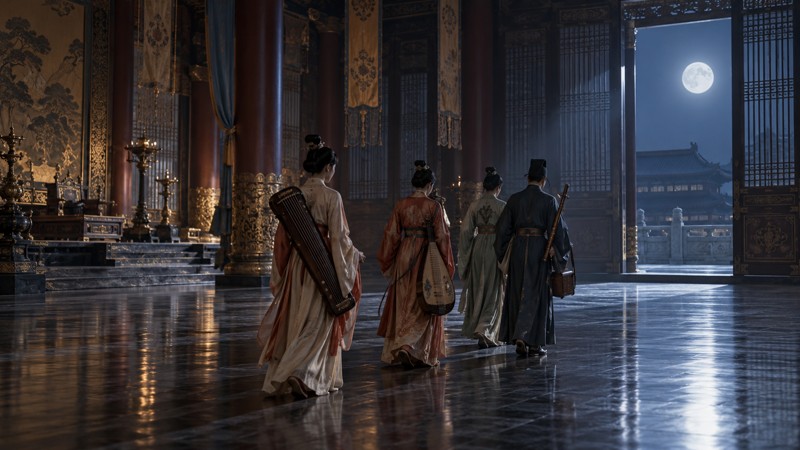
Who wrote song of everlasting sorrow and what is the historical context?
The poem was written by Bai Juyi (白居易), a renowned Tang Dynasty poet, around 806 AD during the Zhenyuan era. The historical context centers on the An Lushan Rebellion (755-763 AD), during which Emperor Xuanzong fled the capital with his court. In the chaos, his beloved consort Yang Guifei was forced to commit suicide by rebellious troops, and the emperor’s grief became legendary. Bai Juyi wrote this poem to memorialize their love while subtly critiquing the political consequences of the emperor’s indulgence.
What literary devices are used in song of everlasting sorrow?
The poem employs numerous literary devices including vivid imagery (particularly of the Huaqing Palace and the moon), metaphor (comparing Yang Guifei’s beauty to flowers and the moon), personification (giving emotions to natural elements), allusion (referencing historical events and mythological figures), parallelism (balanced phrases and sentences), and hyperbole (exaggerating beauty and sorrow). The poem also uses symbolism, such as the moon representing Yang Guifei and the imperial court symbolizing both glory and decline.
What is the cultural significance of song of everlasting sorrow?
The poem holds immense cultural significance in Chinese literature as one of the most celebrated works of the Tang Dynasty. It established the tragic romance between Emperor Xuanzong and Yang Guifei as a quintessential example of love overcome by political circumstances. The poem influenced countless subsequent literary works, operas, and dramas. It also shaped Chinese perceptions of romantic devotion and the idealized beloved, while simultaneously serving as a cautionary tale about the dangers of political negligence and excessive passion.
How should song of everlasting sorrow be interpreted?
The poem can be interpreted on multiple levels: as a romantic narrative celebrating true love that transcends death, as a political allegory critiquing the emperor’s neglect of state affairs in pursuit of pleasure, and as a meditation on the transience of worldly goods and the inevitable decline of empires. Bai Juyi himself stated that the poem was meant to “prick the heart” of those in power while moving the hearts of ordinary readers with its beautiful portrayal of love and loss. Modern interpretations often focus on its universal themes of love, grief, and the human condition rather than strict historical accuracy.
Poems From The Tang Dynasty: Tang Poetry Guide What Drinking Alone by Moonlight Means in Tang Poetry Free Poem Maker: 7 Hidden Meanings You Missed at First Read Wikipedia