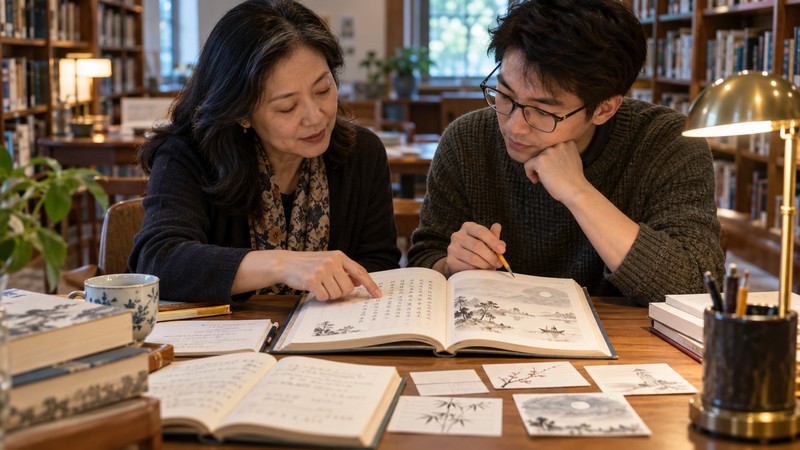
Staring at an English translation of a Tang dynasty poem, many readers mistake its brevity for simplicity—but learning how to read chinese poetry, especially the iconic works of the Tang era, reveals layers of emotion, history, and cultural nuance hidden in every line. Unlike Western poetry’s focus on extended narrative or complex metaphor, Tang poetry relies on precise imagery and tonal rhythm to convey meaning, making it accessible once you grasp its core conventions.
Quick Answer
How to read Chinese poetry means moving from sound and literal meaning into imagery, structure, historical context, and evidence-based interpretation.
Basic Facts
- Study focus: Chinese poetry close reading
- Best use: Tang poetry lessons, self-study, worksheets, and classroom discussion
- Main check: Poem text, vocabulary, imagery, speaker, context, and evidence
- Common mistake: Jumping to a moral lesson before reading the poem's actual language
Quick reference: how to read chinese poetry = sound + words + imagery + context + evidence.
For beginners, the key is to move beyond literal translation and engage with the poetic traditions that have shaped Chinese literature for over a millennium.
What How To Read Chinese Poetry Means in Chinese Poetry
To understand how to read chinese poetry is to move beyond the Western idea of poetry as a personal, idiosyncratic expression. In classical Chinese tradition, poetry is a form of cultural dialogue, rooted in concepts like qingjing (the harmony of scene and emotion) and bi xing (using concrete images to evoke abstract feelings).

A common beginner mistake is treating each line as a standalone sentence, rather than part of a carefully constructed whole that connects to centuries of poetic language. For example, the moon in Chinese poetry is never just a celestial body—it is a symbol of nostalgia, a companion for lonely travelers, and a link to distant loved ones.
This collective meaning, built over millennia, is what makes Tang poetry resonate across time, even when translated into English.
Chinese poetry also places great importance on form, a detail often lost in translation. Tang poets worked within strict structures: the jueju (quatrain) is four lines of five or seven characters, with a fixed tonal pattern and parallelism between lines.
This form is not a constraint but a tool—forcing poets to choose words with deliberate care, so each character carries multiple layers of meaning. A single character like gui (归, return) might mean going home, returning to a state of peace, or even death, depending on context.
For readers, learning to unpack these layers is the first step to truly engaging with how to read chinese poetry.
Another critical misunderstanding is that classical Chinese poetry is outdated or irrelevant. In reality, How To Read Chinese Poetry it is a living tradition: modern Chinese writers still reference Tang poems to convey emotion, and many of its core themes—longing for home, grief over loss, joy in nature—remain universal.
To read Tang poetry well is to recognize that these ancient works speak to the same human experiences we feel today. It is not about memorizing rules, but about learning to look for the small, specific details that make a poem feel personal, even when it was written over 1,200 years ago.
Historical and Cultural Background
The Tang dynasty (618–907 CE) is widely considered the golden age of Chinese poetry, a period when poetry was central to every aspect of social and political life. The imperial civil service exam, or keju, required candidates to write regulated poems (lushi, eight lines with strict parallelism) as part of their tests, turning poetry into a path to power and prestige.
This meant that educated men across the empire—from scholars to minor officials—wrote poetry, creating a diverse body of work that reflected every corner of Tang society.
Tang poets were also a connected community, How To Read Chinese Poetry traveling across the empire to meet friends, take up official posts, or escape political unrest. They exchanged poems as gifts, wrote farewell verses for departing companions, and collaborated on works together.
Li Bai, for example, spent years wandering the Yangtze River, writing about mountains, wine, and friendship; Du Fu, his contemporary, moved between provinces as the An Lushan Rebellion (755–763 CE) upended the empire, his poems chronicling the suffering of ordinary people. This mobility and interconnectedness meant that Tang poetry was not just a literary form, but a way to build relationships and make sense of a rapidly changing world.
The Tang dynasty’s cultural openness also shaped its poetry. It absorbed influences from Central Asia, India, and even the Middle East, leading to new themes and imagery.
For example, Wang Wei, a contemporary of Li Bai and Du Fu, wove Chan (Zen) Buddhist philosophy into his landscape poems, creating works that felt both serene and deeply philosophical. This mix of personal emotion, historical context, and cross-cultural influence is what makes Tang poetry so rich and rewarding to read.
When learning how to read chinese poetry, understanding this historical context is key to unlocking the full meaning of a poem—without it, you might miss the grief in Du Fu’s lines or the joy in Meng Haoran’s celebration of spring.
Key Poems, Poets, or Examples
To grasp how to read chinese poetry, it helps to look at concrete examples from Tang dynasty masters, each of which teaches a different lesson about the tradition. The first is Li Bai’s *Quiet Night Thought* (Jing Ye Si, 静夜思), written during his travels away from home.
The poem is short: “Before my bed, bright moonlight / I thought it was frost on the ground / I raised my head to look at the mountain moon / Then bowed my head to think of my hometown.” Li Bai, known as the “poet immortal,” uses the moon as a universal symbol of nostalgia—every Chinese reader would recognize the moon’s connection to home, even if they have never traveled far. Translations often simplify this, but the original’s brevity makes the emotion feel immediate: anyone who has felt homesick can relate to a sleepless night staring at the moon.
This poem teaches that how to read chinese poetry often means finding universal emotion in small, specific details.
The second example is Du Fu’s *Spring View* (Chun Wang, 春望), written in Chang’an during the An Lushan Rebellion, when the city was sacked by rebel forces. The poem opens: “The nation broken, mountains and rivers remain / Cities in spring, grass and trees deep / I feel sad at the flowers, tears falling / I hate parting, birds startle my heart.” Du Fu, called the “poet-historian,” uses his personal grief to reflect the suffering of an entire nation.
To read this poem well, you need to know the context: Chang’an was his home, and the rebellion killed thousands of people, including his own family members. The line “a letter from home is worth ten thousand gold” is not just a metaphor—during the rebellion, letters were almost impossible to send, so hearing from a loved one was a matter of life and death.
This example shows that how to read chinese poetry requires engaging with the poet’s lived experience, not just the words on the page.
Third is Wang Wei’s *Birds Sing in the Valley* (Lu Chai, 鹿柴), a landscape poem from his *Wangchuan Collection*. The poem: “Empty mountain, no one is seen / But I hear voices / The sun’s light enters the deep forest / It shines back on the green moss.” Wang Wei, a devout Buddhist, uses this poem to explore Chan ideas about emptiness and presence.
The “empty mountain” is not a place with nothing in it—it is a space where sound (voices) and light (sunlight) reveal the beauty of what is not immediately visible. This teaches that how to read chinese poetry often means looking beyond the surface: the “empty” parts of the poem are as important as the lines you see.
For Western readers, this is a shift—we are used to poems that tell us what to think, but Wang Wei’s work invites us to feel the quiet harmony of nature.
The fourth example is Meng Haoran’s *Spring Dawn* (Chun Xiao, 春晓), a short jueju that captures the joy of a spring morning: “I sleep through spring dawn / Everywhere birds sing / Last night there was wind and rain / How many flowers have fallen?” Meng Haoran, a contemporary of Wang Wei, uses this poem to celebrate the small, intimate moments of life. Unlike Li Bai’s grand adventures or Du Fu’s historical grief, this poem is about the quiet pleasure of sleeping in and noticing the world around you.
It teaches that how to read chinese poetry does not always require deep context—sometimes, it is just about savoring the beauty of a single moment.
How to Read and Understand It
Learning how to read chinese poetry is a skill that takes practice, but there are practical steps you can take to improve. First, read slowly.
Tang poems are short, but each word is chosen with care—rushing through a line means missing the layers of meaning. For example, in *Spring Dawn*, the line “last night there was wind and rain” does not just describe weather; it is a way of thinking about the fragility of beauty, the way flowers can be destroyed by a storm.
Taking time to reflect on each line helps you pick up these nuances.
Second, pay attention to rhythm. Tang poems have a specific tonal pattern—level and oblique tones that create a musical flow.
While this is lost in translation, reading the poem aloud (even in English) can help you feel the rhythm. For example, *Quiet Night Thought* has a soft, gentle rhythm that matches the quiet of a sleepless night.
This musicality is not accidental—it is part of how Tang poetry conveys emotion.
Third, use annotated translations. How To Read Chinese Poetry Many modern translations (like those by Xu Yuanchong, one of the most respected translators of Chinese poetry) include notes about allusions, historical context, and word meanings.
For example, an annotation for *Quiet Night Thought* might explain that the moon is a symbol of nostalgia, helping you understand why Li Bai uses it to talk about home. Without these notes, you might miss these layers.
Fourth, compare translations. Different translators emphasize different elements—some focus on literal meaning, others on emotional tone.
For example, Waley’s translation of *Quiet Night Thought* is more literal, while Xu Yuanchong’s is more poetic. Reading both can help you get a fuller picture of the poem.
This is a key part of how to read chinese poetry: no single translation is perfect, so exploring multiple versions gives you a more complete understanding.
Finally, engage with the poet’s life. How To Read Chinese Poetry Knowing that Du Fu wrote *Spring View* during a time of war helps you understand his grief, just as knowing Li Bai was a wanderer helps you connect to his nostalgia.
Many books and websites (like ChinesePoetryHub.com) have detailed biographies of Tang poets, so taking time to learn about them is a valuable part of reading their work.
Why It Still Matters Today
Tang poetry remains relevant today because it speaks to universal human experiences—longing, joy, grief, and wonder—across centuries and cultures. In a world that often feels fast-paced and disconnected, these poems remind us to slow down and notice the small details: the moonlight on a quiet night, the sound of birds in spring, the grief of losing a loved one.
For English readers, it offers a window into a culture that values precision and emotion, helping to build cross-cultural understanding.
In education, How To Read Chinese Poetry Tang poetry is a tool for teaching language, history, and literature. For Chinese students, it is part of their cultural identity, while for international students, it is a way to learn about Chinese civilization.
Even in modern China, Tang poems are taught in schools, recited at festivals, and referenced in popular culture—showing that this tradition is not just a historical artifact, but a living part of daily life.
For poetry lovers, Tang poetry offers a different way of writing about the world. Unlike Western poetry, which often uses complex metaphors, Tang poetry uses concrete images to convey deep emotion.
This simplicity is a strength: a single line can make you feel homesick, sad, or joyful, without needing elaborate language. In a time when many poems feel overcomplicated, Tang poetry’s clarity is refreshing.
It teaches us that sometimes, less is more—and that the most powerful words are the ones that feel true, no matter how old they are.
Frequently Asked Questions
What is the meaning of how to read Chinese poetry?
Reading Chinese poetry, particularly from the Tang Dynasty (618-907 CE), involves understanding the literal meaning of characters, appreciating the imagery and emotional resonance, and recognizing the cultural and historical context in which the poems were written. It requires attention to tone, rhythm, and the subtle use of language where much is conveyed through implication rather than explicit statement.
Who wrote Chinese poetry and what is the historical context?
Tang Dynasty poetry was written by renowned poets such as Li Bai, Du Fu, Wang Wei, Bai Juyi, Li Shangyin, and Meng Haoran, among many others. This period is considered the golden age of Chinese poetry, flourishing during a time of political stability, economic prosperity, and cultural openness under the Tang emperors. The poetry reflects the era’s cosmopolitan nature and the blend of Confucian, Daoist, and Buddhist influences.
What literary devices are used in Chinese poetry?
Tang Dynasty poetry employs numerous literary devices including imagery (particularly of nature, seasons, and landscapes), allusion to historical events and classical texts, parallelism (pairing of phrases with matching structures), enjambment (continuation of ideas across lines), and tonal patterns. Poets also use symbolism, where objects like the moon, bamboo, or autumn leaves carry deeper meanings, and employ contrast between concrete and abstract concepts.
What is the cultural significance of Chinese poetry?
Tang Dynasty poetry holds immense cultural significance as it became a model for all subsequent Chinese literary expression. It shaped East Asian poetic traditions in Japan and Korea, influenced visual arts and calligraphy, and continues to be studied for its philosophical and aesthetic values. The poetry expresses core Chinese values of harmony with nature, moral integrity, and emotional refinement, serving as a window into the worldview and artistic sensibilities of medieval China.
How should Chinese poetry be interpreted?
Chinese poetry should be interpreted by reading slowly and repeatedly, paying attention to each character and the space between words. Consider the poet’s biography and historical circumstances, understand the emotional tone (joy, melancholy, longing, or serenity), and recognize the cultural references. Appreciate the balance between surface meaning and deeper implications, and remember that Tang poetry often expresses universal human experiences through specific, concrete images rather than abstract declarations.
Poetry Of The Tang Dynasty: Major Poets, Poems and Legacy Poetry In Tang Dynasty: Major Poets, Poems and Legacy How to Read Wang Wei Poems: Meaning and Background Wikipedia