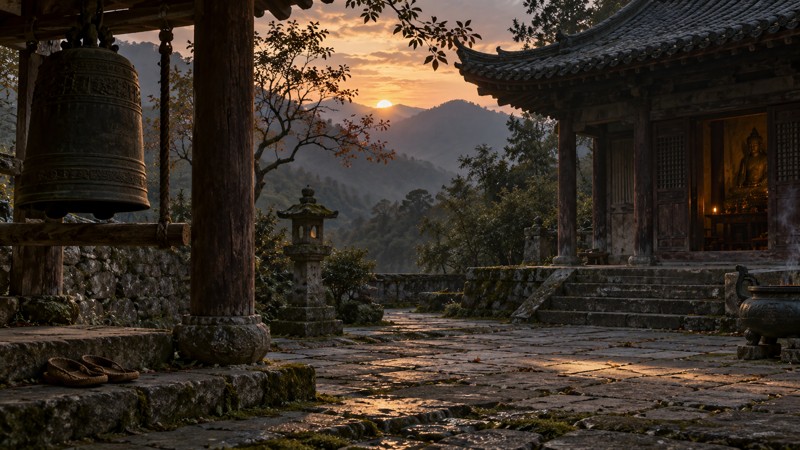
Wang Wei poetry stands as one of the most revered pillars of Tang Dynasty literature, blending visual artistry, philosophical depth, and serene observation to captivate readers across centuries. For both new learners and seasoned poetry enthusiasts, his works offer a window into the harmony between nature and human consciousness, setting a standard for landscape poetry that endures today.
What Wang Wei Poetry Means in Chinese Poetry
Wang Wei poetry is often misunderstood as mere nature verse, but it is far more: a masterclass in “empty stillness” (jing) and the art of showing the unspoken. Chinese poetry values the principle of jing yu yi—where a scene carries layers of meaning—and Wang Wei perfected this balance, turning mundane moments into profound insights.
Beginners frequently mistake his quiet tone for passivity, but his works require active reading: he invites readers to notice the faint sound of a bell in an empty valley, or the way light shifts through bamboo at dusk. This is not about ignoring the world, but about seeing its subtle rhythms, a skill that aligns with Chan (Zen) Buddhist teachings he embraced later in life.
Unlike the grand, sweeping odes of early Tang poets, Wang Wei’s verse favors restraint; every word serves a purpose, no excess allowed. For Chinese language learners, his short quatrains (four-line poems) are ideal: their brevity forces attention to detail, helping learners grasp both vocabulary and the poetic rhythm that defines Tang literature.
Historical and Cultural Background
Wang Wei lived during the mid-Tang Dynasty (701–761), a period when Tang poetry reached its golden age, and when court officials often turned to literature and philosophy to navigate political tension. A talented painter as well as a poet, he earned the nickname “Poet-Painter” for his ability to write verse that reads like a landscape painting—each line a brushstroke of color, light, or sound.
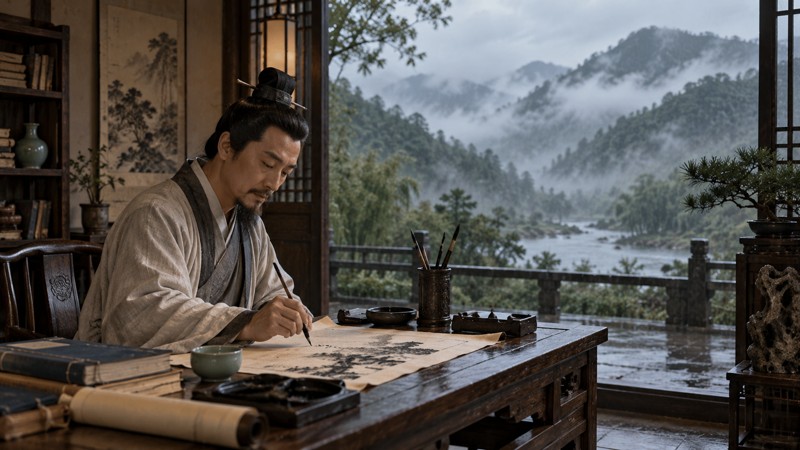
His early career as a court official exposed him to the grandeur of imperial life, but after political upheaval in the mid-8th century, he retreated to a rural estate in Lantian, where he wrote most of his iconic works. This shift from public duty to private reflection shaped his poetry: he moved from celebrating imperial victories to celebrating the quiet of mountain streams and bamboo groves.
In Chinese classrooms, Wang Wei is taught early because his poems bridge the gap between traditional and modern understanding of Tang poetry—they are accessible yet rich with cultural context, linking readers to the values of Chan Buddhism, rural retreat culture, and the Tang’s emphasis on harmony between humanity and nature.
Key Poems, Poets, or Examples
To truly grasp Wang Wei poetry, it helps to compare his work to other Tang masters, highlighting his unique style. The first example is Wang Wei’s own *Deer Enclosure (Lu Chai)*, a four-line quatrain: “Empty mountain, no one is seen / Yet hear human voices.
/ The setting sun enters the deep forest / Shines again on green moss.” Here, Wang Wei uses the contrast between absence (empty mountain) and presence (faint voices, sun on moss) to explore Chan ideas of emptiness as fullness. This poem teaches readers to look beyond surface details—what seems empty is actually alive with quiet life.
A second example is Li Bai’s *Quiet Night Thoughts (Jing Ye Si)*, though contrasting it with Wang Wei shows their different approaches to emotion. Li Bai’s work is direct, personal longing (“Looking up at the moon, looking down at home”), while Wang Wei’s emotion is subtle, woven into nature.
For deeper context on Li Bai’s style, readers can explore Complete Analysis of Li Bai’s “Quiet Night Thoughts”.
Third, Du Fu’s *Spring View (Chun Wang)* offers a counterpoint to Wang Wei’s quietism. Wang Wei Poetry Du Fu’s poem is raw, political, about the chaos of war: “The country is broken, mountains and rivers remain / City in spring, grass and trees deep.” This contrast shows Tang poetry’s two major streams: Du Fu’s social realism and Wang Wei’s introspective nature.
Understanding this duality helps readers see how Tang poets addressed both personal and collective experiences. To learn more about Du Fu’s work, visit Du Fu’s “Spring Prospect”: A Nation in Crisis.
Fourth, Meng Haoran’s *Spring Dawn (Chun Xiao)*, a contemporary of Wang Wei, illustrates the landscape poetry school’s diversity. Meng’s poem is simple: “Spring sleep unaware of dawn / Everywhere birds are singing.
/ Last night there was wind and rain / How many flowers have fallen?” While both Meng and Wang Wei focus on nature, Wang Wei’s work is layered with philosophical meaning, whereas Meng’s is conversational and observational. This comparison reveals how Wang Wei elevated landscape poetry from simple description to a tool for exploring deeper truths.
How to Read and Understand It
Reading Wang Wei poetry requires patience and attention to small details—something many beginners miss when rushing through translations. First, approach each line as a visual element: imagine the scene he describes, not just the words.
For example, in *Autumn Night in the Mountains*, the line “Bright moon shines on pine trees” is not just a description; it sets a quiet, luminous tone that reflects the poem’s mood of retreat. Second, respect the original Chinese structure: Tang quatrains have strict meter and line breaks, which shape the rhythm of the poem.
Reading aloud in a slow, measured way helps capture this rhythm, especially for English learners who are not used to poetic cadence in Chinese. A common mistake is prioritizing literal translation over nuance: phrases like “empty mountain” do not mean a place with nothing, but a space free of human disturbance, full of nature’s presence.
Expert judgment from Tang poetry scholars suggests: “Beginners should start with Wang Wei’s quatrains, as their length and focus make it easier to grasp his signature style before moving to longer, more complex works.” Finally, connect his work to his life: knowing he retreated to Lantian after political turmoil helps readers understand why his poems lean into peace and stillness.
Why It Still Matters Today
Wang Wei poetry remains relevant because its themes—mindfulness, connection to nature, and finding peace in chaos—resonate across cultures and time. In an age of constant digital distraction, his works act as a guide to slowing down: *Deer Enclosure* invites readers to listen for faint sounds, not just loud ones, a practice aligned with modern mindfulness.
Cross-culturally, English readers are drawn to Wang Wei because his poetry avoids the exoticism that can distance Western audiences from other forms of poetry; his focus on universal emotions (longing, tranquility) makes his work relatable. For Chinese cultural identity, Wang Wei’s poems are a staple: lines like those from *Quiet Night Thoughts* are known by every Chinese person, and his name is synonymous with the best of Tang poetry.
In education, both in China and abroad, his work is used to teach not just literature, but also Chan philosophy and the art of observation. Even in film and art, references to Wang Wei’s landscape scenes appear, linking his timeless vision to contemporary creativity.
Frequently Asked Questions
What is the meaning of wang wei poetry?
Wang Wei poetry refers to the works of the Tang Dynasty poet Wang Wei (699-761 CE), who is celebrated for his nature poetry that blends Buddhist philosophy with landscape imagery. His poems often convey a sense of tranquility, solitude, and harmony with nature, reflecting his deep spiritual awakening and mastery of painting through poetry.
Who wrote wang wei poetry and what is the historical context?
Wang Wei wrote wang wei poetry. He lived during the Tang Dynasty (618-907 CE), one of China’s golden ages of literature and art. Born in present-day Shanxi province, Wang Wei served as a government official and became associated with the literary and artistic circles of the Kaiyuan and Tianbao eras. His career was interrupted by the An Lushan Rebellion, after which he retired to a Buddhist monastery, profoundly influencing his later poetry.
What literary devices are used in wang wei poetry?
Wang Wei poetry employs numerous literary devices including vivid imagery of natural landscapes, personification of nature, juxtaposition of stillness and motion, and the use of Buddhist and Daoist symbolism. His characteristic “poetic painting” technique creates visual stillness through careful word choice, while his use of negative space and suggestion rather than explicit statement reflects his mastery of implication and subtlety.
What is the cultural significance of wang wei poetry?
Wang Wei poetry holds immense cultural significance as it represents the pinnacle of Tang Dynasty nature poetry and influenced generations of Chinese poets and painters. His integration of Buddhist enlightenment into landscape verse established a new poetic tradition. His work also contributed to the development of the “poetic painting” concept, where poetry and visual art were considered complementary forms of expression in Chinese culture.
How should wang wei poetry be interpreted?
Wang Wei poetry should be interpreted by considering its Buddhist and Daoist philosophical undertones, its vivid sensory imagery, and the poet’s personal spiritual journey. Readers should appreciate the poems’表面的山水描写 (surface-level landscape descriptions) while understanding the deeper spiritual meanings. The poems often reflect wuwei (non-action) and the unity of humanity with nature, requiring readers to slow down and contemplate the stillness within the verses.
How to Read Du Fu Poetry: Meaning and Background You’ve Been Reading Poems Wrong — Here’s Why Poem Generator App: 7 Hidden Meanings You Missed at First Re Wikipedia