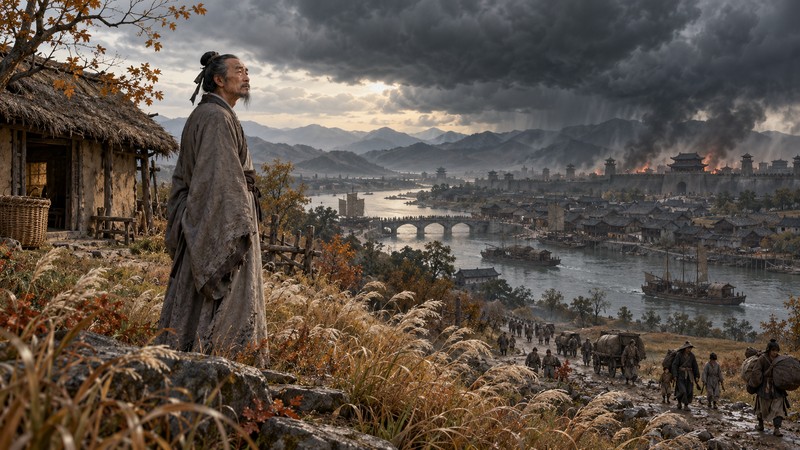
For anyone venturing into classical Chinese poetry, du fu poems are not just a collection of verses—they are a window into the soul of the Tang Dynasty, a golden age of literature that shaped East Asian culture for centuries. This article is for beginners curious about Tang poetry, students of Chinese culture, and poetry lovers seeking work that balances art with unflinching honesty.
By exploring Du Fu’s life, key works, and how to read his poems, readers will gain a deeper understanding of what makes classical Chinese poetry timeless.
What Du Fu Poems Means in Chinese Poetry
Many beginners new to Tang poetry assume all verses are carefree, romantic, or focused on natural beauty—but du fu poems shatter that myth by centering on human suffering and historical reality. Unlike the soaring, otherworldly lines of Li Bai, Du Fu’s work is rooted in the mundane struggles of ordinary people: farmers displaced by war, soldiers dying in distant campaigns, and families torn apart by political upheaval.
This shift marked a turning point in classical Chinese poetry, where before, most verses celebrated courtly life or personal glory. For Chinese learners, this realism is key—Du Fu’s poems are not just lines to memorize, but stories that reflect the values of empathy and sincerity that define traditional Chinese culture.
Du Fu’s poetry is often called “poetry of history” because his verses double as historical documents. Unlike official records that prioritize rulers and battles, Du Fu’s work amplifies the voices of the marginalized.
In his poem *The Song of the Wagons*, he writes of conscripted soldiers leaving their families, a detail not found in Tang court annals. This focus on collective experience redefines what poetry can do: it is a tool to bear witness, not just to express individual emotion.
For Western readers, this is a familiar concept—think of protest literature or war poetry—but in classical Chinese poetry, Du Fu was among the first to use verse for this purpose.
A common misconception is that Du Fu’s work is only sad or bleak. While his later poems (written after the An Lushan Rebellion) carry deep grief, Du Fu Poems his earlier verses show warmth and joy—like poems about his family’s small, happy moments.
This balance makes his work relatable: it captures the full spectrum of human emotion, from laughter to despair, which is why it remains beloved in China and beyond.
Historical and Cultural Background
Du Fu lived from 712 to 770, a lifetime that spanned the High Tang (618–755), the dynasty’s golden age of prosperity and cultural flourishing, to the Late Tang, when the An Lushan Rebellion (755–763) shattered the empire. Born into a scholar-official family, Du Fu failed the imperial exam twice, a setback that left him struggling to find a place in court.
This experience of being an outsider allowed him to connect with common people, a perspective that would shape his poetry.
The An Lushan Rebellion was a turning point not just for Du Fu, Du Fu Poems but for all of Tang poetry. The rebel leader An Lushan seized the capital Chang’an (modern Xi’an), forcing Du Fu to flee with his family.
He was captured and held in Chang’an for a year, a period that inspired his most famous work, *Spring Prospect*. This event turned his poetry from gentle observations to urgent cries of loss—his verses now recorded the chaos of war, the destruction of cities, and the longing for home.
For Chinese culture, this rebellion marked the end of the Tang’s golden age, and Du Fu’s poems became a way to remember the empire’s decline.
Tang Dynasty culture valued “xin” (sincerity) in poetry, and Du Fu embodied this ideal more than any other poet. Unlike poets who used elaborate metaphors to impress the court, Du Fu wrote in a straightforward, colloquial style when addressing common themes.
This authenticity made his work accessible to all, not just the educated elite. For students of classical Chinese poetry, understanding this cultural context is essential—without knowing about the An Lushan Rebellion, many of Du Fu’s lines lose their emotional weight.
Key Poems, Poets, or Examples
To understand du fu poems, comparing his work to other Tang poets reveals his unique voice. Here are four concrete examples that highlight his style and impact:
First, Du Fu’s *Spring Prospect* (757). Written when Du Fu was 45 and captured in Chang’an during the An Lushan Rebellion, this poem describes the ruins of the capital: “The city of Chang’an is in ruins, only mountains and rivers remain / The plants and trees of the capital grow thick and wild.” The poem blends personal grief—longing for his wife and son, who were displaced—with national loss.
Famous translations include Witter Bynner’s lyrical version and Arthur Cooper’s literal translation. Readers learn that Du Fu’s realism is not just about describing destruction, but about personifying nature to mirror human sorrow (lines like “Flowers shed tears, birds startle at parting” give the natural world human emotion to reflect his pain).
Second, Li Bai’s *Quiet Night Thoughts* (c. Du Fu Poems 726).
A contemporary of Du Fu, Li Bai was part of the High Tang’s romantic school, known for his carefree, otherworldly verses. *Quiet Night Thoughts* is a simple poem about a traveler looking at moonlight and missing home: “Before my bed, there is bright light / I suspect it is frost on the ground / I look up at the mountain moon / I bow my head and think of my hometown.” Comparing this to Du Fu’s *Spring Prospect* shows two sides of Tang poetry: Li Bai focuses on individual longing, while Du Fu expands that longing to include an entire nation.
This contrast helps readers understand why Du Fu’s work is often seen as the foundation of Tang realism.
Third, Wang Wei’s *The Deer Fence* (c. 740).
Wang Wei, a friend of Du Fu, was a master of landscape poetry, with verses that capture nature’s tranquility. *The Deer Fence* describes a quiet bamboo forest: “Empty mountains, no one to be seen / Only the sound of voices echoes / The sun’s rays enter the deep forest / And shine on the green moss.” This example shows another key Tang poetry style—focus on harmony with nature—contrasting with Du Fu’s focus on human struggle.
For beginners, this teaches that Tang poetry has diverse voices, not just one “correct” style.
Fourth, Du Fu’s *The Song of the Wagons* (751). Du Fu Poems This is a long, folk-style poem about the Tang’s failed campaign against the Tibetan Empire, where soldiers were conscripted and sent to die.
Du Fu uses colloquial language to give voice to a soldier’s mother: “When I was young, I married your father / He went to war and never came back / Now your son is taken to the front line / The border is so far, how will he return?” This poem is a prime example of Du Fu’s ability to give marginalized people a voice—something that makes his work relatable even today. Readers learn that Du Fu’s realism is not just historical; it’s about empathy for those forgotten by power.
How to Read and Understand It
Reading du fu poems requires slowing down and paying attention to both form and context. Unlike Western poetry that often relies on rhyme or meter for rhythm, classical Chinese poetry uses tonal patterns and line length to create rhythm.
For example, Du Fu’s *Spring Prospect* is a five-character-per-line poem, a strict form that forces conciseness—each line carries more meaning than a longer line in English. Beginners should start with shorter poems, like *Quiet Night Thoughts*, to get used to this rhythm before moving to longer works like *The Song of the Wagons*.
Translations of du fu poems can vary widely, and beginners should compare multiple versions to grasp the nuance. For *Spring Prospect*, Witter Bynner’s version is more lyrical (“The capital is broken, mountains and rivers remain”) while Arthur Cooper’s is more literal (“The city of Chang’an is in ruins, only mountains and rivers are left”).
Neither is “better”—they offer different perspectives, and understanding these differences helps readers appreciate how poetry translates across cultures. For English learners, pairing translations with the original Chinese (if accessible) helps with tone and imagery, as many of Du Fu’s lines lose subtlety in translation.
Context is critical to understanding du fu poems. To fully grasp *Spring Prospect*, readers need to know about the An Lushan Rebellion—why Chang’an was in ruins, why Du Fu was separated from his family.
Many beginners make the mistake of reading Du Fu’s poems in isolation, but his work is deeply tied to the events of his lifetime. For students of Chinese poetry, this means pairing Du Fu’s verses with a timeline of Tang history, so each line makes sense in its historical context.
This approach not only makes the poems more meaningful, but also teaches how literature reflects the times it is written in.
Why It Still Matters Today
Du Fu’s work remains relevant because it speaks to universal human experiences: loss, Du Fu Poems longing, empathy, and hope. For overseas Chinese, his poems are a link to their cultural roots—reciting *Quiet Night Thoughts* at family gatherings or teaching *Spring Prospect* to children connects them to their ancestors and the history of their homeland.
For Western readers, Du Fu’s focus on collective suffering and empathy resonates with modern issues like war, displacement, and inequality. Unlike many classical poets, his work is not distant—it feels like it was written yesterday.
In education, du fu poems are a gateway to classical Chinese poetry. For students learning Chinese, Du Fu’s verses are often taught in schools because they balance beauty with simplicity, making them easy to memorize while also teaching key vocabulary and grammar.
For poetry lovers, his work shows that great poetry is not just about form—it’s about telling the stories of people who are often overlooked. This is why Du Fu is called the “Poet-Historian”: he recorded not just battles, but the lives of ordinary people, a legacy that endures.
Cross-culturally, du fu poems help bridge the gap between Chinese and Western literature. Unlike Li Bai, who is often seen as a romantic counterpart to Western poets like Wordsworth, Du Fu’s realism aligns with modern literary traditions of social commentary.
This makes his work accessible to readers who might not be familiar with classical Chinese culture, yet still connect to his themes. For example, *The Song of the Wagons* could be compared to Western anti-war poems, showing that the human experience of war is universal.
Frequently Asked Questions
What is the meaning of Du Fu poems?
Du Fu poems are renowned for their profound social commentary, capturing the realities of common people during the Tang Dynasty’s turbulent period. They express deep empathy for the poor and displaced, reflect on the human condition, and celebrate the beauty of nature while also mourning the suffering caused by war and political instability.
Who wrote Du Fu poems and what is the historical context?
Du Fu (712-770 AD) wrote these poems during the An Lushan Rebellion (755-763), one of the deadliest conflicts in human history. As a court official who witnessed the fall of Chang’an and lived through years of displacement, his poetry documents the social upheaval, famine, and political corruption of his era, making his work a vital historical record.
What literary devices are used in Du Fu poems?
Du Fu employed sophisticated literary techniques including vivid imagery, precise diction, strict regulated verse forms (律詩), and powerful metaphors. He masterfully used parallelism, allusion to classical works, and tonal patterns characteristic of Tang poetry, while his use of contrast between natural beauty and human suffering creates striking emotional impact.
What is the cultural significance of Du Fu poems?
Du Fu is venerated as the “Poet-Historian” (詩聖) in Chinese literary tradition. His poems became models of ethical poetry, influencing generations of Chinese writers. He is regarded alongside Li Bai as one of the greatest Tang poets, and his works are memorized in Chinese schools today, symbolizing Confucian ideals of social responsibility and moral integrity in literature.
How should Du Fu poems be interpreted?
Du Fu poems should be interpreted with attention to their historical context, paying close attention to his use of concrete imagery and specific details about everyday life. Readers should consider his dual perspective as both a displaced scholar-official and a compassionate observer of common people’s suffering, while appreciating how he weaves personal emotion with broader social commentary.
Chinese Poem Translation: Tang Poetry Guide and Cultural Con Ai Poem Writer Free: 7 Hidden Meanings You Missed at First R Chinese Poetry Translation: Major Poets, Poems and Legacy Wikipedia