For readers looking for romantic Chinese poets, Yuan Zhen and Li Qingzhao offer starting points for love and longing, while Li Bai shows how poetry can create imagined companionship. These are two different uses of “romantic”: writing about attachment, and writing that transforms a scene through imagination. They should not be treated as one school, one dynasty or one shared approach to love.
The useful choice is a poem, rather than a personality label. A speaker remembering an irreplaceable person does something different from a speaker imagining two people longing in separate places. Neither scene is automatically a verified entry in its author’s diary. The examples below identify the Chinese text, show short excerpts and explain what an English reader can notice. The English renderings are newly written reading aids for this article, not quotations from published translators.

Three poets: reference facts and a reading choice
| Poet | Text to start with | What the selected text does |
|---|---|---|
| 元稹, Yuán Zhěn — Tang | 离思五首·其四, Lí Sī Wǔ Shǒu, no.4 | Uses sea and cloud comparisons to describe an attachment that makes alternatives seem inadequate |
| 李清照, Lǐ Qīngzhào — Song | 一剪梅, Yì Jiǎn Méi, beginning 红藕香残玉簟秋 | Moves through autumn images into the idea of shared longing across two places |
| 李白, Lǐ Bái — Tang | 月下独酌四首·其一, Yuè Xià Dú Zhuó Sì Shǒu, no.1 | Invents companions in the moon and a shadow while preserving awareness of solitude |
This is a small reading selection, not a ranking of the most romantic writers. The Mandarin pinyin helps identify names and titles; it does not reproduce the historical sound of Tang or Song performance. Read a complete text after the excerpt, especially when choosing a line for a card, ceremony or personal message.
Yuan Zhen: the language of an irreplaceable attachment
The fourth poem in Yuan Zhen’s five-poem Li Si sequence opens with a comparison whose scale is much larger than a direct declaration of affection:
曾经沧海难为水,除却巫山不是云。
Céng jīng cāng hǎi nán wéi shuǐ, chú què Wū Shān bú shì yún.
Original English reading aid: “After the vast sea, other waters scarcely count; apart from Wushan, other clouds are not clouds.” The English supplies “other” to make the comparison explicit. The Chinese compresses that contrast; it is not a statement about which geographical waters or clouds physically exist.
The rest of the four-line poem matters. The speaker turns away from flowers and divides the explanation between cultivating the Way and the addressed “you.” A quotation of only the first couplet leaves out that divided explanation. The poem can help a reader think about the continuing force of an attachment, but the lines alone do not establish a complete account of whom the poet loved, when he wrote them or how faithfully he behaved throughout his life.
For a romantic message, this is also a tonal choice: the comparison is absolute and retrospective. It may suit remembrance better than a light first declaration. Read the recipient’s situation before borrowing it. A memorable line about an incomparable attachment is not automatically a cheerful wedding blessing.
Li Qingzhao: one longing imagined in two places
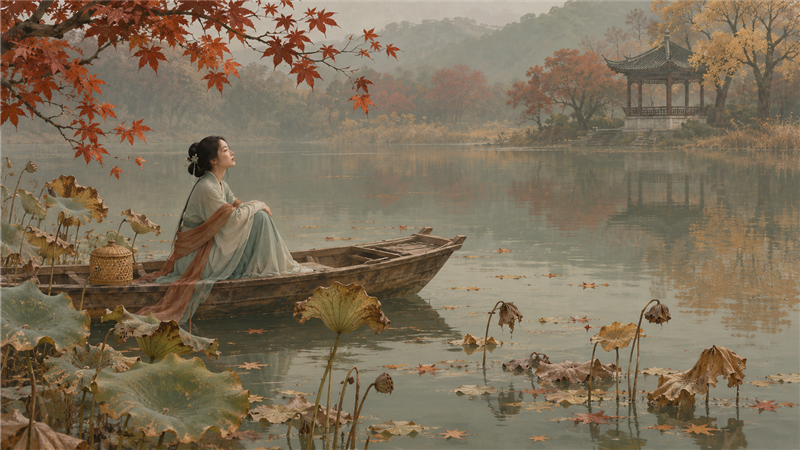
Li Qingzhao’s Yi Jian Mei, beginning 红藕香残玉簟秋, is a ci lyric. The tune-pattern title is not a unique title used only by this author; the opening words identify this particular work. Its autumn setting, boat, anticipated letter and moonlit tower prepare the movement toward longing.
一种相思,两处闲愁。
Yì zhǒng xiāng sī, liǎng chù xián chóu.
Original English reading aid: “One longing, an idle sorrow in two places.” “Idle” here is a deliberately literal aid for 闲, not a claim that the feeling is trivial. The important movement is numerical: one shared attachment, two separated locations. The later lines describe feeling passing from the brow back into the heart, so the emotion does not simply disappear when an outward expression changes.
It is tempting to add a detailed reunion story or identify every image with an event in the author’s marriage. That requires evidence beyond these lines. Stanford’s introduction to another Li Qingzhao lyric explains that ci follows pre-existing tune patterns and that translators often infer speaker and perspective from context. The introduction supports that genre and translation caution; it is not the source text for this Yi Jian Mei excerpt.
Li Bai: imaginative companionship is not a love scene
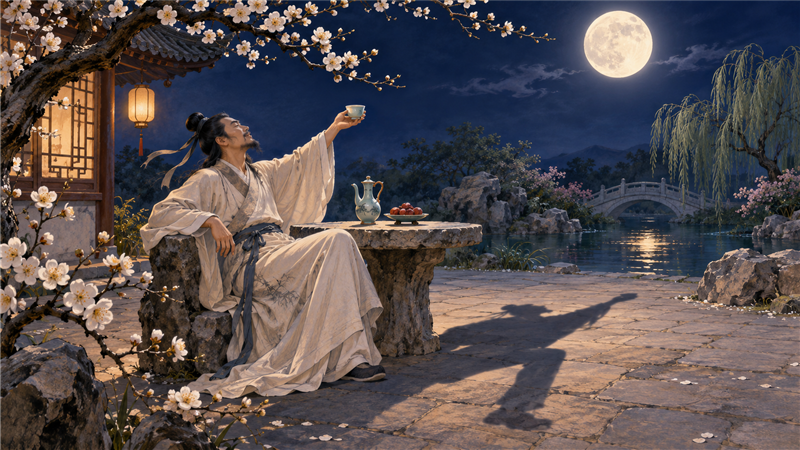
The first poem in Li Bai’s Drinking Alone under the Moon sequence begins with solitary drinking among flowers, then creates a remarkable gathering:
举杯邀明月,对影成三人。
Jǔ bēi yāo míng yuè, duì yǐng chéng sān rén.
Original English reading aid: “I raise my cup to invite the bright moon; facing my shadow, we become three.” The three are the speaker, the moon and the shadow. They are not three human friends seated at a table.
The following lines recognize that the moon cannot understand drinking and the shadow only follows the speaker. That qualification keeps the imaginative company and the underlying solitude present together. This makes a useful example for a reader using “romantic” to mean imaginative or expansive. It does not make the selected passage an address to a lover, and it should not be described as a witnessed dinner from the poet’s life.
For a fuller treatment of these images, continue to our Li Bai moon poems guide. The scene illustrates a literary device; it is not advice to use alcohol to manage loneliness.
Choose an excerpt by the feeling and occasion
Start with what you want to say. Yuan Zhen’s selected poem looks back toward an attachment that changes how other possibilities appear. Li Qingzhao’s lyric imagines related feeling across separation. Li Bai’s moonlit scene creates company through an act of imagination. A quiet image is not necessarily a love poem, and an emotionally intense poem is not necessarily a declaration of romantic love.
Before using a quotation, check the full work, author, title or tune pattern, and the translator’s name. If you adapt an English version, identify the adaptation rather than placing it in quotation marks as someone else’s published translation. Keep Chinese characters beside a short English rendering when space allows: this helps readers locate the text even when English titles vary.
If you are choosing a first poet more broadly, the famous Chinese poets reading map compares different periods and scenes. Here the comparison is narrower: what kind of attachment or imagination a specific text actually puts into words.
Romantic Chinese poets FAQ
Which romantic Chinese poets should I read for love and longing?
Yuan Zhen’s fourth Li Si poem and Li Qingzhao’s Yi Jian Mei beginning 红藕香残玉簟秋 are useful starting texts. Read their complete works and distinguish the poem’s speaker from a proven account of the author’s life.
Does romantic Chinese poetry always mean love poetry?
No. In English, romantic can refer to attachment or to imaginative qualities. The Li Bai passage discussed here invents company in the moon and a shadow rather than describing a human couple.
Are the English excerpts on this page established translations?
No. They are original English reading aids written for this article. They explain selected Chinese lines without claiming to replace a complete scholarly translation.