Early Chinese poetry offers more than a list of famous writers. Two useful starting points before Tang verse are Shijing, the Book of Songs, and Chu Ci. Read a short passage from each with its collection title and source beside it, then notice how sound and landscape shape the voice.
This is a first-reading guide to two excerpts, not a complete history. Chinese quotations retain the traditional characters in the linked texts. The English reading aids are newly written for this page; they do not reproduce a published translator’s wording or settle every interpretive question.
- Collection and tradition
- Shijing 詩經 and Chu Ci 楚辭: two early bodies of verse.
- Poem and section
- 關雎 in Shijing; 湘夫人 in the 九歌 group of Chu Ci.
- Text source
- Linked transmitted Chinese texts, with university context notes.
- Attribution boundary
- A collection title, a poem’s speaker and a historical author are different things.
Two early traditions before the Tang
If your first encounter with Chinese poetry was Li Bai or Du Fu, step back from the individual-poet introduction for a moment. Begin instead with a collection and a short text. That change makes room for works whose transmission, editing and attribution are more complicated than a modern author-and-book label suggests.
Columbia’s introduction to the Classic of Odes describes a compilation of popular and aristocratic Zhou songs and cautions that transmitted songs may have been edited. It is useful context for Shijing, rather than proof that a surviving text preserves one untouched performance.
Chu poetry gives us another early context. Columbia’s introduction to “Li Sao” places the Chu tradition in the Yangzi valley within the wider Zhou world and notes uncertainties surrounding Qu Yuan’s biography. Keep that contextual note separate from the wording of the particular poem you read.
Shijing: hear the repeated call in Guan Ju
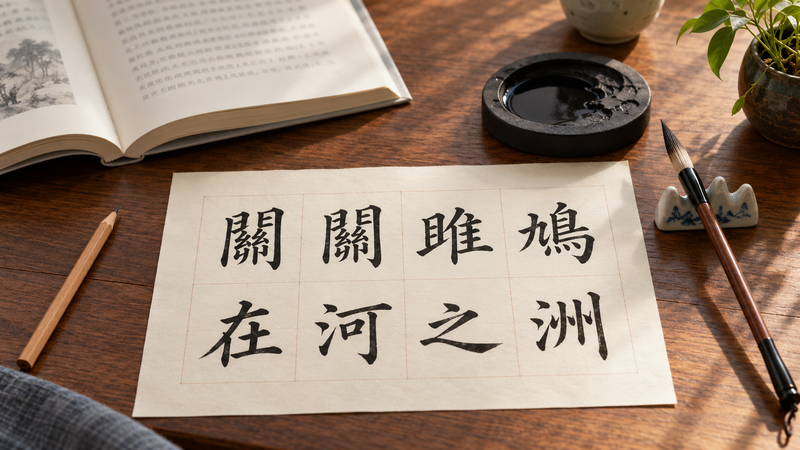
Start with the opening of 關雎, “Guan Ju,” in Shijing:
關關雎鳩,
在河之洲。
Original reading aid: Calling waterbirds, on an islet in the river.
The repeated 關關 places a sound before us, followed by birds and a river setting. Try reading the two four-character groups slowly, pausing between them. Then look at the following lines of the poem, where the attention turns toward a desired human companion. The opening is part of that larger movement, not a self-contained wildlife description.

For a first reading, notice the repeated sound without forcing a complete symbolic explanation onto every object. You might hear an answering call or notice how the scene prepares for human feeling. Those are reading observations to test against the rest of the poem, not a secure biography of the person who first composed it.
Chu Ci: follow wind, waves and falling leaves
Now turn to 湘夫人, “Xiang Fu Ren,” in the Nine Songs:
嫋嫋兮秋風,
洞庭波兮木葉下。
Original reading aid: The autumn wind moves softly; Dongting ripples, and tree leaves fall.
Keep three things in view: wind, moving water and falling leaves. Read the phrases once with a slight pause at each 兮. The movement differs from the even four-character groups quoted above. This is an observation about these passages, not a rule that every line in either collection follows one pattern.

The surrounding poem includes looking into the distance and an anticipated meeting. Read the autumn scene alongside those actions. A landscape can participate in a voice of expectation or unease without becoming a diary entry proving where an author stood on a particular day.
The linked page places this poem within 九歌, “Nine Songs,” and traditionally attributes it to Qu Yuan. Preserve that attribution note while keeping the poem’s speaker distinct from a confidently reconstructed personal experience.
Keep the anthology, poem and speaker separate
Make a small reading record with four entries: collection, poem, source text and attribution note. For the second excerpt, the collection is Chu Ci, the group is Nine Songs, and the poem is Xiang Fu Ren. A source page’s author label belongs in a separate field from the words spoken within the poem.
The Chu Ci table of contents makes one distinction immediately visible: the anthology contains separate works, including Li Sao and Nine Songs. Do not enter “Chu Ci” as though it were a poet’s name or assume that one author label explains the entire collection.
Apply the same care to Shijing. A title such as “Book of Songs” identifies a body of verse. To discuss one passage accurately, keep the individual poem’s title beside it. If your edition adds commentary or an attribution, label that information rather than blending it silently into the poem itself.
Build a first reading from the words on the page
Choose one excerpt and write down only what it explicitly supplies. For Guan Ju, that includes the repeated opening sound, birds and an islet. For Xiang Fu Ren, it includes autumn wind, Dongting water and leaves coming down. Keep your first note concrete before deciding what mood the scene creates.
Then add a second note beginning “I read this as…” That wording helps separate interpretation from quotation. You might describe the first opening as a movement from sound into a scene, or the second as a landscape that becomes restless through motion. Support the description with a particular word or phrase.
Finally, compare your English reading aid with a published translation in an identified edition. Notice which words each version makes explicit and which it leaves open. Credit that translator if quoting their work. A modern Mandarin reading can help you attend to the written phrases, but it should not be presented as the sound of an ancient performance.
Continue with the Chinese poetry reading method if you want a way to organise textual observations. For a later route organised around individual writers, use the guide to famous Chinese poets and first texts.
Questions about early Chinese poetry
Are Shijing and Chu Ci the names of poets?
No. They name collections or bodies of verse. Identify the individual poem and its place in the collection, then record any author attribution separately.
Did every poem in Chu Ci have the same author?
Do not make that assumption. It is an anthology containing separate works. Check the attribution and editorial notes for the particular text rather than assigning the whole collection to one person.
Are the English reading aids published translations?
No. They were written for this page to help readers follow the selected Chinese images and actions. They are not quotations from the modern translations linked through the university resources or definitive versions of the poems.
Does reading these lines in Mandarin reproduce their ancient sound?
No. Modern Mandarin reading is a present-day way to approach the written text. It is different from reconstructing historical pronunciation or claiming to reproduce an early performance.