Chinese poetry analysis works best when it begins with what the poem actually says and does, then moves toward interpretation. A useful reading separates five layers: the base text, syntax, sensory sequence, formal relationships, and historical or translation context. This prevents a familiar problem: deciding what a poem “means” first and then forcing every image to support that answer.
This guide demonstrates the method with Wang Wei’s short Tang poem Deer Enclosure (鹿柴). The example is compact enough to inspect closely, but the same sequence can be used for longer poems.
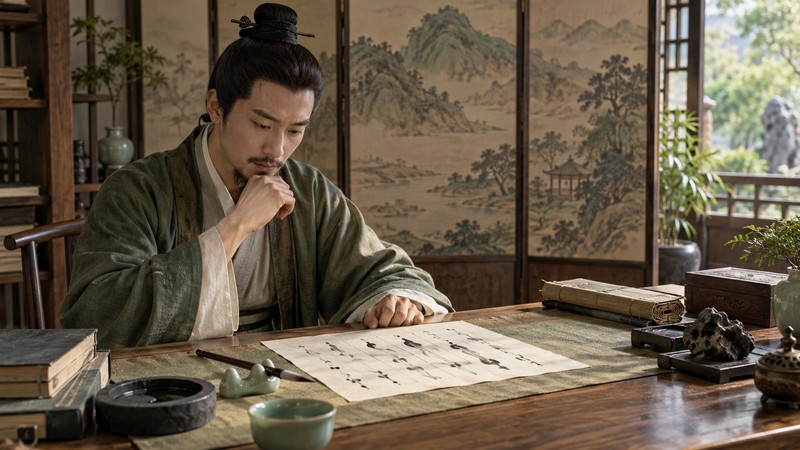
The five-step method at a glance
- Establish the text and form. Confirm the wording, author, title, line count, and the edition or source you are using.
- Build a literal syntax map. Identify actions, objects, modifiers, omitted subjects, and words with more than one plausible sense.
- Track the sensory sequence. Record what the reader sees, hears, and notices as each line changes the scene.
- Examine relationships. Look for parallel positions, contrasts, repetitions, shifts, rhythm, rhyme, and line boundaries.
- Test interpretation against evidence. Add context and translation choices, but mark clearly what is observed and what is inferred.
Strong analysis moves from textual evidence to interpretation. It does not treat biography, symbolism, or an English translation as a substitute for reading the poem.
Worked text: Wang Wei’s Deer Enclosure
The Chinese Text Project records the poem in the Complete Tang Poems under Wang Wei’s Wang River collection. The source text is available in the Chinese Text Project edition of 鹿柴:
空山不見人,
但聞人語響。
返景入深林,
復照青苔上。
A deliberately literal working gloss is: “Empty mountain; no person is seen. / Yet human voices are heard. / Returning light enters the deep forest / and shines again upon green moss.” This is a reading aid, not a claim that one English version can preserve every feature of the Chinese.
Step 1: establish the text before interpreting it
Start by writing down only verifiable facts. The poem has four lines, each with five Chinese characters. It is attributed to Wang Wei and titled 鹿柴. The textual source should be named because punctuation, character variants, romanization, and translation may differ among editions.
Form matters, but labels should be used carefully. A four-line, five-character poem can be discussed as a compact quatrain; formal classification also involves sound patterns that are not visible in an English translation. Columbia University’s Asia for Educators demonstrates why learners should keep the Chinese text, romanization, individual word meanings, and literary translation distinct in its presentation of Du Fu’s “Spring Gaze”.
Step 2: map the syntax and unresolved choices
Classical Chinese often omits information that English grammar expects. In the first two lines, the poem does not explicitly state an “I.” A translator may write “I see no one” for natural English, but an analyst should remember that the Chinese more directly presents “no person is seen.” The difference affects the scene: one version foregrounds an observer, while the other leaves perception less personalized.
Several compact phrases also carry choices. 空山 can describe an empty mountain, a seemingly empty mountain, or a mountain marked by spaciousness and quiet. 人語響 joins human speech with resonance or sound. 返景 refers to returning or reflected light, commonly understood as rays of the setting sun. Record these possibilities before selecting one.
Step 3: follow the sensory sequence
The poem does not simply list mountain, voices, forest, light, and moss. It arranges them as a sequence:
- Line 1: sight fails to find a person.
- Line 2: hearing reveals human presence indirectly.
- Line 3: light moves into a deep, shaded space.
- Line 4: the light reaches a small surface, the green moss.
This progression narrows attention. The scene moves from mountain scale to a patch of moss, and from absence to indirect presence. That observation is stronger than a vague statement that the poem is “about nature,” because it identifies how the poem guides perception.

Step 4: examine contrast, pairing, and form
The first pair of lines places not seeing beside hearing. The second pair places deep forest beside returning light. These are not decorative opposites; each second line changes the reader’s understanding of the first.
Parallel structures can also operate within longer regulated verse. In an Asia for Educators discussion of Wang Wei, scholar Paul Rouzer shows how matched grammatical positions place nouns, verbs, and settings against one another, and how those juxtapositions contribute to meaning. The Wang Wei lesson on parallel couplets is useful here because it treats form as a relationship between words and images, not as a checklist detached from interpretation.
Do not assume that every Chinese poem follows the same tonal or parallel rules. First identify the poem’s period and form; then decide which formal tools are relevant. An English translation can reproduce contrast and lineation, but it cannot automatically reproduce the sound system of the original.
Step 5: test interpretations instead of announcing one answer
At least three readings can be tested against Deer Enclosure:
- Perceptual reading: the poem stages how sight, hearing, and light reveal a place in different ways.
- Solitude reading: human beings are not visible, yet voices prevent the landscape from becoming completely uninhabited.
- Contemplative reading: attention settles on a brief illumination within shade, making a small change feel significant.
All three are plausible because they can point to the sequence of the lines. None should be presented as the only possible meaning without further evidence. Biography or religious context may deepen a reading, but they should not erase the poem’s ambiguity.

A reusable analysis worksheet
For any poem, make three short lists before writing a paragraph:
- Textual evidence
- Exact words, line order, repeated elements, contrasts, and formal features.
- Translation decisions
- Added pronouns, tense, articles, word senses, and details that English makes explicit.
- Interpretive claims
- What the poem may suggest, plus the specific lines that support each claim.
Then write one sentence that connects all three: “The shift from an unseen person to audible voices makes the mountain feel quiet but not uninhabited.” A sentence like this is arguable, specific, and grounded in the poem.
For additional practice, compare this method with our guide on how to read Chinese poetry, then examine how interpretive choices change in Chinese poetry in English. Readers focusing on this poet can continue with the Wang Wei poetry overview.
Frequently asked questions
Do I need to know Chinese to analyze Chinese poetry?
No, but you should use a source that keeps the original text visible and compare more than one translation when a key word matters. Mark conclusions based only on translation as provisional.
Should historical context come before close reading?
Usually, begin with the text and then add the context needed to test or refine your reading. Starting with a biography can tempt you to turn every image into a biographical symbol.
How can I avoid overinterpreting an image?
Describe what the image does in the poem before assigning symbolism. Check whether the interpretation explains the line sequence, contrast, or wording better than a simpler reading.
Can an English translation preserve the poem’s form?
It can preserve selected features such as line count, parallelism, image order, or brevity, but usually not every feature at once. State which qualities the translation prioritizes.