
If you’ve ever found solace in lines about moonlit nights or soaring mountains, you’ve likely encountered li bai poetry—work that defines the romantic, free-spirited essence of Tang Dynasty poetry, a golden age of Chinese verse that still captivates readers worldwide. For beginners and seasoned lovers alike, understanding li bai poetry unlocks not just beautiful words, but a window into ancient Chinese culture and the poet’s legendary life.
What Li Bai Poetry Means in Chinese Poetry
Many new readers mistakenly reduce li bai poetry to the work of a drunken, carefree poet—a stereotype fueled by tales of his wine-fueled gatherings and poetic improvisations. But this misses the core of his verse: a deep reverence for nature, a rejection of rigid social norms, and a longing for connection to something larger than himself.
Unlike some Tang poets who adhered strictly to Confucian ideals of duty and order, Li Bai embraced Taoist philosophy, which emphasizes harmony with the natural world and the pursuit of personal freedom. This tension between social expectation and individual spirit runs through every line of his work, making it relatable across centuries.
In Chinese poetic tradition, Li Bai is known as Shi Xian, the “Immortal Poet”—a title that elevates him beyond a mere mortal writer. This label reflects his ability to blend the mundane with the mystical, turning ordinary moments (like a sip of wine or a glance at the moon) into profound meditations on existence.
For example, his poem “Quiet Night Thoughts” uses a simple scene of a man staring at moonlight to explore the universal experience of homesickness, a theme that resonates with anyone who has felt far from loved ones. This is why li bai poetry is often the first introduction to Tang poetry for students in China and abroad: it balances accessibility with depth, inviting readers to engage without requiring extensive prior knowledge of classical Chinese.
Another key aspect of li bai poetry is its focus on imagery that transcends language. Where Western poetry might rely on extended metaphors, Li Bai uses concise, vivid details—like the “thousand-foot waterfall” of Mount Lu or the “jade rabbit” (moon) in the sky—to convey emotion.
These images are not decorative; they are central to the meaning of the poem. For instance, in “View of Mount Lu,” the waterfall is not just a natural feature but a symbol of the sublime power of nature, which dwarfs human concerns and reminds readers of their place in the universe.
This approach to imagery is a hallmark of Tang poetry, and Li Bai mastered it better than most of his contemporaries.
For readers new to classical Chinese poetry, li bai poetry serves as a gateway to understanding the form and function of Tang verse. Tang poetry is divided into two main forms: jueju (four-line poems) and lushi (eight-line poems), both with strict tonal and rhyme schemes.
Li Bai excelled at both, but his jueju are particularly famous for their brevity and emotional punch. A beginner can start with these short poems, learning to recognize the patterns of tone and rhyme while connecting with the themes of freedom and wonder that define his work.
This foundational understanding then makes it easier to explore longer, more complex poems by other Tang poets like Du Fu or Wang Wei.
Historical and Cultural Background
Li Bai lived during the Tang Dynasty (618–907), Li Bai Poetry often called the golden age of Chinese poetry. This was a time when poetry was not just a literary art but a central part of social life: scholars recited poems at banquets, used them to express loyalty or affection, and even included poetic compositions in the imperial examinations that determined official careers.
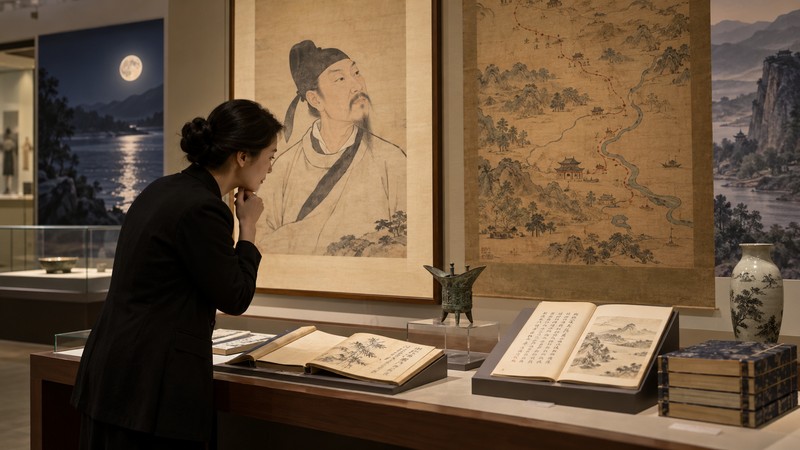
Li Bai was born in 701, in a region that is now part of Sichuan, and spent much of his life wandering across China, a choice that was unusual for a man of his time. Unlike many poets who settled in the capital Chang’an (modern Xi’an) to pursue official roles, Li Bai preferred to travel, seeking out mountains, rivers, and like-minded scholars.
This wanderlust is evident in his poems, which are filled with descriptions of far-flung places and encounters with ordinary people.
The Tang Dynasty was also a period of political upheaval, particularly in the later years of Li Bai’s life. The An Lushan Rebellion (755–763) shattered the dynasty’s peace, leading to widespread chaos and displacement.
Li Bai, who had briefly served in the imperial court, was caught up in the conflict and spent time in exile. This experience of loss and uncertainty deepened his poetry, adding a layer of melancholy to his earlier celebration of freedom.
For example, his poem “The Hard Road to Shu” was written during this period, reflecting the dangers of travel and the fragility of life, even as it still retains his signature awe at nature’s power. This connection between personal experience and historical events is a key feature of Tang poetry, and Li Bai’s work is a powerful example of how poets responded to their times.
Tang culture was a mix of Confucian, Taoist, and Buddhist traditions, and Li Bai’s poetry draws on all three. Confucianism emphasizes duty to family and society, which is why many Tang poets wrote about their desire to serve the emperor and the state.
Taoism, which Li Bai embraced fully, focuses on living in harmony with nature and achieving spiritual immortality, themes that appear in his poems about mountains, rivers, and the moon. Buddhism, too, influenced his work, particularly in his meditations on impermanence.
This syncretism is why li bai poetry feels both timeless and deeply rooted in its cultural context: it speaks to universal human experiences while reflecting the values of Tang Dynasty China.
In Chinese classrooms, li bai poetry has been a staple for over a thousand years. Primary school students learn short poems like “Quiet Night Thoughts” to practice character writing and basic poetic concepts, while secondary school students study longer works to analyze their structure and meaning.
This educational tradition has helped keep Li Bai’s work alive, making him a household name in China. For international learners, this means that li bai poetry is not just a set of ancient lines but a living part of Chinese culture, with lessons that still apply today.
When you read Li Bai’s poem about missing home, you are connecting with a tradition that has been passed down through generations of Chinese people.
Key Poems, Poets, or Examples
To truly understand li bai poetry, it helps to look at specific works that showcase his style and themes. The most famous of these is “Quiet Night Thoughts” (Jing Ye Si), a four-line jueju written around 726, when Li Bai was traveling in Yangzhou, far from his family in Sichuan.
The poem’s Chinese original is: “ / / / .” Translated literally, this means: “Before the bed, bright moonlight / I suspect it’s frost on the ground / I raise my head to look at the bright moon / I lower my head to think of my hometown.” The beauty of this poem lies in its simplicity: every word serves a purpose, and the emotion of homesickness is conveyed without elaborate language. Multiple English translations exist, but even the most literal versions capture the core feeling, making it accessible to readers who may not know classical Chinese.
This is why “Quiet Night Thoughts” is often called the most famous poem in Chinese history, and it’s a perfect entry point for anyone new to li bai poetry. For a deeper dive into this work, explore our complete analysis of Li Bai’s “Quiet Night Thoughts”.
Another iconic work is “View of Mount Lu” (Wang Lu Shan Pu Bu), a seven-line poem (a rare form for Li Bai) written during his travels to Mount Lu in Jiangxi. The poem describes the waterfall cascading down the mountain: “ / / / .” Translated, this is: “The sun illuminates the incense burner peak, creating purple smoke / From afar, the waterfall hangs across the river / It flows straight down for three thousand feet / I suspect the Milky Way has fallen from the sky.” Here, Li Bai uses hyperbole (three thousand feet) and a vivid comparison to the Milky Way to convey the awe of seeing such a natural wonder.
This poem is a masterclass in how li bai poetry blends imagination with reality, turning a simple waterfall into a cosmic event. It also shows his ability to capture the beauty of nature, a theme that runs through much of his work.
To contrast Li Bai’s romantic style with another Tang poet, consider Du Fu’s “Spring View” (Chun Wang), an eight-line lushi written during the An Lushan Rebellion. Du Fu, often called Li Bai’s contemporary and equal, focused on realism and the suffering of ordinary people during times of war.
His poem “Spring View” describes the capital Chang’an after it was captured by rebels: “ / / / .” This poem is far more somber than Li Bai’s work, reflecting the chaos of the rebellion. While Li Bai’s poetry is marked by freedom and wonder, Du Fu’s is marked by loyalty and sorrow.
Reading both poets together helps readers understand the range of Tang poetry, and how different poets responded to the same historical period. For anyone studying li bai poetry, comparing it to Du Fu’s work offers valuable context about Li Bai’s unique perspective.
A fourth example that complements Li Bai’s style is Wang Wei’s “Deer Enclosure” (Lu Zhai), a five-line jueju written in the landscape poetry tradition. Wang Wei, a contemporary of Li Bai, was known for his ability to blend poetry and painting, creating images that feel both visual and musical.
His poem: “ / / / .” Translated: “Empty mountain, no one is seen / Only the sound of voices is heard / The sun’s rays return to the deep forest / Shining again on the green moss.” This poem is quieter than Li Bai’s, focusing on the subtle beauty of nature rather than its grandeur. While Li Bai uses bold imagery and hyperbole, Wang Wei uses understatement and stillness.
This contrast shows the diversity of Tang poetry, and how li bai poetry is just one part of a rich literary tradition. For readers learning to appreciate classical Chinese poetry, exploring works by multiple poets—including Li Bai, Du Fu, and Wang Wei—helps them develop a broader understanding of the form.
How to Read and Understand It
Reading li bai poetry (and classical Chinese poetry in general) requires a different approach than reading Western poetry. Many new readers make the mistake of translating each word directly, which can lead to awkward or inaccurate interpretations.
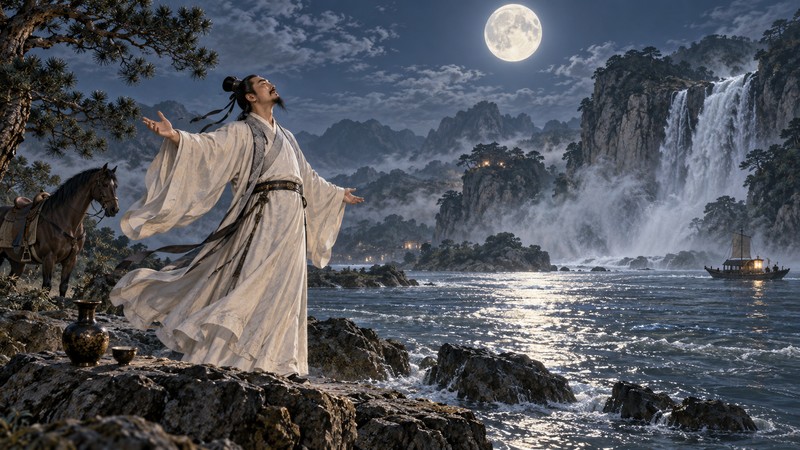
Instead, it’s better to focus on the overall imagery and emotion, rather than individual words. For example, in “Quiet Night Thoughts,” the line about frost is not meant to be taken literally; it’s a way to describe the moonlight’s cold, white glow.
When you read the poem, imagine the scene: a man sitting by his bed, looking at the moon, feeling far from home. That’s the core of the poem, and it’s something you can grasp even without knowing every word’s literal meaning.
For beginners, this is a key lesson: classical Chinese poetry is about feeling, not just translation.
Another important aspect is understanding the form of Tang poetry. Jueju (four-line poems) have a strict structure: each line has a set number of characters (usually five or seven), and the lines rhyme in specific patterns.
Lushi (eight-line poems) follow even stricter rules, with parallel lines that mirror each other in meaning and tone. Li Bai excelled at both forms, but his jueju are often more accessible because of their brevity.
When reading a Li Bai jueju, pay attention to the rhythm: the tones of the words create a musical quality that enhances the emotion. For example, in “Quiet Night Thoughts,” the fourth line (“”) has a slower, more drawn-out tone, which matches the sadness of missing home.
Learning to recognize these rhythmic patterns can deepen your appreciation of li bai poetry.
It’s also helpful to look at multiple translations of a poem, since no single translation can capture all the nuances of the original Chinese. For example, Ezra Pound’s translation of “Quiet Night Thoughts” (titled “The River-Merchant’s Wife: A Letter”) is famous, but it takes liberties with the original text, focusing on a romantic relationship rather than homesickness.
A more literal translation, like Arthur Waley’s, stays closer to the original meaning. By comparing different translations, you can get a better sense of what the poem is really about, and how translators balance accuracy with readability.
For li bai poetry, this is especially important because his work relies on subtle imagery and emotion that can be lost in translation.
Finally, the best way to understand li bai poetry is to read it slowly and repeatedly. Unlike modern poetry, which can be read in one sitting, classical Chinese poetry is meant to be savored.
Take time to imagine the scene, feel the emotion, and connect it to your own experiences. For example, if you’ve ever been away from home, you can relate to “Quiet Night Thoughts”’s feeling of longing.
If you’ve stood under a waterfall, you can understand the awe in “View of Mount Lu.” This personal connection is what makes li bai poetry so powerful, and it’s something that every reader can experience, regardless of their background.
Why It Still Matters Today
Li bai poetry continues to resonate with modern readers because it speaks to universal themes: longing, wonder, freedom, and the beauty of nature. In a world that often feels chaotic and fast-paced, Li Bai’s celebration of the simple moments—staring at the moon, listening to a waterfall, wandering through mountains—offers a sense of peace and perspective.
For example, “Quiet Night Thoughts”’s theme of homesickness is something that anyone who has moved away from family can relate to, no matter where they live. This cross-cultural appeal is why li bai poetry is translated into dozens of languages, and why it remains a staple of world literature.
In China, li bai poetry is a core part of cultural identity. It’s taught in schools, recited at festivals, and referenced in popular culture—from movies to music.
When Chinese people quote a line from Li Bai, they are not just quoting a poem; they are connecting to a long tradition of storytelling and emotion. For overseas Chinese communities, li bai poetry is a way to stay connected to their roots, offering a link to their cultural heritage.
This cultural significance means that li bai poetry is more than just a literary work; it’s a living part of Chinese society, passed down through generations.
For students of Chinese culture and language, li bai poetry is an invaluable resource. It offers insight into Tang Dynasty society, philosophy, and daily life, while also providing a way to practice reading classical Chinese.
Many students start with Li Bai’s short poems, which have simple vocabulary and clear themes, before moving on to more complex works. This makes li bai poetry a practical tool for language learning, as well as a source of aesthetic pleasure.
Even for advanced learners, Li Bai’s work offers new depths to explore, from his use of imagery to his philosophical beliefs.
Finally, li bai poetry offers a counterpoint to modern pressures. In an age of social media, work deadlines, and constant connectivity, Li Bai’s emphasis on freedom and solitude feels refreshing.
His rejection of rigid social norms—choosing to wander rather than pursue an official career—speaks to anyone who has felt constrained by expectations. His love of nature also aligns with modern efforts to protect the environment, as we look for ways to reconnect with the natural world.
In this way, li bai poetry is not just a window into the past; it’s a guide for living a more meaningful life in the present.
Frequently Asked Questions
What is the meaning of Li Bai poetry?
Li Bai’s poetry explores themes of nature, friendship, wine, solitude, and the desire for transcendence. His verses often express longing for freedom, celebrate the beauty of the natural world, and reflect on the fleeting nature of life and the human condition.
Who wrote Li Bai poetry and what is the historical context?
Li Bai (701-762 CE) was a legendary poet of the Tang Dynasty, often called the “Immortal Poet.” He lived during the golden age of Chinese poetry, writing during a period of relative peace and prosperity in the Tang Dynasty, though his life was marked by political turmoil and personal wanderings.
What literary devices are used in Li Bai poetry?
Li Bai’s poetry employs vivid imagery, romantic imagination, nature symbolism, and parallelism. He frequently uses contrast, exaggeration, and personification to create powerful emotional effects and convey his transcendent vision.
What is the cultural significance of Li Bai poetry?
Li Bai’s poetry represents the pinnacle of Tang Dynasty literature and has influenced Chinese poetry for over a millennium. His work embodies the romantic spirit of the era, celebrates the unity of humanity and nature, and continues to be celebrated as a fundamental part of Chinese cultural heritage.
How should Li Bai poetry be interpreted?
Li Bai poetry should be interpreted with attention to its vivid imagery, emotional spontaneity, and connection to nature. Readers should appreciate his use of wine, moon, and mountains as symbols, and consider his and transcendence as central themes that reflect both personal longing and universal
Poem Generator App: 7 Hidden Meanings You Missed at First Re Chinese Poetry Tang Dynasty: Major Poets, Poems and Legacy Ancient Chinese Poetry: Major Poets, Poems and Legacy Wikipedia