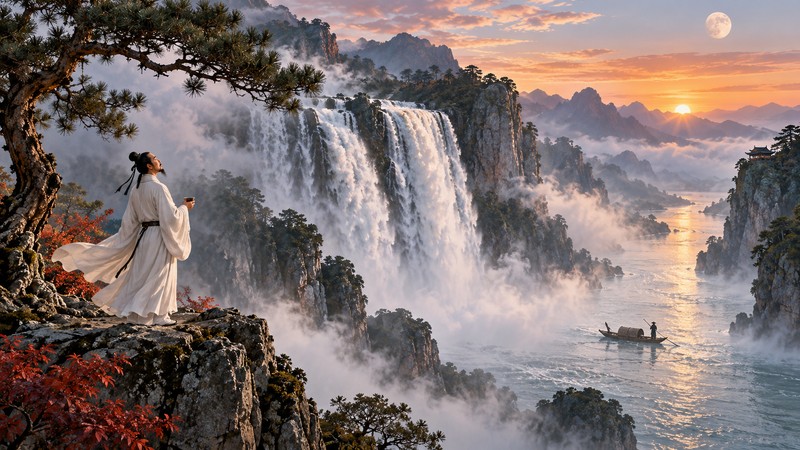
Li Bai poems are among the most celebrated works of Tang Dynasty poetry, blending wild imagination, heartfelt emotion, and deep connection to Chinese cultural traditions. For readers new to classical Chinese poetry, these verses often feel both familiar and exotic, bridging centuries of history and art with their universal themes.
What Li Bai Poems Means in Chinese Poetry
Li Bai poems form a cornerstone of Tang Dynasty’s poetic legacy, often paired with Du Fu as the two greatest poets of the era. Beginners frequently misunderstand his work as mere romantic verse about wine and mountains, but this overlooks their roots in classical Chinese poetic conventions and cultural values.
Unlike Western poetry’s focus on individual identity, Li Bai’s verses weave together personal emotion, natural imagery, and philosophical undertones—specifically Taoist reverence for nature and Confucian emphasis on human connection. For example, his friendship poems are not just anecdotes but meditations on the universal bond between people, a core tenet of Confucian thought.
A key misunderstanding among new readers is that Li Bai’s bold metaphors (like “the Milky Way fell from the ninth heaven”) are random flourishes. In reality, these devices are intentional: Tang poets used hyperbole to express ineffable feelings, a technique Li Bai mastered to capture awe, loneliness, or joy.
This is why Chinese poetry learning prioritizes Li Bai early—his work is accessible yet layered, making it an ideal entry point to classical Chinese literary culture.
Another layer of meaning lies in his title: the “Immortal Poet” (shi xian), Li Bai Poems a label given by contemporaries that reflects his reputation for transcending ordinary limits. This title is not just flattery; it ties his work to Taoist ideals of freedom from social constraints, a theme that runs through all his verses.
For readers, grasping this title adds depth to every line—Li Bai is not just a poet, but a figure who channeled the spirit of the mountains, moon, and rivers into his words.
Historical and Cultural Background
Li Bai lived from 701 to 762 CE, during the Tang Dynasty’s golden age (618–907), a period of unprecedented cultural prosperity. The Tang court valued poetry as a critical skill for scholars seeking official positions, and poets gathered regularly at banquets, temples, and mountain retreats to compose verses together.
Li Bai rejected the rigid formalities of court life, choosing instead to travel extensively across China—from his birthplace in Sichuan to the Yangtze River basin—exposing himself to diverse landscapes and people that shaped his imagery.
The An Lushan Rebellion (755–763) marked a turning point in Tang history, Li Bai Poems and it deeply affected Li Bai. He was caught in the conflict, briefly imprisoned, and his later poems shifted from carefree celebration to quiet resilience.
Unlike Du Fu, who wrote about the suffering of common people, Li Bai focused on the individual spirit’s ability to endure chaos—for example, his poem “Drinking Alone Under the Moon” finds joy in solitude even amid political upheaval. This contrast between the two poets is central to understanding Tang poetry’s diversity: Li Bai represents the era’s adventurous, imaginative spirit, while Du Fu embodies its social consciousness.
Tang literary culture was communal, and Li Bai was a central figure in these gatherings. He was known for improvising poems while drinking wine, a practice that made his work feel conversational yet lyrical.
This communal aspect is why Li Bai’s poems were preserved and celebrated across generations—they were not just personal works, but part of a shared cultural conversation about life, beauty, and freedom.
Key Poems, Poets, or Examples
The power of Li Bai poems is best illustrated through concrete examples that showcase his range and style. Four standout works offer insight into his genius and Tang poetry’s core conventions.
First is Li Bai’s “Quiet Night Thoughts” (Jing Ye Si, 726), written when he was 25 and traveling in Yangzhou, away from his family. The poem: “Before my bed, bright moonlight / I suspect it’s frost on the ground / I lift my head to look at the mountain moon / I lower my head to think of home.” Its emotional situation is quiet, intimate homesickness.
Readers learn that simple, concrete imagery (moonlight, frost) can convey profound emotion without grand language. This poem is so iconic that it’s memorized by Chinese schoolchildren from age 7, making it a bridge between ancient and modern Chinese culture.
(For a deeper analysis, see *Complete Analysis of Li Bai’s “Quiet Night Thoughts”*.)
Second is Li Bai’s “Viewing Mount Lu’s Waterfall” (Wang Lu Shan Pu Bu, Li Bai Poems 756), written during a stay at Mount Lu, a sacred Chinese mountain. The poem: “The sunlit incense burner gives off purple smoke / The waterfall hangs in front of the river like a long river / The waterfall flies down three thousand feet / As if the Milky Way fell from the ninth heaven.” Its emotional situation is awe at nature’s grandeur.
Readers learn that hyperbole (three thousand feet, Milky Way) is not exaggeration but a tool to express the ineffable—Li Bai uses it to make the waterfall feel like a divine, otherworldly phenomenon.
Third is Li Bai’s “Drinking Alone Under the Moon” (Xing Jiu Yue Xia Du Zhuo, 742), written when he was lonely after leaving the Tang capital Chang’an. The poem: “Among the flowers, a jug of wine / I drink alone, with no nearby kin / I raise my cup to invite the moon / And with my shadow, we become three / The moon does not know how to drink / My shadow only follows my body / For a while, I play with the moon / Then I dance with my shadow / While I am awake, we share joy / When I get drunk, we separate forever / We will meet again in the Milky Way / Beyond the vast sky.” Its emotional situation is loneliness turned into whimsical companionship.
Readers learn that Li Bai finds magic in solitude, using imagination to turn isolation into a playful, almost spiritual experience—reflecting his Taoist belief in the unity of all things.
Fourth is Wang Wei’s “Deer Enclosure” (Lu Zhai, Li Bai Poems 740), a contemporary Tang poem that contrasts with Li Bai’s bold style. Wang Wei, known as the “poet-painter,” wrote: “Empty mountain, no one seen / Yet voices are heard / The sunlight enters the deep forest / And shines back on the green moss.” Its emotional situation is serene solitude.
Readers learn that Tang landscape poetry is not monolithic—Li Bai’s grandeur and Wang Wei’s subtlety show the era’s diversity, helping readers appreciate the full range of Tang poetic expression.
How to Read and Understand It
Reading Li Bai poems effectively requires slowing down and engaging with both imagery and cultural context, especially for English speakers. Unlike Western poetry, classical Chinese poetry is concise—each line is a single snapshot, so pausing after each line allows the reader to visualize the scene.
For example, in “Quiet Night Thoughts,” the first two lines set a cold, quiet room; the next two shift to the speaker’s longing. Reading aloud in the original Chinese helps capture tonal rhythm, which is often lost in translation.
Translation limits are a key challenge for English readers. English cannot replicate Chinese’s tonal patterns or cultural allusions—for instance, Li Bai Poems the “Milky Way” in Li Bai’s waterfall poem refers to a Chinese myth of a celestial river, not just a galaxy.
To get the full meaning, look for translations by scholars like Burton Watson, who balance fidelity to the original with readability, rather than literal translations that strip away poetic imagery. Expert advice: Beginners should start with Li Bai’s shorter poems (like “Quiet Night Thoughts”) before moving to longer works, as they are emotionally accessible and use simple language.
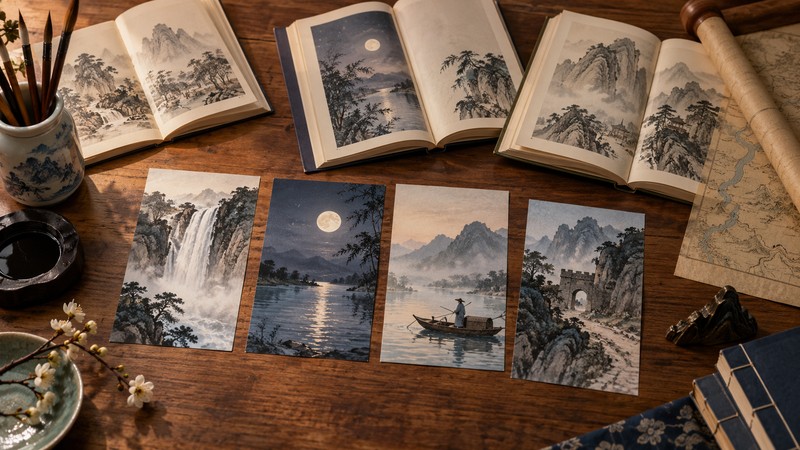
Another practical tip is to pair poems with traditional Chinese paintings of the same scenes. For example, viewing a painting of Mount Lu’s waterfall while reading Li Bai’s poem helps visualize the hyperbolic imagery and understand how Tang poets and artists collaborated to capture natural beauty.
This approach deepens appreciation for the cultural context that shaped Li Bai’s work, making the verses feel more tangible and meaningful.
Why It Still Matters Today
Li Bai poems remain relevant today because they address universal human experiences: homesickness, loneliness, awe at nature, and joy in friendship. “Quiet Night Thoughts” is translated into over 50 languages and taught in schools worldwide, because everyone understands the feeling of missing home.
This cross-cultural appeal is why English readers actively search for Li Bai poems—they offer a window into Chinese culture while speaking to shared emotions.
In Chinese culture, Li Bai is more than a poet; he’s a cultural icon symbolizing freedom and creativity. His image appears in art, opera, and popular media, and during festivals, families often recite his poems together to pass down cultural values.
For overseas Chinese, reading Li Bai’s work is a way to connect to their heritage, even when living far from China—his verses become a link to their roots.
Tang poetry, Li Bai Poems including Li Bai’s work, is also a cornerstone of Chinese language learning. Students of classical Chinese start with Li Bai because his language is relatively simple yet rich in meaning, helping them grasp key vocabulary and grammatical structures while developing an appreciation for literary art.
Even in the digital age, Li Bai’s poems are shared on social media, quoted in speeches, and used in advertising—proof that their power endures across time and cultures.
Frequently Asked Questions
What is the meaning of Li Bai poems?
Li Bai’s poems express profound themes of nature, friendship, loneliness, longing for freedom, and the transience of life. His works often explore the relationship between humans and the natural world, using vivid imagery of mountains, rivers, moon, and wine to convey deeper philosophical meanings about existence and the human condition.
Who wrote Li Bai poems and what is the historical context?
Li Bai (701-762 AD) was a legendary Tang Dynasty poet known as the “Immortal Poet.” He lived during the golden age of Chinese poetry, writing during the reign of Emperor Xuanzong. His work emerged during a period of cultural flourishing when poetry was highly valued in the imperial court, and he became one of the most celebrated figures in Chinese literary history alongside Du Fu and Wang Wei.
What literary devices are used in Li Bai poems?
Li Bai employed numerous literary devices including vivid imagery, romantic hyperbole, personification, allusion, parallelism, and symbolism. He frequently used contrast between the natural world and human society, employed classical references to mythology and history, and utilized dramatic shifts in perspective. His famous technique of “wandering” (you) poetry often features spontaneous, unrestrained expressions and dream-like sequences.
What is the cultural significance of Li Bai poems?
Li Bai’s poems hold immense cultural significance in Chinese literature and have influenced poetry across East Asia for centuries. His works are considered pinnacle of Tang poetry and remain central to Chinese literary education. They represent the spirit of romantic individualism and freedom that continues to resonate in Chinese culture. His poems about friendship, nature, and yearning have become embedded in Chinese cultural consciousness and are still widely recited today.
How should Li Bai poems be interpreted?
Li Bai poems should be interpreted with attention to their historical context, literary allusions, and emotional resonance. Readers should consider the poet’s own life experiences, including his wanderings, his理想 of becoming a statesman, and his fascination with Taoist mysticism. The poems should be read as expressions of both personal emotion and universal human experiences, appreciating their musical rhythm, vivid imagery, and the tension between romantic idealism and political reality that characterizes much of his work.
Haiku About Love: 6 Hidden Meanings You Missed at First Read Wedding Poem Readings: 6 Hidden Meanings You Missed at First Poem Maker Online: 6 Hidden Meanings You Missed at First Rea Wikipedia