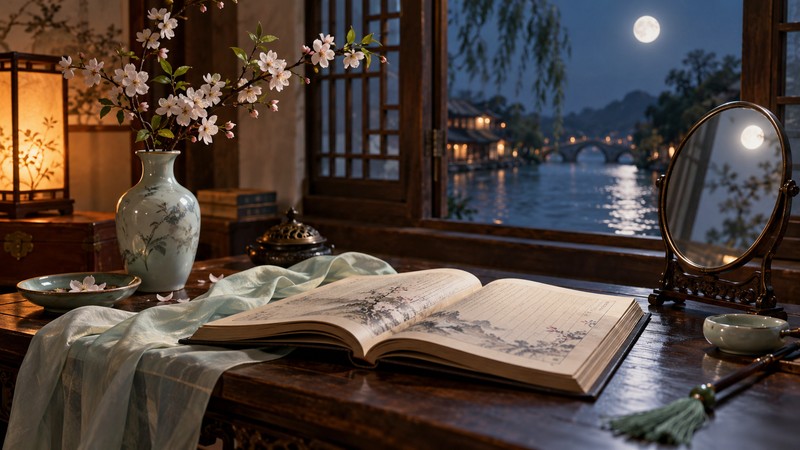
Love poetry has moved readers for over a thousand years.
Among the treasures of Tang Dynasty verse, one poem stands apart for its dreamy beauty and heartfelt longing.
“Moon over the River on a Spring Night” captures the essence of love poetry—moonlight, water, flowers,
and a lover’s tender yearning.
This poem by Zhang Ruoxu remains one of China’s most beloved works, its verses echoing across centuries.
Zhang Ruoxu wrote this poem during the height of the Tang Dynasty, Love Poetry around 8th century.
The poem describes a spring night along the Yangtze River. A woman waits for her beloved who travels far away.
She watches the moon rise over the flowing water. Her thoughts drift toward him, full of hope and sorrow.
The poem weaves together natural beauty and human emotion perfectly. Its gentle rhythm and vivid imagery make it unforgettable.
About the Love Poetry Poet
Zhang Ruoxu (张若虚, c. 660-720) lived during the early Tang Dynasty.
He served as a low-ranking official and is best known for just two surviving poems.
Both appear in the famous anthology “Three Hundred Tang Poems.” Despite his small body of work, he earned lasting fame.
Zhang Ruoxu belonged to a generation of poets who refined the court poetry style.
Love Poetry He combined elements from earlier traditions with fresh emotional depth.
His technique showed mastery of complex rhyming and imagery.
Yet his work remained relatively unknown until later scholars recognized his genius.
A surprising fact: Only two poems by Zhang Ruoxu survive today.
Yet the shorter one, “Moon over the River on a Spring Night,
” is often called “the poem that tops the entire Tang Dynasty” (孤篇压全唐). This single work secured his place in literary history.
The Tang Dynasty (618-907) represented China’s golden age of poetry.
Love Poetry Emperor Xuanzong’s reign (712-756) saw extraordinary cultural flourishing.
Scholars and poets gathered in the capital Chang’an. Poetry became essential education for the educated class.
Love and nature themes dominated creative work. This cultural richness produced Zhang Ruoxu’s masterpiece.
The Poem: Moon over a Spring River
Original Chinese Text:
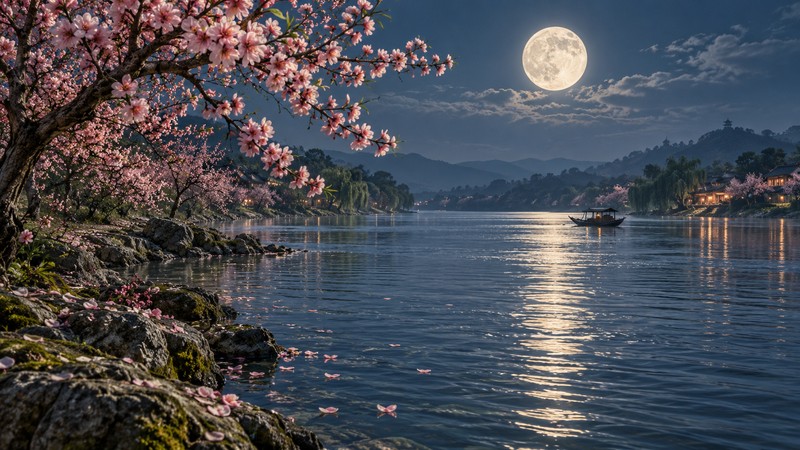
春江潮水连海平,海上明月共潮生。 滟滟随波千万里,何处春江无月明。 江流宛转绕芳甸,月照花林皆似霰。 空里流霜不觉飞,汀上白沙看不见。
江天一色无纤尘,皎皎空中孤月轮。 江畔何人初见月?江月何年初照人? 人生代代无穷已,江月年年望相似。 不知江月待何人,但见长江送流水。
白云一片去悠悠,青枫浦上不胜愁。 谁家今夜扁舟子?何处相思明月楼? 可怜楼上月徘徊,应照离人妆镜台。 玉户帘中卷不去,捣衣砧上拂还来。
此时相望不相闻,愿逐月华流照君。 鸿雁长飞光不度,鱼龙潜跃水成文。 昨夜闲潭梦落花,可怜春半不还家。 江水流春去欲尽,江潭落月复西斜。
斜月沉沉藏海雾,碣石潇湘无限路。 不知乘月几人归,落月摇情满江树。
—
Pinyin Romanization:
Chūn jiāng cháo shuǐ lián hǎi píng, Love Poetry hǎi shàng míng yuè gòng cháo shēng.
Yàn yàn suí bō qiān wàn lǐ, hé chù chūn jiāng wú yuè míng.
Jiāng liú wǎn zhuǎn rào fāng diàn, Love Poetry yuè zhào huā lín jiē sì sàn.
Kōng lǐ liú shuāng bù jué fēi, tīng shàng bái shā kàn bù jiàn.
Jiāng tiān yī sè wú xiān chén, Love Poetry jiǎo jiǎo kōng zhōng gū yuè lún. Jiāng pàn hé rén chū jiàn yuè?
Jiāng yuè hé nián chū zhào rén? Rén shēng dài dài wú qióng yǐ, Love Poetry jiāng yuè nián nián wàng xiàng sì.
Bù zhī jiāng yuè dài hé rén, dàn jiàn cháng jiāng sòng liú shuǐ.
Bái yún yī piàn qù yōu yōu, Love Poetry qīng fēng pǔ shàng bù shēng chóu. Shuí jiā jīn yè piān zhōu zǐ?
Hé chù xiāng sī míng yuè lóu? Kě lián lóu shàng yuè pái huái, Love Poetry yīng zhào lí rén zhuāng jìng tái.
Yù hù lián zhōng juàn bù qù, dǎo yī zhēn shàng fú hái lái.
Cǐ shí xiāng wàng bù xiāng wén, Love Poetry yuàn zhú yuè huá liú zhào jūn.
Hóng yàn cháng fēi guāng bù dù, yú lóng qián yuè shuǐ chéng wén.
Zuó yè xián tán mèng luò huā, Love Poetry kě lián chūn bàn bù hái jiā. Jiāng shuǐ liú chūn qù yù jìn, jiāng tán luò yuè fù xī xié.
Xié yuè chén chén cáng hǎi wù, Love Poetry jié shí xiāo xiāng wú xiàn lù. Bù zhī chéng yuè jǐ rén guī, luò yuè yáo qíng mǎn jiāng shù.
—
English Translation:
The spring river’s tide connects with the sea level; On the sea, the bright moon rises with the tide. Glittering waves extend for a thousand miles— Where is the spring river without moonlight?
The river curves gently through fragrant meadows; Moonlight on the flowering forest looks like hail. Frost flows through the empty sky, unnoticed; White sand on the island cannot be seen.
River and sky share one color, without dust; Bright and solitary, the moon hangs in the air.
Who on the riverbank first saw this moon? In what year did the river moon first shine on people?
Generations of people pass without end; The river moon gazes yearly, always similar. I wonder whom the river moon awaits— Only the long river sends flowing water.
A white cloud drifts, leisurely and far; On Green Maple Shore, unbearable sorrow. Whose boat travels tonight?
On which bright moonlit tower does someone yearn?
The poor moon lingers over the tower, Shining on the mirror stand of the one who left. In the jade curtain, Love Poetry it cannot be rolled away; On the washing stone, brushing it returns.
Now we gaze at the same moon, Love Poetry yet cannot hear each other; I wish to follow the moonlight and shine on you. Wild geese fly far, Love Poetry yet their light cannot cross; Fish and dragons leap silently, creating ripples.
Last night I dreamed of flowers falling in the quiet pool; Alas, spring is half-gone, and he has not returned. The river carries spring away, about to end; The moon over the pool sets again to the west.
The slanting moon hides in the sea mist; From Jieshi to Xiangxi, there are infinite roads.
I wonder how many will return by moonlight? The setting moon shakes emotion across the river trees.
—
Stanza-by-Stanza Analysis:
Stanza One: The River under the Moon
*What it means:* The poem opens with a grand scene. The spring tide rises to meet the sea.
The bright moon rises from the sea, Love Poetry as if born from the waves themselves.
The moonlight spreads across thousands of miles of water. Every part of the river glows with moonlight.
*Why it’s beautiful:* The opening lines create a sense of vastness. The moon and tide seem connected, rising together.
The phrase “born with the tide” suggests natural harmony. This sets the dreamy, romantic atmosphere.
Stanza Two: Reflection on Time
*What it means:* The poet watches the moon hanging alone in the empty sky. He asks philosophical questions.
Who saw this moon first? When did the moon first shine on humans? Human generations come and go endlessly.
The moon remains the same each year. The moon may be waiting for someone—but only the river knows.
*Why this line is unforgettable:* “The river moon gazes yearly, Love Poetry always相似” captures eternal beauty.
The moon becomes a witness to human longing. This line connects personal love to cosmic time.
Stanza Three: The Woman’s Sorrow
*What it means:* A white cloud drifts away. On the riverbank, Love Poetry someone suffers from unbearable sorrow.
Whose boat travels tonight? Where does a lovesick person stay in a moonlit tower? The moon lingers over her building.
It shines on her empty makeup table.
*Why it’s beautiful:* The stanza shifts from cosmic themes to human love. The moon becomes a symbol of the beloved’s memory.
The woman cannot escape her longing—even rolling up the curtain cannot block the moonlight.
Stanza Four: Longing and Separation
*What it means:* The lovers gaze at the same moon but cannot speak. She wishes to follow the moonlight to him.
Yet geese cannot carry letters. Fish and dragons stay hidden, creating only ripples. Last night she dreamed of flowers falling.
Spring is half-gone, but he still hasn’t returned. The river carries spring away. The moon sets in the west.
*Why it’s beautiful:* This stanza captures the pain of separation. Love Poetry The moon becomes a messenger she cannot use.
Her dreams bring no comfort. Time passes while he remains absent.
Stanza Five: The Final View
*What it means:* The slanting moon hides in sea mist. Love Poetry The road from north to south stretches endlessly.
How many lovers will actually return under this moon? The setting moon leaves emotion scattered among the river trees.
*Why it’s beautiful:* The ending suggests both hope and sorrow. Some may return; others may not.
The emotion remains—scattered like moonlight on trees. This open ending leaves readers with lingering feelings.
Why Love Poetry Endures
“Moon over the River on a Spring Night” endures because it captures universal human feelings.
Love and longing do not change with time. The poet expresses what every separated lover feels.
The moon, river, and spring flowers remain relevant today.
The poem’s imagery is remarkably vivid. Readers can picture the moonlight on water, the flowers, the wandering thoughts.
Each line creates a beautiful scene. The language feels fresh despite twelve centuries.
Modern culture continues celebrating this poem. Musicians have set it to song. Artists create paintings inspired by its lines.
Schools teach it as essential Tang poetry. The poem appears in films and television about ancient China.
Scholars praise its technical mastery. The poem uses complex rhyme schemes and imagery.
Yet it reads smoothly, almost like natural speech. This balance of skill and simplicity explains its lasting appeal.
How to Appreciate Love Poetry
Read the poem slowly. Let each image settle in your mind. Notice how the moon appears in every stanza.
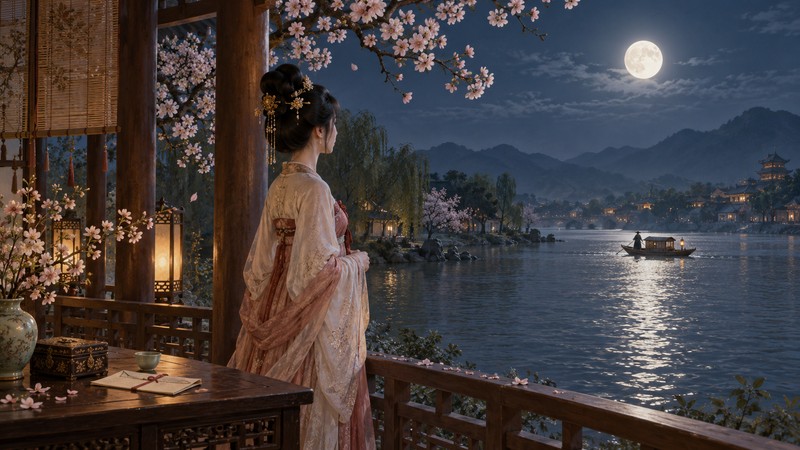
It serves as both witness and symbol.
Notice the poem’s structure. Five stanzas move from nature to human emotion. The rhythm flows like the river itself.
Listen for the sound of words—”glimmering,” “flowing,” “spring.”
Try reading the Chinese original. Even without fluency, the sounds carry beauty. Notice the rhymes at line endings.
They create a musical quality.
Memorize your favorite lines. Recite them during a full moon.
The poem gains meaning when shared with the actual moonlight Zhang Ruoxu described.
One Final Reflection
Love poetry like Zhang Ruoxu’s masterpiece reminds us what matters most.
Across twelve hundred years, human hearts remain the same. We still watch the moon and think of those we miss.
We still feel spring passing without our beloved nearby.
This poem teaches us to find beauty in longing itself. The ache of separation and the hope of return—these feelings make us human.
The moonlight over the river holds our collective memory of love.
I invite you to read this poem again on a spring evening. Find a place near water if possible. Watch the moon rise.
Let Zhang Ruoxu’s words fill your mind. You will understand why this poem has moved readers for over a millennium.
The Tang Dynasty left us countless treasures. This single poem about love and moonlight stands among the greatest.
It invites us to pause, to feel, to remember what matters most.
—
*Explore more Tang poetry to discover other expressions of love, nature, and human experience that have shaped Chinese literature for centuries.*
Love Poetry 4 Love Poetry 3 Love Poetry 2 WikipediaFrequently Asked Questions
Quick Answer: Love Poetry 5
The value of Love Poetry 5 is practical interpretation: what to read first, what background matters, and how the page can support students, teachers, or close reading.
Basic Facts: Love Poetry 5
- Reading task: connect poem, poet, scene, and evidence
- Verification: check dynasty context and line-level clues
- Avoid: broad literary summaries without a text path
Source note: Read this page with source context from Chinese poetry background, then compare it with the page examples and internal links.
Related reading: Tang dynasty poets How to read Chinese poetry
What is the main theme of this poem?
The poem explores love and longing during separation. A woman waits for her beloved who travels far away.
She watches the spring moon rise over the river. Her thoughts turn to him throughout the night.
The poem also meditates on time and memory.
Why is this poem so famous?
Only two poems by Zhang Ruoxu survive, yet this one is considered one of the greatest Tang poems.
It perfectly captures romantic longing with beautiful imagery. Its philosophical questions about time and existence add depth.
The language is both elegant and accessible.
What is “moonlight” symbolic of in the poem?
The moon represents multiple things. It symbolizes the beloved far away. It represents memory and longing.
It also stands for time passing and eternity. The moonlight connects separated lovers while proving their separation.
How does the poem reflect Tang Dynasty culture?
The Tang Dynasty valued romantic poetry and natural beauty. This poem shows the connection between love and nature.
The references to boats, towers, and washing stones reflect daily life. Poetry was essential education for the educated class.
What is the poem’s structure and form?
The poem uses a variation of the “song” (ge) form. It has five stanzas of varying lengths.
Each stanza follows an ancient musical pattern. The rhyming scheme changes but maintains musical quality.
The lines flow like the river described within them.
How should I read this poem for best understanding?
Read slowly and aloud. Picture each image in your mind. Notice how feelings shift between stanzas.
Pay attention to the moon as it moves across the poem. Consider your own experiences of longing and waiting.
One Final Reflection: Love poetry like Zhang Ruoxu’s masterpiece reminds us what matters most.
Across twelve hundred years, human hearts remain the same. We still watch the moon and think of those we miss.
We still feel spring passing without our beloved nearby. This poem teaches us to find beauty in longing itself.
The ache of separation and the hope of return—these feelings make us human.
The moonlight over the river holds our collective memory of love. I invite you to read this poem again on a spring evening.
Find a place near water if possible. Watch the moon rise. Let Zhang Ruoxu’s words fill your mind.
You will understand why this poem has moved readers for over a millennium. The Tang Dynasty left us countless treasures.
This single poem about love and moonlight stands among the greatest.
It invites us to pause, to feel, to remember what matters most.
— *Explore more Tang poetry to discover other expressions of love, nature,
and human experience that have shaped Chinese literature for centuries.*
Leave a Reply