For contemporary Chinese poetry in translation, choose the kind of reading before choosing a famous name. An anthology lets you encounter several voices; a sustained work lets you follow one poet’s structure over a longer stretch. Three useful options to investigate are Push Open the Window, Jade Ladder and Yang Lian’s Narrative Poem.
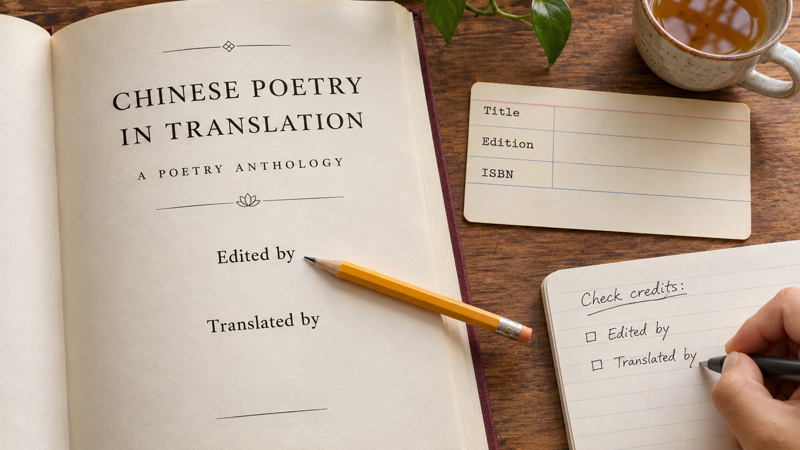
This is a comparison of identifiable editions and publisher descriptions, not a ranking of the best Chinese poetry or a claim to have reviewed every poem in the books. It does not reproduce their poems. The illustrations show imagined reading situations, not the books’ actual covers, pages or authors.
Compare an anthology with a sustained single work
| Book | Reading format | Useful starting task | Edition identifier |
|---|---|---|---|
| Push Open the Window, edited by Qingping Wang | Bilingual anthology; publisher describes 49 poets | Browse different voices, then follow one poet further | 9781556593307 |
| Jade Ladder: Contemporary Chinese Poetry | English-language anthology with contextual introductions | Explore several forms alongside an editorial account of the field | 9781852248956 |
| Yang Lian, Narrative Poem, translated by Brian Holton | One extended work in a bilingual edition | Return to recurring images and connections across a longer reading | 9781780373515 |
These formats invite different commitments. Browsing a few poets can help you discover a voice to pursue. A long work asks you to remember earlier images and relationships rather than treating each page as an independent quotation. Neither format substitutes for the other.
Push Open the Window: browse a bilingual range
Copper Canyon Press identifies Push Open the Window as a bilingual anthology edited by Qingping Wang, bringing together 49 poets. It offers a route for readers who want more than one voice and the opportunity to see Chinese text alongside English.
The publisher’s authorized sample provides a useful credit exercise: it names Xi Chuan as the poet of “Ode to Skin” and Lucas Klein as that text’s translator. Keep those roles attached to the sample. Do not infer that the named editor wrote the poems, or that the translator of one sample translated the entire anthology.
For an initial reading, choose one poem rather than trying to absorb the collection’s range at once. Record its title and translator, notice an image or change in voice, then read another work by the same poet. That is a proposed reading approach, not a claim about every poem’s difficulty.

Jade Ladder: use the anthology’s contextual structure
Bloodaxe’s record for Jade Ladder identifies W. N. Herbert and Yang Lian, with Brian Holton and Qin Xiaoyu as associate editors. The edition was published in 2012. Its description emphasizes introductions and a range extending beyond short lyric poems to sequences, narrative, experimental writing and long poems.
That makes it worth investigating when your question is how different kinds of writing sit within a broader literary field. Use the introductions as an editorial perspective and keep returning to individual poems, rather than assuming a movement label explains every writer.
Check the contents and a sample of the edition you intend to use. “Chinese poetry in English” does not by itself promise facing Chinese pages, pinyin, recordings or a classroom apparatus. This comparison does not claim those features for Jade Ladder. Its relevant contrast here is the anthology’s contextual structure.
Narrative Poem: follow one extended bilingual work
Bloodaxe presents Narrative Poem as Yang Lian’s extended work, translated by Brian Holton in a bilingual Chinese-English edition published in 2017. The publisher distinguishes that edition from the Chinese publication in 2011. An English publication date is not automatically the date of composition or first publication in Chinese.
The publisher describes a framework of family photographs and movement through different times and places. It also identifies a preface by the poet and an afterword by the translator. These are useful companion materials for a reader investigating how personal material becomes a sustained poetic structure.
Try keeping a short note of an image when it first appears, then revisit the note when it returns. Ask what the later context changes. That approach follows connections across a long work, rather than expecting every section to stand alone like an anthology selection. The description here stays with the publisher’s account; it does not substitute an invented close reading for the text.

Choose the edition for the reading you want to do
If you want to encounter a range of voices with Chinese text available, investigate Push Open the Window. If contextual introductions and varied forms are your priority, examine Jade Ladder. If you want to stay with one extended work and its translator’s afterword, consider Narrative Poem. These are format-based routes, not guarantees of personal preference.
Before borrowing or buying, match the title and ISBN, inspect a permitted sample and confirm the language layout of the exact edition. Availability, format and price need a current check with your library or seller. A publisher’s record identifies a book; it does not prove delivery to your location.
For a wider map of writers, continue with our modern Chinese poet reading map. To distinguish translated work from poetry originally published in English, see original English poems and translations. Those answer different questions from choosing among the editions compared here.
Questions about translated contemporary poetry
Does contemporary mean every poem was written recently?
No. Treat the word as part of a collection’s stated scope, and check its contents and dates. The date of an English edition is also separate from when a Chinese work was first published.
Does a bilingual edition let me judge translation accuracy without Chinese?
It gives you access to both texts, but assessing the relationship still requires language knowledge and context. You can begin by recording credits and noticing the English poem’s visible features without claiming a complete accuracy judgment.