Ancient Chinese poems about love do not all speak in the same voice. In 关雎 (Guān Jū), attraction develops through repeated images and a wish for companionship; 上邪 (Shàng Yé) makes an emphatic vow; 迢迢牵牛星 (Tiáo Tiáo Qiān Niú Xīng) imagines separation through the Weaver and the distant Cowherd star. Reading these three together helps distinguish courtship, commitment and longing instead of treating every memorable line as a ready-made romantic message.
This selection focuses on anonymous works from the Shijing and early verse traditions, rather than surveying famous Tang and Song poets. The Chinese excerpts follow the linked reference texts, with simplified characters used here. Mandarin pinyin identifies the wording for a modern learner; it is not a reconstruction of ancient pronunciation. All English renderings below are original reading aids written for this article, not quotations from an established translator. Interpretation is tied to the words shown, and an anonymous poem’s speaker is not a known historical author.
Compare courtship, commitment and separation
| Poem and reference | Main emotional movement | Image to follow | Use case and reading risk |
|---|---|---|---|
| 关雎 / 關雎 Guān Jū Shijing, Zhou Nan |
Desire for a suitable companion, with unrest and imagined harmony | Waterbirds, gathering plants and music | Read the repeated changes; do not turn a wish into proof of a completed marriage |
| 上邪 Shàng Yé Anonymous yuefu poem |
A vow that makes separation depend on the overturning of the natural world | Mountains, river, seasons, heaven and earth | An intense declaration; not a mild compliment or a weather report |
| 迢迢牵牛星 / 迢迢牽牛星 Tiáo Tiáo Qiān Niú Xīng Nineteen Old Poems |
Longing expressed through work interrupted and speech prevented | Weaving, tears and the river between the two figures | A poem of separation; do not insert a reunion absent from its ending |
The works offer different reading tasks, not a ranked list of the greatest love poems. Start by noticing who speaks, whether another person can answer, and what changes between the opening and the ending. Those questions keep a translated excerpt connected to a whole poem.
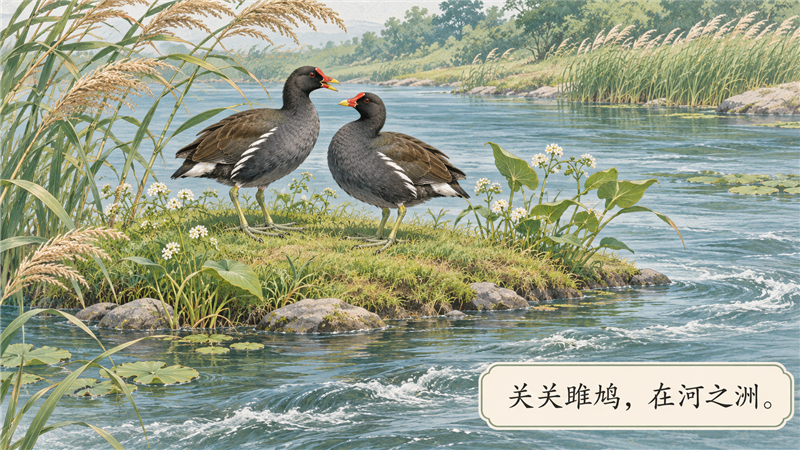
关雎: a wish for companionship
The Hong Kong Education Bureau reference text identifies 关雎 as a Shijing poem. Its opening gives a river scene before introducing the desired human companion:
关关雎鸠,在河之洲。
窈窕淑女,君子好逑。
Guān guān jū jiū, zài hé zhī zhōu.
Yǎo tiǎo shū nǚ, jūn zǐ hǎo qiú.
Original English reading aid: “Calling waterbirds, on an islet in the river; a graceful, good woman, a fitting companion for the gentleman.”
“Waterbirds” leaves the exact bird identification open rather than building the interpretation on one confidently asserted species. 好逑 concerns a good or fitting mate; this is not simply an observation that the woman is attractive. The rendering is explanatory and does not reproduce the original rhythm.
The later repetition is where a fuller reading begins. 求之不得 says the sought companion is not obtained, and 輾轉反側 describes tossing and turning. The poem then moves toward instruments and celebratory music. You can hear a movement from desire and unrest toward an imagined harmonious relationship without inventing a documented wedding or deciding that every line reports an event that literally happened.
For a personal message, consider the difference between expressing hope and assuming entitlement. A poem that represents desire does not establish the other person’s feelings. For a reading exercise, mark each return of 窈窕淑女 and ask what verb follows it. The repeated phrase stays recognizable while the action and emotional position change.
上邪: the scale of an emphatic vow
The title is read Shàng Yé: 邪 functions here as an exclamatory particle, not as the ordinary word for something evil. The Macau collection’s reproduction of the poem gives the vow and the sequence of extraordinary conditions. Its ending reads:
山无陵,江水为竭,
冬雷震震,夏雨雪,
天地合,乃敢与君绝。
Shān wú líng, jiāng shuǐ wéi jié,
dōng léi zhèn zhèn, xià yù xuě,
tiān dì hé, nǎi gǎn yǔ jūn jué.
Original English reading aid: “When mountains have no heights and the river has run dry, when winter thunder rolls and snow falls in summer, when heaven and earth join—only then would I dare part from you.”
The force is cumulative. Each condition enlarges the imagined disruption, until the final one brings heaven and earth together. The speaker does not offer practical conditions for ending a relationship. The sequence expresses the intensity of a commitment by imagining a world radically unlike the expected one.
Notice the reading of 雨 in 夏雨雪: yù, a verb for falling precipitation, rather than yǔ, the ordinary noun for rain. An English paraphrase that says “summer rain and snow” loses that grammatical point. Likewise, 绝 at the end concerns breaking the bond in this address; it should not be turned into a claim about supernatural punishment.
This intensity matters when borrowing the lines. They fit a discussion of an absolute vow better than a light greeting to someone you barely know. The poem provides a voice for reading and reflection, not a guarantee about any modern relationship. Its anonymous transmission also gives no basis for inventing a named couple or a detailed biography of the speaker.

迢迢牵牛星: near in view, unable to speak
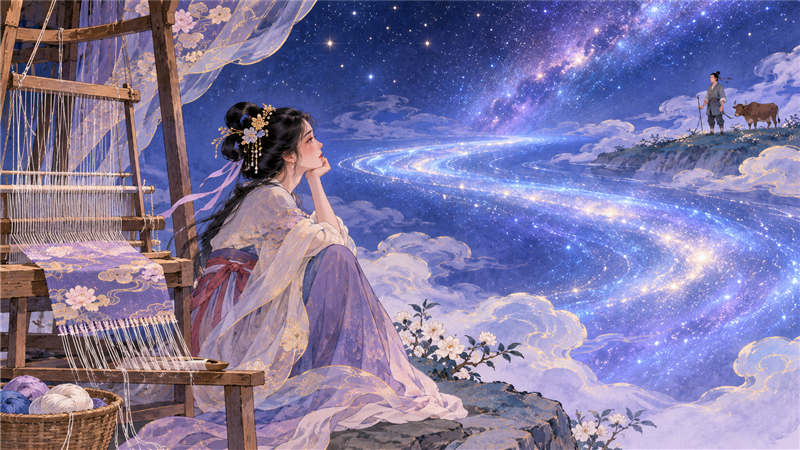
The Education Bureau text places this anonymous poem in 古诗十九首, the Nineteen Old Poems. It begins with the distant Cowherd star and the bright woman of the celestial river. The weaving then fails to become completed patterned cloth: 终日不成章. The failure to finish work makes the emotion visible through an action, rather than merely naming sadness.
The final four lines narrow attention to the barrier between the figures:
河汉清且浅,相去复几许。
盈盈一水间,脉脉不得语。
Hé hàn qīng qiě qiǎn, xiāng qù fù jǐ xǔ.
Yíng yíng yī shuǐ jiān, mò mò bù dé yǔ.
Original English reading aid: “The celestial river is clear and shallow—how far apart can they be? One stretch of water lies between them; gazing with feeling, they cannot speak.”
The apparent smallness of the distance increases the frustration. The poem can put the figures within imagined view while keeping communication impossible. 脉脉 is read mò mò here; the translation expands it to make the silent, affectionate gaze understandable. The explanation is a reading of the scene, not an astronomical description of the distance between stars.
Do not add a magpie bridge or a successful annual reunion to the poem’s ending. Those may belong to other tellings of the Cowherd and Weaver tradition, but this text ends with an inability to speak. Adding a comforting conclusion removes precisely the tension these final lines preserve.
Choose an excerpt without changing its claim
For courtship, follow the repeated hopes and unrest in 关雎. For an emphatic declaration, examine the conditional structure of 上邪. For separation, read the interruption of weaving and the unspeaking ending of 迢迢牵牛星. An attractive image alone is not enough to choose a quotation: a line about unreachable companionship can sound melancholy in a celebratory card.
Keep the Chinese title, source collection and translator’s credit beside an English quotation whenever possible. If you write your own adaptation, label it as an adaptation. Simplified and traditional forms can look different while representing the same passage; check the whole line before deciding that two versions disagree. Punctuation is editorial, so a changed comma does not by itself establish a different ancient text.
For a later-period comparison, our guide to romantic Chinese poets discusses different Tang and Song works. For the earlier collection behind 关雎, continue with Shijing and Chu Ci in context. These are routes to further reading, not evidence that every classical poem belongs to one continuous romantic school.
Questions about these ancient love poems
Who wrote these three poems?
The selected works are transmitted anonymously. Identify their collection or tradition rather than inventing a named author, lover or occasion. An anonymous speaker is not a verified historical person.
Does 上邪 use the ordinary pronunciation xié?
No. The title is read Shàng Yé, with 邪 functioning as an exclamatory particle in this usage. The poem is an address to heaven and an emphatic vow.
Does 迢迢牵牛星 end with a reunion?
No. Its final line describes the figures gazing with feeling but unable to speak. A reunion bridge should not be added to this poem’s ending.
Are the English passages published translations?
No. They are original English reading aids for this article. For formal quotation or study, consult a complete edition and identify its translator; these short renderings do not reproduce every feature of the Chinese poems.