Here are three short Chinese poems in Chinese characters, with Mandarin pinyin and an original English reading aid beneath each text. Each poem has four lines of five characters. The selections offer three different scenes: red seeds that carry longing, a sunset reached in an unsettled mood, and a mountain visit that never finds its destination.
The main texts below use simplified characters and modern punctuation. Linked sources display traditional characters and, in some cases, variant wording. Pinyin is provided for modern Mandarin reading; it does not reconstruct Tang pronunciation. The English versions are close reading aids written for this page, rather than quotations from a published translator.
Read the Chinese lines before looking at the translation. Notice the objects and actions you can recognize, then use the English to connect them. Keeping one verse line on each line also lets you see the compact shape that is easily lost when a poem is copied into a paragraph.
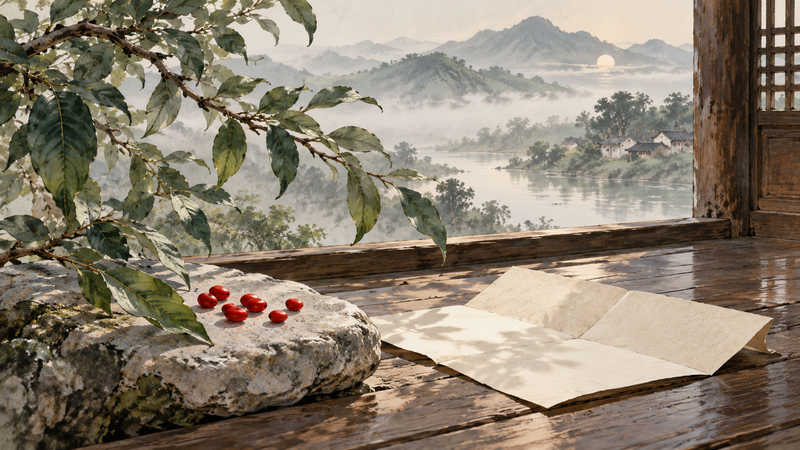
相思: red seeds and the meaning of longing
Wang Wei — 相思 (Xiāngsī), “Longing.” The source text records variant readings; this page follows its main reading with 春, 愿, and 多采撷.
红豆生南国,
春来发几枝。
愿君多采撷,
此物最相思。
Hóngdòu shēng nánguó,
chūn lái fā jǐ zhī.
Yuàn jūn duō cǎixié,
cǐ wù zuì xiāngsī.
Red seeds grow in the southern land;
when spring comes, how many branches sprout?
May you gather plenty of them:
these things most call forth longing.
The small object carries the emotion. 君 addresses “you”; the poem does not require an English translator to identify the addressee as a husband, wife, or lover. 相思 can be translated here as longing or thinking affectionately of someone. The poem alone is not a botanical identification or a suggestion to eat unidentified seeds.
乐游原: sunset, mood, and translation context
Li Shangyin — 乐游原 (Lèyóu Yuán), “Leyou Plateau.” This is the five-character quatrain on the source page, which also contains other poems with the same title.
向晚意不适,
驱车登古原。
夕阳无限好,
只是近黄昏。
Xiàng wǎn yì bù shì,
qū chē dēng gǔ yuán.
Xīyáng wúxiàn hǎo,
zhǐ shì jìn huánghūn.
Toward evening, my mood is uneasy;
I drive a carriage up to the old plateau.
The setting sun is boundlessly beautiful;
only, dusk is drawing near.
夕阳 and 黄昏 both concern the end of the day, but they do different work: the first presents the beautiful setting sun, while the last brings the approach of dusk into focus. This reading keeps the final line’s qualification. Interpreting the sunset as aging or a declining era goes beyond the literal scene; it should be identified as interpretation rather than inserted into the Chinese text.

寻隐者不遇: a conversation with an absent center
Usually attributed to Jia Dao — 寻隐者不遇 (Xún Yǐnzhě Bù Yù), “Seeking a Hermit, but Not Finding Him.” The source entry also notes an attribution to Sun Ge and a related title. That note matters if you are comparing editions.
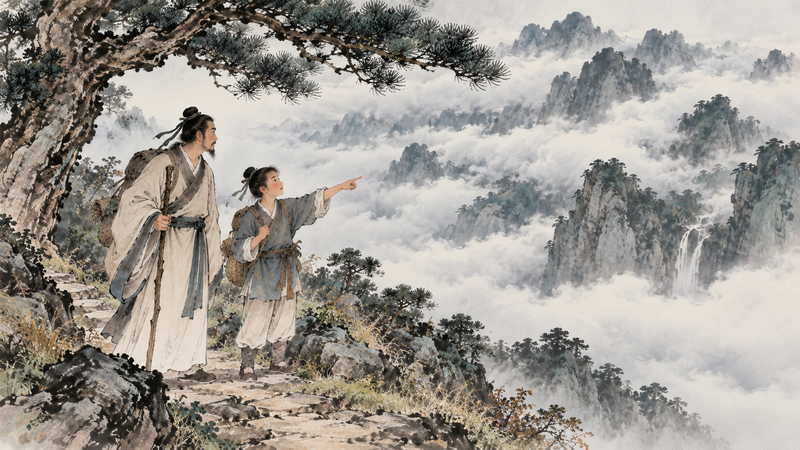
松下问童子,
言师采药去。
只在此山中,
云深不知处。
Sōng xià wèn tóngzǐ,
yán shī cǎi yào qù.
Zhǐ zài cǐ shān zhōng,
yún shēn bù zhī chù.
Beneath the pine, I ask a young attendant;
he says his teacher has gone to gather herbs.
He is somewhere on this very mountain,
but deep clouds hide the place, and I do not know where.
The English makes speakers explicit for readability. Classical Chinese can leave more unstated. The final lines narrow the search to this mountain while leaving the exact location unknown. Clouds create both a visible landscape and a limit to the visitor’s knowledge. That is enough to discuss without inventing a meeting that the poem never supplies.
Keeping characters, pronunciation, and interpretation separate
When copying a poem, keep its title, author attribution, chosen wording, and line breaks together. A traditional character such as 雲 and its simplified form 云 can represent the same word; changing 春 to 秋 changes the wording itself. Script conversion and a textual variant are different kinds of difference.
Questions about reading poems in Chinese characters
Are these poems in simplified or traditional characters?
The main texts on this page use simplified characters. The linked source editions display traditional forms and sometimes record different wordings.
Does pinyin reproduce the poems’ original sound?
No. These pinyin lines support modern Standard Mandarin reading. They do not reconstruct historical pronunciation or show every feature of the poems’ original sound patterns.
Do punctuation marks count as poem characters?
No. Each verse line here contains five Chinese characters, excluding modern punctuation. The four-line layout makes that form easy to see.
Why might my book print a different line?
Check whether the difference is a simplified or traditional form, an actual wording variant, or a different work sharing a title. Keep the edition’s reading intact and note the difference rather than silently mixing versions.