Quick answer
Tang dynasty literature is much broader than a shelf of famous poems. The period, conventionally dated 618–907, includes shi poetry, regulated verse, older-style verse, essays associated with the classical prose movement, chuanqi tales, and performance-linked bianwen texts. Poetry remains the best-known part of the record, but prose and narrative reveal different readers, settings, and literary ambitions.
The clearest way to begin is to identify the form before interpreting a passage. Ask whether you are reading a compact lyric, a persuasive essay, a crafted tale, or a text shaped for recitation. Then consider occasion, speaker, audience, and translation choices. This prevents “Tang literature” from collapsing into a single style.
Tang literature at a glance
| Form | Typical shape | Useful examples | First reading question |
|---|---|---|---|
| Shi poetry | Short lyric forms, including regulated and older-style verse | Li Bai, Du Fu, Wang Wei, Bai Juyi | Who speaks, in what situation, and through which images? |
| Guwen prose | Direct classical prose used for argument, memorial, biography, or preface | Han Yu and writers linked with the classical prose movement | What claim does the author build, and for which audience? |
| Chuanqi | Literary tales with developed scenes, characters, and strange or romantic events | “The Story of Yingying” and other Tang tales | What does the marvelous event expose about desire, status, or judgment? |
| Bianwen | Alternating prose and verse, often connected with storytelling and religious subjects | Dunhuang transformation texts | Which passages explain, narrate, or heighten performance? |
These labels are reading tools, not sealed boxes. Tang writers could mix quotation, description, argument, and narrative. Modern genre names also organize a body of texts transmitted through later anthologies and manuscript discoveries.
Poetry as art and social practice
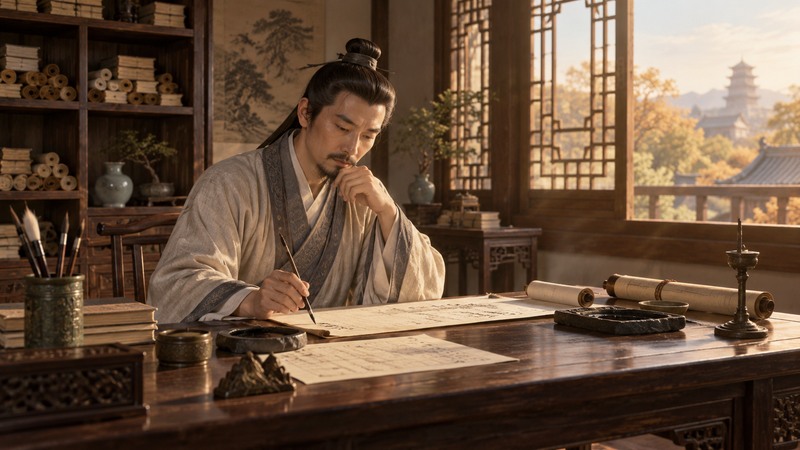
Poetry in the Tang was both literary art and social action. A poem could mark departure, answer a friend, describe travel, respond to war, or circulate within official and educated networks. That setting matters because an apparently private image may also carry a recognizable social occasion.
The Metropolitan Museum of Art’s Tang overview identifies the dynasty as a classical period of Chinese art and literature and places Li Bai and Du Fu among its defining poets. Columbia’s Introduction to Tang Poetry likewise treats poetry as both a literary and social genre. Together, these perspectives explain why biography alone is insufficient: a poem also participates in inherited forms, shared allusions, and acts of exchange.
When reading a Tang poem, begin with four questions:
- What occasion can be inferred from the title or opening lines?
- Which concrete images organize the poem—moon, river, mountain, road, city, or frontier?
- Does the poem turn from scene to memory, from observation to judgment, or from public event to private feeling?
- What changes in translation, especially word order, parallel structure, rhyme, and ambiguity?
For a closer method, see How to Read Chinese Poetry. To compare major writers, use the guide to Tang dynasty poets.
Regulated verse and older-style verse
Two labels often encountered in English are regulated verse (jintishi) and older-style verse (gushi). Regulated verse follows more exacting patterns of line length, tonal contrast, rhyme, and—especially in the middle couplets of an eight-line regulated poem—parallelism. Older-style verse gives the poet more freedom in line count and tonal pattern, though it still draws on strong literary conventions.
| Reading feature | Regulated verse | Older-style verse |
|---|---|---|
| Structure | Usually compact and formally bounded | More flexible in length and progression |
| Sound | Patterned tonal contrasts and rhyme | Less tightly regulated tonal scheme |
| Parallelism | Often central in paired lines | May appear without the same structural obligation |
| Translation challenge | Formal balance can disappear in English | Shifts of pace and voice may be flattened |
Do not treat “regulated” as mechanical or “older-style” as spontaneous. Form creates possibilities. A balanced couplet can set two landscapes, times, or political conditions against each other. A longer older-style poem can accumulate episodes or make abrupt rhetorical turns. The page on Tang poetry meaning gives a practical introduction to imagery, form, and translation.
Guwen and the classical prose movement
Tang literature also contains a major prose tradition. Guwen, often translated as “ancient-style prose” or “classical prose,” names a preference for models associated with earlier classical writing instead of highly ornate parallel prose. Han Yu is the writer most commonly linked with this movement, together with Liu Zongyuan.
The label should not be reduced to “plain writing.” Guwen could be forceful, patterned, allusive, and highly crafted. Its importance lies in what prose was asked to do: argue about learning and government, defend a position, commemorate a person, frame another text, or turn a small scene into moral and political reflection.
A useful reading method is to outline the argument before interpreting the style. Mark the problem, the author’s claim, the historical or classical examples, and the final appeal. Then ask why an older model of prose gave the claim authority. The University of Michigan Press description and contents for A Guide to Chinese Literature place ancient-style prose beside Tang poetry, short stories, and other developing forms, which helps restore prose to the literary map of the period.
Chuanqi tales and literary narrative
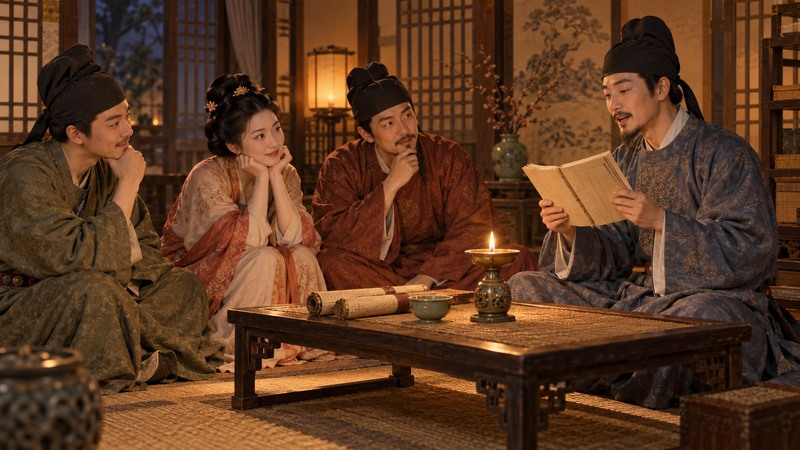
Chuanqi, often rendered “tales of the marvelous,” refers to sophisticated literary narratives that flourished in the Tang. Some involve dreams, spirits, uncanny journeys, or transformations; others center on love, ambition, examination culture, and the consequences of choice. Their interest is not limited to whether the supernatural event is “believed.” The strange event can test a character’s values or expose pressures created by status and social expectation.
These tales usually reward attention to narrative design. Notice who reports the event, where the story slows into description or dialogue, and how an ending judges—or refuses to judge—the characters. The Columbia teaching selection on chuanqi introduces the form as Tang tales of the marvelous, while Indiana University Press’s discussion of classical Chinese tales connects their development with literary storytelling, prose writing, and educated culture.
Bianwen and performance-linked texts
The term bianwen, usually translated as “transformation texts,” is associated especially with manuscripts found at Dunhuang. Many alternate prose narration with verse and appear connected to oral or visual storytelling, including Buddhist subjects as well as secular narratives. Because the surviving evidence comes through manuscripts and later scholarship, it is safer to read bianwen as evidence of performance-linked textual culture than to imagine one uniform public show.
On the page, shifts between prose and verse are a clue. Prose can carry the action or explanation; verse can repeat, intensify, or invite a different delivery. Reading both parts together shows how literature moved beyond the compact poem and formal essay. It also reminds us that Tang literary history includes texts preserved outside the standard author-centered canon.
How to read Tang literature in translation
Translation opens access while changing the evidence available to the reader. Chinese lines may omit a grammatical subject, compress time, or place two images beside each other without an explicit connective. An English translation often has to select a pronoun, tense, or logical relationship. That choice can make one interpretation feel more definite than the source.
Use the following practice:
- Read one reliable translation straight through for scene and movement.
- Check notes for names, places, historical events, and allusions before making a symbolic claim.
- Compare a second translation when a line seems unusually smooth or unusually obscure.
- Look for repeated images and structural turns rather than assigning a fixed symbolic meaning to every object.
- Keep author, genre, and historical context separate: a poem is evidence of a crafted voice, not a complete transcript of the author’s life.
Columbia University Press’s How to Read Chinese Poetry in Context emphasizes reading poems within social and cultural settings. That principle works across Tang literature: form and context should guide interpretation before a universal theme is imposed.
A practical reading path
Start with three or four short poems by different writers. Compare Li Bai’s movement and imaginative scale, Du Fu’s historical pressure and controlled detail, Wang Wei’s compressed landscapes, and Bai Juyi’s narrative clarity without turning those tendencies into rigid labels. Next, read one regulated poem slowly enough to see its couplets, followed by a longer older-style poem.
Then add one guwen essay and one chuanqi tale. The shift in form makes the period’s range immediately visible. Finish by examining a bianwen excerpt or manuscript discussion, noting where prose and verse alternate. A short overview of Tang dynasty culture can supply political, religious, and cosmopolitan context without replacing close reading.
The goal is not to master a list of genres. It is to learn which questions each form invites. A poem asks you to hear compression and pattern; an essay asks you to follow argument; a tale asks you to track narration and judgment; a performance-linked text asks you to notice the movement between voices and modes.
Frequently asked questions
What are the main forms of Tang dynasty literature?
Major forms include shi poetry, regulated and older-style verse, guwen prose, chuanqi tales, and bianwen transformation texts. The surviving record also includes official, religious, historical, and technical writing, so no short list is exhaustive.
Why is the Tang dynasty called a golden age of poetry?
The period produced a large, influential poetic record, highly developed verse forms, and writers such as Li Bai, Du Fu, Wang Wei, and Bai Juyi. “Golden age” is a later evaluative label, so it should describe influence and reception rather than imply that every Tang text shared one quality or style.
What is guwen in Tang literature?
Guwen is commonly translated as ancient-style or classical prose. Writers associated with the movement looked to earlier prose models for argument and expression, in part as an alternative to highly ornate parallel prose. Han Yu and Liu Zongyuan are central names.
What is a Tang chuanqi tale?
A chuanqi is a crafted literary tale, often involving marvelous, romantic, dreamlike, or supernatural events. Its narrative art also addresses social status, examinations, desire, loyalty, and judgment, so it should not be read only as folklore.
Can Tang literature be understood in translation?
Yes, especially when a translation includes notes and identifies the form and context. Comparing translations helps reveal choices about pronouns, tense, imagery, rhythm, and allusion. Translation supports serious reading, although it cannot reproduce every sound pattern or ambiguity at once.