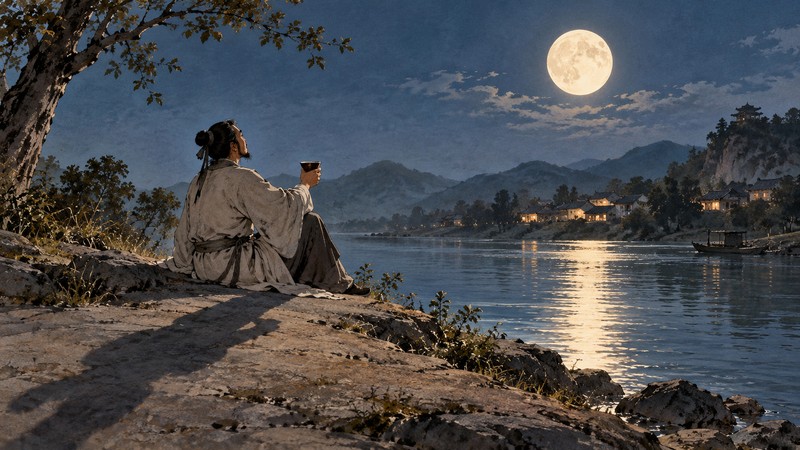
Few poets in history capture the imagination quite like Li Bai (李白, 701–762), known as the Immortal Poet of the Tang Dynasty. His verses dance between the earthly and the celestial, blending wine, moonlight, friendship, and an unshakeable longing for freedom.
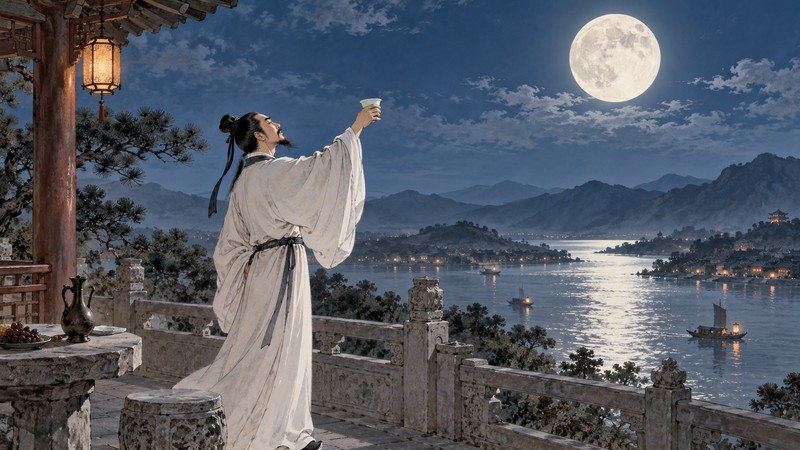
Early Life: A Wanderer Is Born
Born in Suyab (modern-day Kyrgyzstan), Li Bai grew up in Sichuan province, where legends say he was conceived from moonlight by his mother. From an early age, he showed extraordinary talent — one famous story tells of a visiting monk who saw young Li Bai composing poetry while watching his mother weave, her shuttle striking the loom in perfect rhythm with his verses.
Unlike many scholars of his era, Li Bai never pursued the imperial examination system. He preferred the wandering life of a swordsman and Taoist seeker, believing that true poetry could only come from true experience.
The Poet and His Moon
Li Bai’s relationship with the moon is legendary. In his most famous poem, Quiet Night Thought (静夜思), he sits alone beneath moonlight:
Before my bed, a pool of light — / Can it be frost on the ground? / I lift my eyes to see the moon so bright, / I bow my head and think of home.
The poem uses just 20 characters yet conjures an entire emotional universe of homesickness and wonder.
Friendship and Wine
His friendship with Du Fu is one of poetry’s great love stories. The two met in 744 CE and spent months traveling together. Their parting inspired some of the most moving verse in Chinese literature. Wine was his constant companion. Legend claims he drowned in the Yangtze while reaching for the moon’s reflection — even in death, faithful to the beautiful.
His Legacy

Li Bai’s influence extends far beyond China. His poems were among the first Chinese verses translated into English, inspiring poets and philosophers worldwide. Today, visitors to sites associated with his life feel the echo of his spirit still wandering the mountains and rivers he loved so deeply.