Before Basho. Before the seventeen syllables of Zen meditation. Before haiku became the most widely recognized poetic form on Earth — there was Tang Dynasty China.
The Silk Road of Poetry
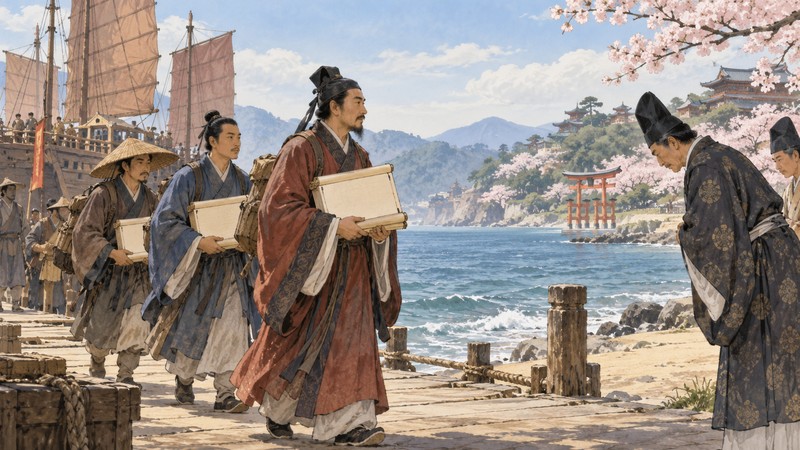
During the 7th and 8th centuries, Japanese monks, students, and diplomats made perilous voyages across the East China Sea to study at the Tang court in Chang’an (modern Xi’an). They returned home carrying Buddhist scriptures, Confucian classics, and something unexpected: Chinese poetry — particularly the short, imagistic verses that would eventually transform into haiku.
The Bridge: Wang Zhihuan’s Five Characters
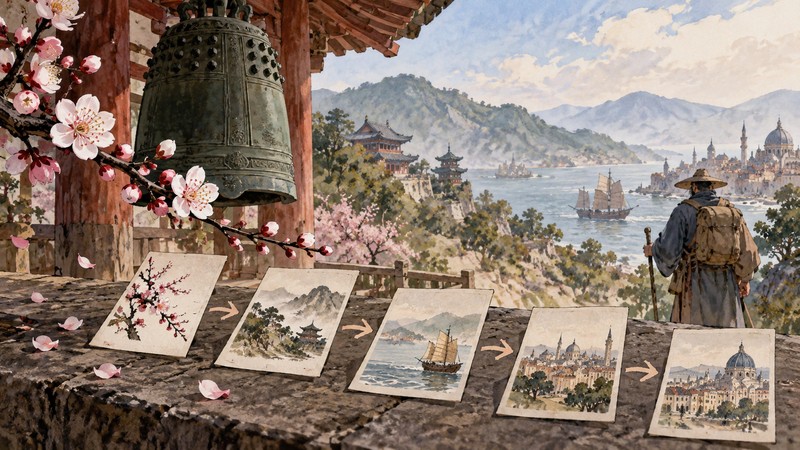
One poem, by Tang Dynasty poet Wang Zhihuan (王之涣), demonstrates how Chinese verse seed planted haiku’s DNA:
White clouds crowd a lone mountain peak, / The Yellow River flows to the distant sea. / Climb high and look back — the horizon’s edge / Has no more roads, yet the wind sails on.
Seven characters per line. Natural imagery. A philosophical turn. Sound familiar? This is the ancestor of every haiku ever written.
From Chinese Jueju to Japanese Haiku
The Japanese adapted the Chinese jueju (截句, “severed verse”) — four lines of five or seven characters — and merged it with their native aesthetic sensibilities. Where Chinese poetry often resolved its images in the final couplet, Japanese poets began to leave theirs suspended, unresolved, like a stone thrown into still water whose ripples never quite settle.
Matsuo Basho (1644–1694) transformed this inheritance into something distinctly Japanese: haiku, three lines (5-7-5 syllables), anchored by a seasonal kigo word, charged with kireji — the “cutting word” that creates a juxtaposition of images. But the roots reach back to Chang’an, to the poets Li Bai and Du Fu, to a thousand years of Chinese verse tradition.
The Living Bridge
Today, haiku poets worldwide trace their lineage through Japan back to Tang China. The form that began with wandering monks carrying Chinese manuscripts across the sea has returned the gift — Japanese haiku masters now teach Chinese poets to see their own tradition through new eyes.