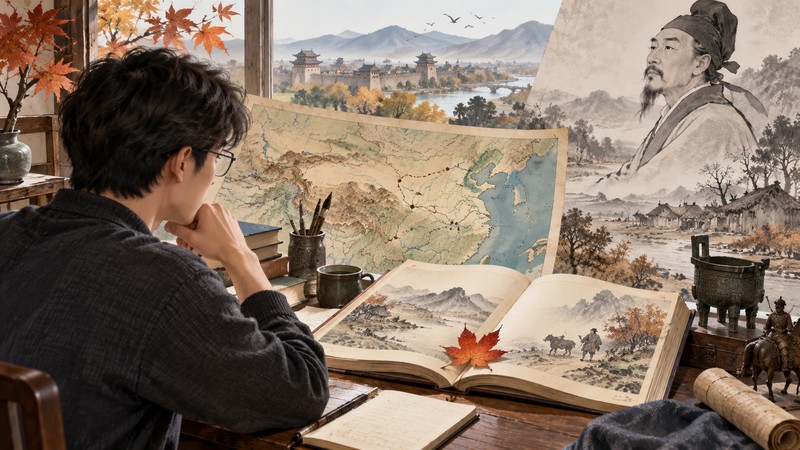
If Li Bai is the poet of heaven and wind, Du Fu (杜甫, 712–770) is the poet of earth and sorrow. Where Li Bai floated above the world, Du Fu descended into it — into war zones, refugee camps, and the broken homes of common people — and wrote what he saw with the eye of both a journalist and a prophet.

The Meeting That Changed Poetry
In 744 CE, the two greatest poets of the Tang Dynasty met at an inn in Shantung province. Li Bai, already famous, was 32. Du Fu, still unknown, was 23. They spent months together — composing poems, visiting monks, wandering in the mountains — and developed a friendship that would define both their legacies. When they parted, Li Bai wrote:
My friend is the man of the eastern road — / How tall he stands! / After the fire of a thousand li, we meet again.
The An Lushan Rebellion

In 755, the An Lushan Rebellion shattered the Tang Empire. Du Fu was in the capital when the rebels attacked. He barely escaped, was captured, and witnessed the destruction of everything he loved. His poems from this period — Spring Prospect, The City Fallen, Alone and Sad at Chengdu — became the first great anti-war poetry in Chinese literature.
The Poet of the People
Du Fu’s greatest gift was his empathy. While other poets wrote about emperors and generals, Du Fu wrote about old men gathering firewood and women knitting cloth for the army. His poem Thatched Cottage Injured by the Autumn Wind imagines a humble cottage destroyed by a storm — yet even in ruin, Du Fu dreams of a world where all people have shelter:
Would that I might build a mansion with ten thousand rooms, / To give the world’s poor people shelter from wind and cold.
His Enduring Voice
Du Fu spent his final years in Chengdu, where a simple thatched cottage has become one of China’s most visited literary shrines. His poems remain essential reading — not because they teach history (though they do) but because they teach compassion. In a world of chaos and change, Du Fu reminds us to look at the person standing next to us and see their suffering as our own.